
Outdoor pickleball courts account for the majority of municipal park, HOA, and school facility installations nationwide, and the commercial specification problem they present is substantially different from indoor. Property-line light trespass, dark-sky compliance, wind loading, curfew enforcement, and coordinated neighbor-complaint management dominate the decision set. Regulatory pressure has tightened: more municipalities adopt quantitative trespass limits, more HOAs require photometric submittal with architectural review, and federal grant-funded projects increasingly require documented compliance paths. This guide covers ASBA and USA Pickleball outdoor standards, pole and fixture geometry, light trespass and dark-sky compliance, the noise-and-light complaint management picture, HOA and municipal procurement, retrofit from legacy systems, and typical cost per court for commercial outdoor installations.
Outdoor pickleball courts typically specify 20-foot poles (18 to 25-foot range acceptable), ASBA Category II at 50 footcandles average maintained horizontal illuminance for club and competitive play or Category III at 30 fc for recreational and parks facilities, maximum-to-minimum uniformity of 2.0, and 4 fixtures per court in perimeter or corner mounting. Full-cutoff optics, house-side shielding, and property-line spill limits of 0.1 to 1.0 footcandles are standard for residential-adjacent sites. Dark-sky compliance per International Dark Sky Association-modeled ordinances is increasingly required, with uplight capped at 1 percent of total output.
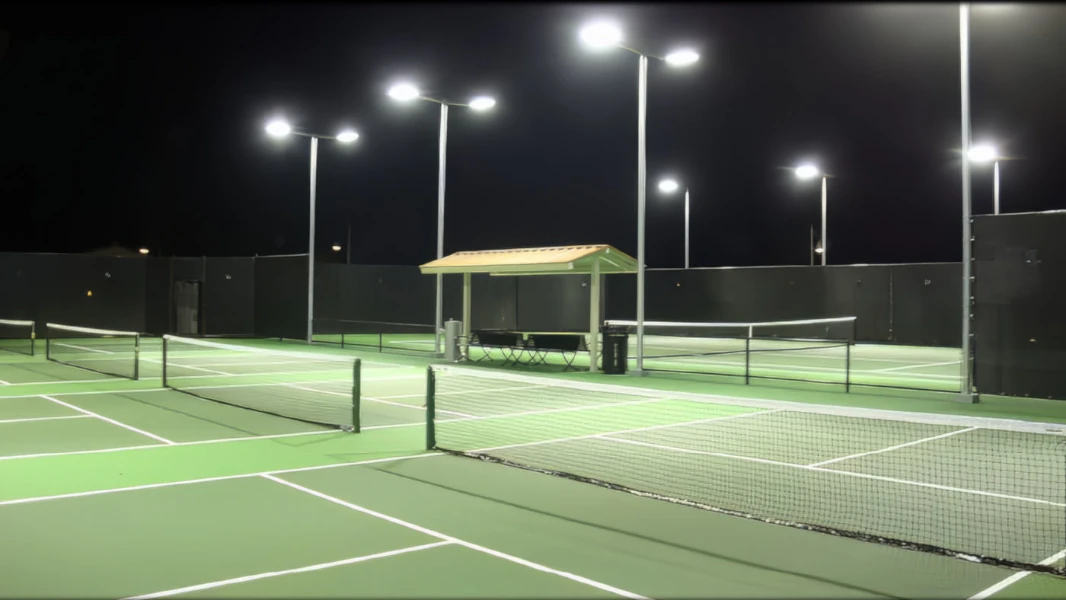
Outdoor pickleball facilities are specified against the same framework established by USA Pickleball and the American Sports Builders Association 2023 Pickleball Courts Construction & Maintenance Manual. Most municipal park and HOA installations specify Category III (recreational) or Category II (club and competitive); dedicated tournament-hosting outdoor facilities specify Category I.
| Category | Typical outdoor facility | Avg horizontal | Min horizontal | Max:Min uniformity | Avg vertical at 3′ above net |
|---|---|---|---|---|---|
| III | Municipal parks, HOA community courts, school recreation | 30 fc / 300 lux | 20 fc / 200 lux | 2.0 | 20 fc / 200 lux |
| II | Dedicated club courts, competitive leagues | 50 fc / 500 lux | 40 fc / 400 lux | 2.0 | 30 fc / 300 lux |
| I | Tournament-hosting outdoor facilities | 75 fc / 750 lux | 60 fc / 600 lux | 1.7 | 50 fc / 500 lux |
Values are maintained illuminance (average after Light Loss Factor depreciation of 0.8 to 0.9 typical for modern LED), measured across the Primary Playing Area of the court plus 6 feet beyond each sideline and 10 feet beyond each baseline. The full multi-category framework and how outdoor specifications relate to indoor targets are covered in our complete guide to pickleball court lighting. Foundational footcandle terminology is covered in our ultimate footcandle lighting guide.
Pole height is the most important single variable in outdoor pickleball lighting because it drives coverage, uniformity, glare on lob play, and property-line spill simultaneously.
20 feet is the most common and widely recommended mounting height for dedicated outdoor pickleball courts, cited consistently across ASBA and USA Pickleball guidance. The acceptable range is 18 to 25 feet. Taller poles (up to 30 feet) are used for multi-court complexes where wider fixture spacing and reduced light trespass are priorities. Shorter poles (below 18 feet) are sometimes dictated by local zoning or HOA aesthetic restrictions but typically require more fixtures to meet uniformity and create more sightline glare during overhead play.
The rationale for 20 feet is geometric. At this height, a 4-fixture perimeter layout achieves Category II uniformity across the Primary Playing Area without excessive spacing complexity, the lighted cone reaches ball-flight height for lob tracking without placing fixtures directly in player sightlines, and property-line spill is controllable with standard cutoff optics. Taller poles improve all three factors but add pole, foundation, and wind-load cost. Shorter poles compromise all three and typically produce the complaints that drive retrofits two or three years later.
Typical outdoor fixture counts per court:
Fixtures are perimeter or corner mounted, aimed cross-court to produce even coverage, and positioned away from primary player sightlines during lob and overhead play. ASBA guidance recommends padding poles located within 5 feet of the sideline for player safety. Cross-court aiming (each fixture illuminating the opposite side of the court rather than the area directly beneath it) improves uniformity and reduces direct glare on nearby players.
Per-court lighting cost drops substantially as court count increases. A single dedicated court may run $12,000 to $20,000 installed because every fixture requires its own pole, foundation, and conduit run. A 12-court complex sharing 9 poles and common electrical distribution can land at $5,000 to $8,000 per court for the same category specification. Multi-court projects should be designed holistically; sequencing court-by-court over time typically costs more than designing the full complex upfront even if installation is phased.
Property-line light trespass is the most common cause of outdoor court complaints, citations, and mandated shutdowns. Addressing it during specification is substantially cheaper than addressing it post-install.
Municipal and HOA limits on horizontal illuminance at the property line commonly range from 0.1 to 1.0 footcandles, with variation by jurisdiction and zone type:
Always verify limits with the local Authority Having Jurisdiction before specifying. Post-install violations trigger fines, mandated corrective action, and in some cases forced operational curfew that reduces facility utility significantly.
The effective control approaches, applied in combination:
Dark-sky ordinances modeled on International Dark Sky Association guidelines are increasingly adopted by municipalities, HOAs, and counties nationwide. Typical ordinance provisions:
Commercial outdoor sports fixtures designed for current regulatory compliance include cutoff optics, backlight control, and low-uplight designs as standard rather than aftermarket additions. Our outdoor pickleball lighting category includes fixtures engineered for these requirements.
Outdoor pickleball facilities face two parallel neighbor-complaint vectors that drive most shutdown orders and operational restrictions: light trespass and noise. Light is the more tractable problem because fixture specification, shielding, and controls can be engineered to precise performance targets. Noise is the harder problem because the paddle-on-ball sound (typically 70 to 80 dBA at 15 feet from the court) is intrinsic to the sport rather than an addressable byproduct.
Commercial outdoor court specifications that address only one vector frequently fail neighbor scrutiny on the other. An HOA that invested in dark-sky compliant lighting can still face complaints and restrictions if noise mitigation was not planned. A facility with acoustic barriers can still face shutdowns if lighting overshoots the property line. Coordinated planning for both is the practical commercial standard in 2026.
Commonly specified noise-reduction strategies for outdoor pickleball facilities include:
These considerations typically require specialized acoustic engineering guidance beyond the lighting scope. We are publishing a dedicated guide to pickleball facility noise mitigation as a companion to this lighting post, covering barrier specifications, siting analysis, quiet-paddle standards, and HOA ordinance structure. For combined light-and-noise specification on a current project, coordinate the lighting photometric plan with an acoustic consultant during the same design phase that fixture selection happens. Split planning produces costly mid-project rework when one vector constrains the other.
Outdoor pickleball lighting hardware operates under environmental conditions that indoor lighting does not face, and specification must account for the full range.
Poles must be engineered for local wind loading under the International Building Code (IBC) and ASCE 7, typically rated 90 to 130+ mph depending on region. Coastal, high-wind, and hurricane-prone zones push toward the upper end of the range. Foundation design is equally important: concrete piers sized for the combined pole, fixture, and wind load, set deep enough for regional frost conditions, and engineered for the soil type present. Site-specific engineering is standard practice; generic “one size fits all” pole packages should be verified against local code before commit.
Low-EPA (Effective Projected Area) LED fixtures reduce wind load on poles meaningfully compared to bulky legacy metal halide housings. A modern LED sports fixture presents roughly 30 to 50 percent less EPA than an equivalent-output metal halide, which translates to smaller pole diameter, smaller foundation, or both. For retrofit projects reusing existing poles, the reduced EPA can create structural margin that extends pole service life.
Verify IP ratings and environmental certifications against LM-79 test reports and manufacturer documentation; marketing-claimed ratings without documented test data are a common source of post-install issues.
Outdoor pickleball lighting procurement varies substantially by facility type, and specification language should match the procurement process to avoid rebid or clarification cycles.
HOA outdoor court projects typically require:
Municipal park projects typically follow competitive bid or RFP processes with specification requirements that reference:
Evaluation is typically “lowest responsible bid” or “best value,” with best-value evaluation scoring performance characteristics, total cost of ownership, and vendor support capability alongside bid price. Photometric-backed specifications win best-value evaluations more consistently than price-only bids.
Federal infrastructure funds including the Infrastructure Investment and Jobs Act (IIJA) and various state park and recreation grants often include domestic content requirements under the Buy American Act (BAA) and Build America, Buy America (BABA) provisions. Projects funded through these programs require fixtures, poles, controls, and related products to meet domestic manufacturing thresholds, with waiver processes available for specific cases. Specification language for grant-funded outdoor pickleball projects should address the domestic content requirements explicitly and require documented compliance from bidders. Verify current applicability with the funding agency because thresholds and waiver availability evolve.
School facility outdoor pickleball lighting follows similar processes to municipal parks, typically with tighter energy code enforcement (ASHRAE 90.1 or IECC compliance, plus state-specific code), cooperative purchasing availability (OMNIA, Sourcewell, and similar consortia), and after-school community use considerations driving specification decisions. Durability and vandalism resistance matter more than in private club applications.
Outdoor controls are typically more important to operational success than indoor controls because curfew compliance depends entirely on automated enforcement. Manual operation produces complaints every time it fails.
A pre-commissioned wireless control system handles outdoor-specific requirements with the same architecture used for indoor installations: automated curfew enforcement at configured times, photocell integration for astronomical dusk-to-dawn operation, dimming during late-evening hours to minimize any residual property-line spill, remote gateway access for facility managers, and integration with court reservation platforms for activity-based operation. Waterproof IP-rated sensor nodes support full weather exposure while preserving the plug-and-play pre-commissioning experience. Full architecture, protocol, and operational details are covered in our pickleball facility lighting controls guide. Our lighting controls category includes the indoor and outdoor node options.
Many existing outdoor pickleball courts (particularly those built before 2015 or converted from tennis) run legacy metal halide or high pressure sodium fixtures. Retrofit economics and operational improvements strongly favor LED conversion.
Typical energy savings on outdoor retrofit are 60 to 75 percent against metal halide and high pressure sodium. Maintenance costs drop 70 to 90 percent because LED L70 ratings of 50,000 to 100,000+ hours eliminate the annual or biannual relamping that legacy systems require at height, along with ballast failures. Additional operational gains include instant full output (no 3 to 12 minute warm-up), no restrike delay after power interruption, dimmability for controls integration, and consistent color over fixture life.
Retrofit projects reusing existing poles and foundations typically run $5,000 to $15,000 per court depending on fixture count, controls scope, and labor region. Full replacement including new poles runs $8,000 to $25,000+ per court. Existing conduit is usually reusable if load calculations confirm capacity and photometric design aligns with existing fixture locations; mismatches force new conduit runs that substantially increase cost. Our warehouse LED retrofit guide covers related retrofit economics for indoor installations.
Outdoor pickleball lighting costs vary substantially by site conditions, project scope, play category, and whether existing infrastructure can be reused. The following ranges reflect current 2025 to 2026 commercial market pricing and are planning estimates only. Three or more competitive bids backed by stamped photometric designs should drive any specific project decision.
| Project type | Per-court installed cost | Typical scope |
|---|---|---|
| Single dedicated court, new construction | $12,000 to $25,000 | 4-6 fixtures, new 20-ft poles with foundations, wiring, controls, photometric design, labor |
| Multi-court complex (4 to 12 courts) | $5,000 to $15,000 per court | Shared poles and electrical distribution, fixture counts optimized across complex |
| Retrofit on existing poles | $5,000 to $15,000 per court | New LED heads, controls upgrade, photometric re-verification, aiming |
| Tournament-level (Category I) | $20,000 to $40,000+ per court | Higher fixture counts, higher output, tighter uniformity, vertical illuminance |
The same court can land at either end of the range depending on: existing pole and conduit reuse potential, local labor rates, wind-load and soil conditions for new foundations, dark-sky and trespass mitigation scope (shields, louvers, specialized optics), controls sophistication, and whether photometric design is included in the bid or contracted separately. Federal, state, and local rebates commonly recover 20 to 50 percent of fixture cost when programs are coordinated through pre-approval. DLC-qualified fixtures are typically required for utility rebate eligibility.
Outdoor pickleball court lighting decisions are one application of broader commercial outdoor LED specification. For the complete specification process covering fixture selection, certifications, controls, and rebate qualification, see our commercial LED lighting buyer’s guide. For HOA and municipal procurement specifically, the BAA/BABA compliance requirements covered in that guide are particularly relevant for federally-funded parks and recreation projects.
Outdoor pickleball courts follow the ASBA 2023 Pickleball Courts Manual and USA Pickleball recommended framework: Category III (recreational and parks) at 30 fc average maintained horizontal with 20 fc minimum and 2.0 maximum-to-minimum uniformity; Category II (club and competitive) at 50 fc average with 40 fc minimum and 2.0 uniformity; Category I (tournament) at 75 fc average with 60 fc minimum and 1.7 uniformity. Vertical illuminance at 3 feet above the net ranges from 20 fc for Category III to 50 fc for Category I. Most municipal and HOA outdoor installations specify Category III; dedicated club facilities specify Category II.
20 feet is the standard and most widely recommended mounting height, with an acceptable range of 18 to 25 feet. Taller poles (up to 30 feet) are used for multi-court complexes to widen coverage and reduce trespass. Shorter poles below 18 feet are sometimes required by local zoning or HOA aesthetic rules but typically require more fixtures and produce more glare on lob play.
It depends on the jurisdiction. Many municipalities, HOAs, and counties have adopted ordinances modeled on International Dark Sky Association guidelines that require full-cutoff luminaires, cap uplight at 1 percent of fixture output, and restrict CCT in environmentally sensitive zones. Even in jurisdictions without specific dark-sky rules, property-line spill limits of 0.1 to 1.0 fc commonly apply, and full-cutoff sports fixtures with house-side shielding are standard commercial practice for residential-adjacent courts.
Typical per-court fixture count is 4 fixtures on 20-foot poles for dedicated single courts, in perimeter or corner mounting with cross-court aiming. Multi-court complexes share poles: 6 to 9 poles serving 4 to 12 courts is common. Exact quantity should come from a photometric design for the specific site, because fixture count depends on pole height, fixture output, required category level, and site-specific obstructions. Generic spacing calculators often underperform on pickleball courts because they are not optimized for the small-court, high-vertical, tight-uniformity profile.
Noise is the other major neighbor-complaint vector alongside light trespass, and outdoor pickleball facility specification increasingly addresses both in coordinated planning. Paddle-on-ball sound is typically 70 to 80 dBA at 15 feet from the court and is intrinsic to the sport rather than a lighting-related byproduct. Common mitigation approaches include acoustic barrier fencing (typically 8 to 10 feet tall, rated 15 to 25 dBA reduction), siting courts with setbacks of 100 feet or more from residential boundaries, quiet-paddle requirements, and scheduled quiet hours aligned with lighting curfew. Acoustic engineering guidance is typically required alongside the lighting photometric design for coordinated neighbor-impact specification.
Yes, in most service territories. Rebate programs typically require fixtures listed on the DesignLights Consortium Qualified Products List, with DLC Premium qualifying for higher incentive tiers. Typical rebates range from $0.10 to $0.50+ per watt of installed fixture capacity, and projects routinely recover 20 to 50 percent of fixture cost through combined prescriptive and custom utility programs. Check the DSIRE database or local utility for current 2026 programs.
1st Source Lighting has manufactured commercial LED fixtures in Auburn, California since 1993. For outdoor pickleball projects we provide free photometric design services, outdoor sports-optic fixtures with integral cutoff and backlight control engineered for dark-sky and trespass compliance, pre-commissioned wireless control systems with automated curfew enforcement, DLC-listed fixtures for utility rebate eligibility, and 5 to 10 year commercial warranties. Our engineering team supports specification assistance, rebate coordination, and code compliance documentation for HOA, municipal, parks, school, and private club outdoor pickleball facilities.
Outdoor pickleball lighting specification sits at the intersection of sports performance, regulatory compliance, neighbor impact management, and long-term operational economics. Getting it right before pole foundations go in avoids the rework cycles that plague facilities where lighting was treated as an afterthought. 1st Source Lighting provides free photometric design, commercial outdoor sports-optic fixtures engineered for dark-sky and light-trespass compliance, pre-commissioned wireless control systems for automated curfew and remote facility management, DLC-listed fixtures for utility rebate eligibility, and engineering support for HOA, municipal parks, school, and private club pickleball installations nationwide.
Contact us for a free outdoor pickleball lighting consultation