
Pickleball is the fastest-growing sport in the United States, with the Sports & Fitness Industry Association reporting 24.3 million American players in 2025 and the Pickleheads facility database tracking more than 82,600 courts across 18,000+ locations. Dedicated indoor facilities grew 45 to 55 percent year over year, and municipal and HOA outdoor court construction rose roughly 25 percent in 2025 alone. For facility operators, HOA boards, municipal parks departments, and architects specifying new or retrofit courts, lighting has become one of the clearest operational differentiators: the facilities that extend evening and shoulder-season revenue, retain league players, and pass neighbor-complaint scrutiny are the ones that specified to recognized standards from the start. This guide covers the ASBA and USA Pickleball recommended footcandle framework, indoor and outdoor court design, fixture selection, glare and spill control, energy code and rebate pathways, and typical cost per court for commercial and municipal installations. For specifiers focused specifically on indoor facility fixture selection and deep indoor-only technical guidance, our indoor pickleball lighting category page is the definitive product-level reference.
Pickleball court lighting is specified against a three-tier framework codified in the ASBA 2023 Pickleball Courts Construction & Maintenance Manual and aligned with USA Pickleball recommendations: Category III (recreational, 30 footcandles average horizontal), Category II (club and competitive, 50 fc), and Category I (tournament and professional, 75 fc). Indoor courts typically use direct-indirect fixtures to control glare, outdoor courts use pole-mounted sports optics on 20-foot poles, and both require tight max-to-min uniformity ratios of 2.0 for Category II and III or 1.7 for Category I, because the small 20-by-44-foot court and fast ball speeds make dark spots unsafe and inconsistent to play.
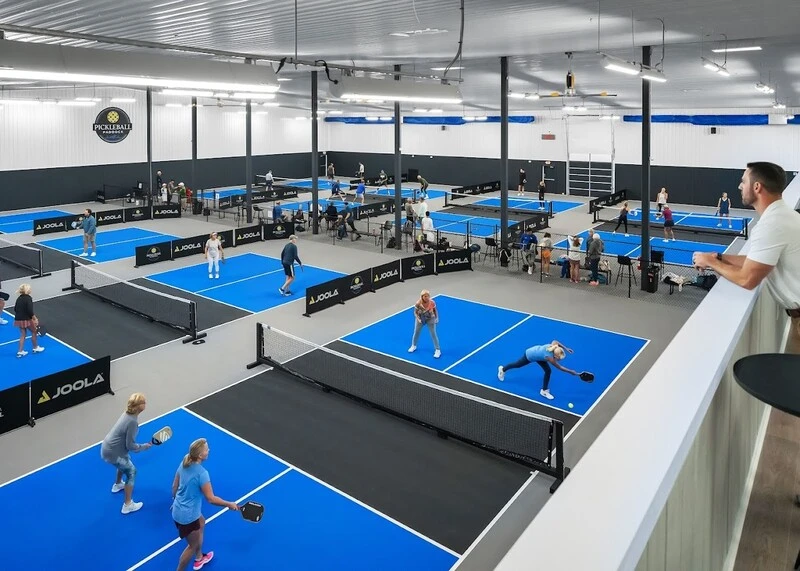
USA Pickleball does not publish a standalone mandatory lighting specification for every facility. Instead, the organization defers technical guidance to the American Sports Builders Association 2023 Pickleball Courts Construction & Maintenance Manual (Chapter 6 is dedicated to lighting) and to IES RP-6-24, the Illuminating Engineering Society’s 2024 Recommended Practice for Sports and Recreational Area Lighting. RP-6-24 added a pickleball enhancement for the first time, acknowledging the small-court, fast-action needs around uniformity, vertical illuminance, and glare control.
The ASBA manual organizes recommendations into three categories of play, with an additional tier for broadcast-capable professional venues. Targets apply to the Primary Playing Area, defined as the court surface plus 6 feet beyond each sideline and 10 feet beyond each baseline. Values are maintained illuminance, meaning the average footcandle level on the playing surface after accounting for fixture depreciation, dirt accumulation, and ambient losses. A typical Light Loss Factor for modern LED fixtures is 0.8 to 0.9.
| Category | Play level | Avg horizontal (fc / lux) | Min horizontal (fc / lux) | Max:Min uniformity | Avg vertical (fc / lux) |
|---|---|---|---|---|---|
| III | Recreational / HOA / parks | 30 / 300 | 20 / 200 | 2.0 | 20 / 200 |
| II | Club / competitive / league | 50 / 500 | 40 / 400 | 2.0 | 30 / 300 |
| I | Tournament / professional | 75 / 750 | 60 / 600 | 1.7 | 50 / 500 |
| Broadcast* | Elite / televised events | 100+ / 1000+ | N/A | <1.7 | 75-100+ / 750-1000+ |
*Broadcast-level values are derived from general sports broadcast lighting practice rather than a USA Pickleball or ASBA standalone specification. Premier PPA Tour and MLP events typically meet or exceed Category I with supplemental vertical illuminance for cameras, and these numbers should be treated as a working range rather than a codified rule.
These values are consistent with the broader commercial footcandle framework. For a fuller treatment of how footcandle targets are set across commercial and sports applications, see our ultimate footcandle lighting guide.
Three illuminance metrics matter for a commercial pickleball court, and they work together rather than in isolation.
Horizontal illuminance is the light level on the court surface, measured in footcandles or lux. It governs how well players see the ball after it bounces, how lines contrast against the surface, and how well referees and spectators see the playing area. This is the primary specified value (the “30 / 50 / 75” numbers above).
Vertical illuminance is the light level on a vertical plane, typically measured at 3 feet above the net, which approximates the height at which a ball is traveling during a serve, drive, or lob. Because pickleball is a short-arc game with aggressive lob and overhead play, vertical illuminance is critical for ball tracking in flight. Under-specifying vertical is one of the most common causes of player complaints even when horizontal levels meet category targets.
Uniformity ratio is the relationship between the brightest and darkest points inside the Primary Playing Area, expressed as max-to-min (or sometimes min-to-average). Pickleball uses tighter uniformity ratios than large-field sports because the court is small (20 by 44 feet of playing surface, with minimum 30-by-60-foot total surface including overrun) and ball speeds in the kitchen and baseline exchanges are high. A max:min of 2.0 means the brightest point is at most twice the darkest. A 3.0 ratio, acceptable on a baseball outfield, would create noticeable dark spots on a pickleball court where the ball would briefly disappear into shadow.
For Category I tournament courts, the tighter 1.7 max:min ratio reflects both player performance requirements and, where applicable, camera needs. Achieving these ratios requires photometric design, not just fixture count. Four correctly aimed sports optics can produce a 1.7 uniformity; eight generic high bays in a grid may not.
Indoor pickleball facilities fall into three common building types, and each drives different lighting decisions. Purpose-built dedicated centers offer the most design flexibility. Repurposed gymnasiums, which dominate the club and school segment, impose ceiling height and structural constraints. Warehouse and retail conversions (the fastest-growing indoor category) offer large open floor plates but often the lowest and most uneven ceilings.
| Ceiling height | Typical facility type | Recommended fixture approach |
|---|---|---|
| Below 18 ft | Retail conversions, older gyms | Direct-indirect or wide-optic linear; avoid direct UFO high bay because source is in player sightline |
| 18 to 25 ft | Repurposed gyms, mid-tier conversions | Direct-indirect preferred for glare control; UFO viable only with careful spacing and shielding |
| 25 to 30 ft | Dedicated facilities, large warehouses | UFO round high bay or hybrid direct-indirect both work; uniformity easier to achieve |
| 30 ft and above | Purpose-built or high-bay warehouse | Direct high bay or indirect pendants dropped 8 to 14 ft from ceiling |
USA Pickleball specifically recommends against locating direct fixtures directly above the playing area unless ceiling height exceeds roughly 30 feet, because low overhead light sources are the single biggest cause of in-play glare complaints.
Glare is the dominant indoor pickleball lighting complaint, and controlling it requires addressing both the measurement framework (IES Unified Glare Rating, with sports targets below UGR 19 to 22) and the physical cause (concentrated point-source luminance from individual LED diodes visible through clear or minimally diffused lensing). Direct-indirect fixtures that reflect light off a high-reflectance ceiling (70 to 80 percent reflectance or higher) and heavily diffused lensing that spreads emission across a large lens surface both address the physical cause directly, producing glare-free lob and overhead play even at ceiling heights where UFO high bays fail.
Our indoor pickleball lighting category page covers the complete indoor specification framework in depth, including the Cave Effect and why 100 percent direct lighting fails on rectangular courts, the 60/40 direct-indirect split rationale, the scallop effect from round fixtures versus linear continuity, LBAT (Lens Beam Augmentation Technology) and how diode harshness drives glare beyond UGR, vertical illuminance modeling with sphere-based ball-tracking analysis, and the complete fixture series comparison (PCS Direct-Indirect, HEX Indirect, High Lumen Pickle Panel, LINTA Architectural Linear, and Contractor Select) matched to facility type and constraints. For any indoor pickleball project where fixture specification decisions matter, the category page is the definitive 1st Source Lighting reference.
Outdoor courts account for most municipal, HOA, and park installations. The design problem is different from indoor: the primary constraints are pole height limits set by local zoning, light trespass onto adjacent residential property, dark-sky compliance, wind loading, and weather sealing.
The most common outdoor pole height for dedicated pickleball courts is 20 feet, with an acceptable range of 18 to 25 feet. Taller poles (up to 30 feet) are used for multi-court complexes where wider light distribution and reduced spill are priorities. Shorter poles (below 18 feet) are sometimes dictated by local ordinance but typically require more fixtures and careful optics to meet uniformity and avoid player sightline issues.
Typical outdoor fixture counts are 4 per court (two per long side, or four corners) for single dedicated courts, with shared poles for multi-court complexes (6 to 9 poles serving 4 to 12 courts is common). Fixtures are perimeter or corner mounted, aimed cross-court to produce even coverage, and positioned away from primary player sightlines during overhead play. ASBA guidance recommends padding poles located within 5 feet of the sideline for player safety.
Property-line spill is the most frequent cause of outdoor court complaints and shutdown orders. Typical municipal or HOA limits range from 0.1 to 1.0 footcandle horizontal at the property line, with some jurisdictions enforcing stricter limits in residential-adjacent or dark-sky zones. Control strategies include:
Dark-sky ordinances modeled on International Dark Sky Association guidelines are increasingly adopted by municipalities and HOAs, and typically cap uplight at 1 percent of total output. Outdoor pickleball sports fixtures designed for commercial projects include cutoff optics and backlight control as standard features rather than aftermarket additions.
Poles must be engineered for local wind loading under IBC and ASCE 7, typically rated 90 to 130+ mph depending on region. Fixtures should be IP65 minimum, with IP66 or IP67 preferred for coastal, humid, or high-particulate environments. Modern LED sports fixtures are low-EPA (effective projected area), which reduces wind load on poles compared to bulky legacy metal halide housings. Salt-air environments require marine-grade or powder-coated finishes. Commercial-grade outdoor sports fixtures typically carry 5 to 10 year warranties.
Lighting quality metrics matter more on a pickleball court than in most commercial applications because fast-moving targets amplify any deficiency in color rendering, flicker, or spectral quality.
Correlated color temperature (CCT) recommendations were updated in the ASBA 2023 manual. Outdoor pickleball courts should specify 3800K to 5000K, with 4000K to 5000K most common for daylight-like ball tracking. Indoor courts typically use 3000K to 4000K, which is warmer and more comfortable for extended play sessions and tends to perform better in repurposed gym and conversion environments. CCTs above 5000K are not recommended: the bluish cast increases perceived harshness and can interfere with color perception over long matches.
Color Rendering Index (CRI) minimums scale with play level. Recreational and club courts should specify CRI 80 or higher with R9 of 50 or higher (R9 covers red rendering, which affects ball, paddle grip, and skin tone accuracy). Tournament and professional courts should specify CRI 90 or higher with strong TM-30 Rf and Rg values for full-spectrum color fidelity. Modern LED fixtures achieve 80+ CRI as standard and 90+ without a meaningful efficacy penalty, unlike legacy metal halide (typically 65 to 70 CRI) or high pressure sodium (roughly 20 to 30 CRI, which is why HPS-lit courts feel monochromatic). For a fuller treatment of CRI, R9, and the current TM-30-24 framework, see our guide on color rendering index simply explained.
Flicker is the most commonly missed quality metric in pickleball lighting specifications. Low-quality LED drivers or cheap PWM dimming produce temporal light artifacts that cause eye strain, headaches, and visual disorientation when tracking a fast-moving ball. Industry practice targets percent flicker below 5 percent at 100 to 120 Hz for player comfort, and below 1 to 2 percent for any broadcast or streaming application to avoid camera moiré and rolling banding artifacts. High-frequency drivers above 1 kHz or DC drivers effectively eliminate visible flicker. Specify fixtures with LM-79 tested flicker data rather than relying on “flicker-free” marketing claims.
Multiple fixture archetypes are used in pickleball installations. The right choice depends on indoor versus outdoor, ceiling or pole height, play category, and glare tolerance.
| Fixture type | Best application | Strengths | Limitations |
|---|---|---|---|
| Direct-indirect angled | Indoor courts, all ceiling heights | Glare-free, excellent uniformity, superior player comfort, accurate color rendering | Higher initial cost, requires reflective ceiling, slight upward efficacy loss |
| UFO round high bay | Indoor ceilings 25 ft and above | High efficacy, compact, cost-effective, easy installation | Glare and hotspot risk at lower mounting heights, not recommended directly above play |
| Linear high bay | Indoor grid or perimeter mount | Asymmetric batwing distribution, lower point-source glare than UFO, scalable | May require more fixtures for even coverage |
| Pole-mounted sports optic | Outdoor courts, 20 to 25 ft poles | Precise court coverage, strong vertical illuminance, backlight control, cutoff compliance | Higher pole and foundation cost, wind load engineering required |
| Wallpack | Outdoor perimeter supplemental | Low cost, easy retrofit, good for spill-sensitive edges | Limited coverage and uniformity for full-court primary lighting |
| Flood light | Temporary or multi-use events | Adjustable aiming, portable options, flexible deployment | Typically higher spill, less optimal uniformity for permanent pickleball installs |
For commercial and municipal projects, specifying sport-specific optics with photometric proof is essential. Generic warehouse or area-lighting fixtures applied to pickleball courts are the single most common cause of uniformity, glare, and spill complaints. Dedicated sports-optic fixtures are engineered for the short-throw, high-vertical, low-spill profile that pickleball requires.
The same optical principles apply across racquet sports. Facilities combining pickleball with tennis, racquetball, or multi-sport gymnasium use often share fixture families; our indoor tennis lighting category covers fixtures suitable for combined tennis and pickleball facility installations.
Lighting controls deliver 30 to 60 percent additional energy savings on top of the baseline LED-versus-legacy improvement, and they are now required rather than optional under most current commercial energy codes.
ASHRAE 90.1-2022 sets Lighting Power Density allowances for sports courts and recreational areas, typically in the 1.0 to 2.0 W/sq ft range depending on category. Modern LED sports fixtures deliver Category II and III footcandle levels at roughly 0.5 to 1.5 W/sq ft, well below the allowances. California Title 24 (with 2025 and 2026 updates) imposes tighter requirements including mandatory occupancy controls, demand response capability, flicker limits, and higher minimum efficacy. IECC adoption varies by state but generally parallels ASHRAE. The compliance path for new pickleball facilities is LED with occupancy sensing plus time-based or daylight-based controls.
Most utility rebate programs require fixtures listed on the DesignLights Consortium (DLC) Qualified Products List, with DLC Premium qualifying for higher incentive tiers. Typical rebate ranges run $0.10 to $0.50 per watt of installed lighting, with additional incentives for controls and high-efficacy tiers. Commercial pickleball projects regularly recover 20 to 50 percent of fixture cost through rebates when fixtures are pre-verified on DLC and the project is submitted through pre-approval before installation. Always check the DSIRE database or your local utility for current programs in 2026, because rebate levels are trending upward as efficiency mandates accelerate.
Outdoor courts benefit most from photocell dusk-to-dawn control paired with scheduled curfew shutoff (common HOA and municipal restrictions are 10 PM or earlier), occupancy or vacancy sensing to shut off unused courts, and wireless controls for zone-level dimming and remote monitoring. Indoor courts use occupancy-driven scheduling (particularly for multi-court facilities where utilization varies through the day), dimming for recreational-level play at off-peak hours, and daylight harvesting where clerestory or roof monitor glazing exists. Our commercial smart lighting controls guide covers wireless Bluetooth SIG Mesh, Zigbee, and wired control architectures in detail.
Many existing pickleball courts (particularly those converted from tennis, volleyball, or general recreational facilities) are lit with legacy metal halide, high pressure sodium, or fluorescent fixtures. Retrofit to LED is typically justified by energy, maintenance, quality, and regulatory factors in combination.
Typical energy savings are 60 to 75 percent against metal halide and high pressure sodium, and 40 to 50 percent against fluorescent. Maintenance costs drop 70 to 90 percent because LED L70 ratings of 50,000 to 100,000+ hours eliminate the annual or biannual relamping that legacy systems require, along with ballast failures. Light quality improves on every axis: instant full output rather than 3 to 12 minute warm-up, no restrike delay after power interruption, no color shift over fixture life, higher CRI, and dimmability for controls integration.
Regulatory timing matters for indoor pickleball facilities still using fluorescent. As of January 1, 2025, seven states (California, Colorado, Hawaii, Illinois, Maine, Oregon, Vermont, Washington, and others adopting similar measures) banned new sales of most general-service linear fluorescent lamps. Federal rulemaking has signaled a phase-out trajectory extending through 2028. Converting pickleball courts to LED ahead of lamp supply shortages avoids emergency retrofits and unlocks utility rebate timing while programs remain at current levels.
Simple payback for LED retrofit on a pickleball court is typically 2 to 5 years counting energy and maintenance savings alone. Utility rebates and high-utilization facilities (indoor clubs running 14+ hours daily) commonly reduce payback to 1 to 3 years. Retrofit economics for broader commercial applications, including typical wattage equivalents, utility rebate coordination, and fluorescent phase-out timing, are covered in our warehouse LED conversion guide.
Pickleball court lighting costs vary widely by site conditions, project scope, play category, and whether existing poles and wiring are reusable. The following ranges reflect current 2025 to 2026 commercial market pricing and should be treated as planning estimates. Obtain three or more competitive bids backed by stamped photometric designs for any specific project.
The same court can land at either end of the range depending on: whether existing poles or conduit can be reused, local labor rates, wind-load and soil conditions for new foundations, ceiling height and access for indoor work, whether photometric design is included in the bid or contracted separately, play category (Category III versus Category I drives fixture count and output), and controls sophistication. Federal, state, and local rebates commonly recover 20 to 50 percent of fixture cost when programs are coordinated through pre-approval.
Most pickleball lighting complaints and rework are caused by a small number of recurring specification and installation errors.
Under-lighting with generic high bay fixtures. Specifying warehouse or generic commercial fixtures without a court-specific photometric design typically produces 10 to 20 footcandles average instead of the 30 fc Category III minimum. Players experience poor ball tracking, especially on lobs and evening play, and league participation suffers. The fix is photometric design to ASBA Category III minimums (at minimum) using sports-specific optics.
Glare from wrong fixture selection on converted indoor spaces. Direct UFO high bays on 14 to 20 foot ceilings in warehouse or retail conversions are the leading cause of indoor glare complaints. Players looking up to track a lob see a bright point source, and the ball visually disappears into the light. The fix is direct-indirect fixtures that bounce light off a reflective ceiling, or perimeter-mounted fixtures angled inward away from primary sightlines.
Light trespass complaints from outdoor residential-adjacent courts. Absence of house-side shielding, wide-beam non-cutoff fixtures, and fixtures aimed without site-specific photometric analysis produce spill at the property line that exceeds local ordinances. Neighbor complaints lead to fines, mandated retrofits, or shutdown. The fix is cutoff optics with integral shields, stamped photometric plans submitted to the AHJ, and curfew timers.
Flicker from low-quality drivers. Cheap PWM-dimmed LED fixtures produce temporal light artifacts that cause headaches and disorientation on fast-moving ball tracking. The fix is specifying high-frequency or DC drivers with documented LM-79 flicker testing, and rejecting fixtures that cannot provide percent-flicker data.
Uneven coverage. Max:min ratios above 2.5 to 3.0 produce hotspots and dark spots that frustrate play and create safety concerns. The fix is cat-specific uniformity targets achieved through photometric design, not fixture count. Four correctly specified sports fixtures produce better uniformity than eight generic high bays in a grid.
Specifying non-DLC fixtures. Using fixtures not listed on the DesignLights Consortium Qualified Products List disqualifies the project from most utility rebates, often leaving 20 to 50 percent of potential project savings on the table. The fix is verifying SKU-level DLC status before issuing the PO.
The ASBA 2023 Pickleball Courts Manual and USA Pickleball recognize three categories: Category III (recreational) at 30 fc average maintained horizontal with 20 fc minimum, Category II (club and competitive) at 50 fc average with 40 fc minimum, and Category I (tournament) at 75 fc average with 60 fc minimum. Vertical illuminance at 3 feet above the net ranges from 20 fc for Category III to 50 fc for Category I. Broadcast-capable venues typically exceed 100 fc horizontal and 75 to 100 fc vertical, though this range is derived from general sports broadcast practice rather than a USA Pickleball published standard.
Outdoor courts typically use 4 fixtures (two per long side, or four corners) on 20-foot poles for a dedicated single court. Multi-court complexes share poles: 6 to 9 poles for 4 to 12 courts is common. Indoor fixture counts depend on ceiling height and fixture output, ranging from 6 to 12+ fixtures per court. Fixture count is secondary to photometric design: four well-aimed sports optics usually outperform eight generic high bays on uniformity and glare.
Outdoor pickleball courts should specify 3800K to 5000K, with 4000K to 5000K most common. Indoor courts typically use 3000K to 4000K, which is warmer and more comfortable for extended sessions. CCTs above 5000K are not recommended because the bluish cast increases perceived harshness. Dark-sky sensitive areas may require 3000K or below to meet local ordinances.
ASBA recommends a maximum-to-minimum uniformity ratio of 2.0 for Category II and Category III courts (the brightest point no more than twice the darkest) and 1.7 for Category I tournament courts. Ratios above 2.5 to 3.0 produce visible dark spots and hotspots that compromise safe play on the small court.
Dark-sky compliance depends on local jurisdiction. Many municipalities, HOAs, and coastal or rural areas have adopted International Dark Sky Association-inspired ordinances that cap uplight at 1 percent of total output and require full-cutoff luminaires. Even in jurisdictions without specific dark-sky rules, property-line spill limits of 0.1 to 1.0 fc typically apply, and full-cutoff sports fixtures with house-side shielding are standard for residential-adjacent courts.
Yes, in most service territories. Rebate programs typically require fixtures listed on the DesignLights Consortium Qualified Products List, with DLC Premium qualifying for higher incentive tiers. Typical rebates range from $0.10 to $0.50+ per watt of installed fixture capacity, and projects routinely recover 20 to 50 percent of fixture cost through combined prescriptive and custom utility programs. Check the DSIRE database or your local utility for current 2026 programs.
The Unified Glare Rating measures glare based on average luminance across a fixture’s emitting surface and does not account for the brightness of individual LED diodes behind the lens. A fixture can report a compliant UGR value and still produce a zonal cone of luminance, a concentrated beam directly beneath the fixture where individual diodes remain visible through a clear or minimally diffused lens. Players tracking a lob look directly into this concentrated source, the ball briefly disappears into the light, and complaints result despite the paper specification. The fix is heavily diffused lensing that spreads emission across a large lens surface (curved acrylic is most effective), direct-indirect fixtures that bounce light off a reflective ceiling, or both. Specify fixtures by lens geometry and diffusion approach, not only by the reported UGR number.
20 feet is the most common and widely recommended mounting height, with an acceptable range of 18 to 25 feet. Taller poles (up to 30 feet) are used for multi-court complexes to widen coverage and reduce spill. Shorter poles below 18 feet are sometimes required by local zoning but typically require more fixtures and produce more sightline and glare issues on lobs.
1st Source Lighting has manufactured commercial LED fixtures in Auburn, California since 1993. We provide free photometric design services for pickleball court projects, with indoor direct-indirect fixtures engineered specifically for court sports and outdoor sports-optic fixtures with integral cutoff and backlight control. All fixtures are DLC listed for utility rebate eligibility, BAA and BABA compliant for federal, state, and municipal grant-funded projects, and carry 5 to 10 year commercial warranties. Our engineering team supports specification assistance, rebate program coordination, and code compliance documentation for commercial, municipal, HOA, and institutional facilities nationwide.
Commercial pickleball facilities face a fast-moving specification landscape: ASBA and USA Pickleball recommended levels, IES RP-6-24 design methodology, ASHRAE 90.1-2022 and Title 24 energy code compliance, DLC rebate qualification, BAA and BABA federal content rules, dark-sky and light-trespass ordinances, and the tight uniformity and glare requirements that pickleball’s small court and fast ball impose on fixture selection. 1st Source Lighting provides free photometric design, DLC-listed indoor and outdoor pickleball fixtures, BAA and BABA compliant documentation, rebate program coordination, and engineering support for commercial, municipal, HOA, educational, and institutional pickleball projects.