
Choosing commercial LED lighting is a substantially different exercise from selecting residential fixtures. Commercial buyers face specification requirements, code compliance obligations, utility rebate qualifications, total cost of ownership calculations, and performance expectations that consumer lighting decisions simply don’t involve. This guide covers the systematic process commercial buyers, facility managers, specifiers, and architects should follow when choosing LED fixtures for any commercial or industrial application, from warehouses and manufacturing facilities to offices, schools, healthcare facilities, and sports venues.
To choose commercial LED lighting correctly: first define the application and facility requirements, then calculate required illumination levels in footcandles, select appropriate fixture types for the space and mounting conditions, specify color temperature and CRI for visual task performance, evaluate efficacy and energy performance, plan lighting controls for energy codes and rebates, verify certifications and compliance requirements (CSA, DLC, BAA/BABA), and analyze total cost of ownership including energy savings and utility rebates. This systematic approach ensures commercial projects deliver appropriate light levels, qualify for incentives, comply with codes, and minimize total lifecycle cost.
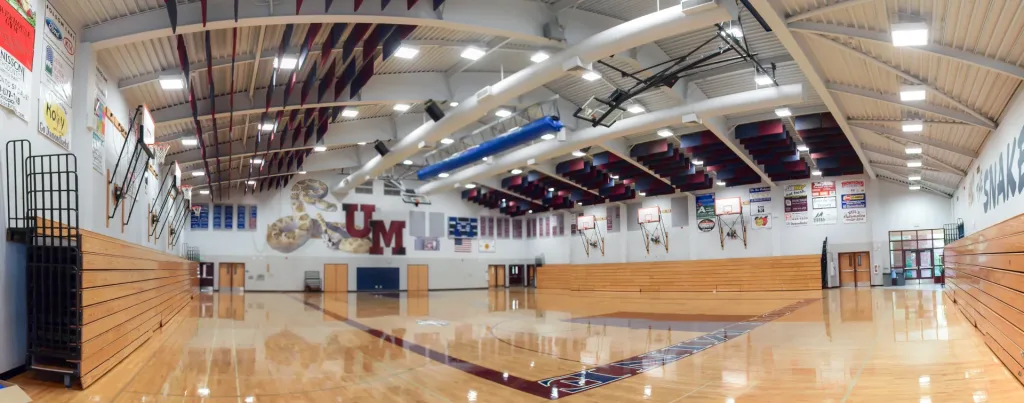
Commercial lighting selection starts with rigorous definition of what the lighting needs to accomplish. This is different from residential lighting where ambiance and aesthetics often drive decisions. Commercial applications have functional requirements that must be met before aesthetic considerations matter.
Document the following for your project:
This initial documentation drives every subsequent decision. A post-installation correction due to incomplete upfront specification is substantially more expensive than getting the specification right before purchasing.
Commercial light levels are specified in footcandles (fc), the unit measuring how much light reaches a work surface. Different commercial applications require different footcandle levels to support task performance, safety, and code compliance.
| Application | Typical Footcandles Required |
|---|---|
| Parking garages and outdoor parking | 1-5 fc |
| General warehouse storage | 10-20 fc |
| Warehouse aisles and picking | 20-30 fc |
| General office | 30-50 fc |
| Open office and classrooms | 30-50 fc |
| Manufacturing (general assembly) | 30-50 fc |
| Retail sales floor | 50-100 fc |
| Manufacturing (precision assembly, quality control) | 75-150 fc |
| Healthcare exam and clinical | 70-100 fc |
| Gymnasiums and recreational sports | 30-50 fc |
| Tournament sports and courts | 50-75 fc |
For comprehensive footcandle specification by application, see our footcandle guide. To translate required footcandles into fixture lumens needed for your space, see our commercial lumens guide.
A qualified lighting manufacturer should provide a free photometric layout showing exactly how specified fixtures will deliver light across your space. This calculation accounts for fixture lumens, optical distribution, mounting height, room reflectances, and light loss factor (typically 0.9-0.94 for LED). The photometric output is the deliverable that proves the specification will meet your required footcandle levels.
Commercial LED fixtures come in several form factors, each suited to specific applications. Choosing the wrong fixture type is a common commercial specification mistake that results in inadequate illumination, excessive energy use, or poor fixture longevity.
| Fixture Type | Typical Applications | Mounting Heights |
|---|---|---|
| LED High Bay (UFO round) | Warehouses, manufacturing, gymnasiums, large retail | 20-40+ ft |
| LED High Bay (linear) | Warehouses with rack aisles, manufacturing | 15-30 ft |
| LED Recessed Troffer | Offices, classrooms, healthcare, retail ceiling grids | 8-12 ft (dropped ceiling) |
| LED Panel Light | Offices, classrooms, corridors, healthcare | 8-12 ft (dropped ceiling) |
| LED Cold Storage | Freezers, refrigerated warehouses, food processing | 10-30 ft (specialized) |
| LED Outdoor Area/Pole | Parking lots, pathways, outdoor sports, perimeter | 15-30 ft (pole-mounted) |
| LED Wall Pack | Building perimeter, loading docks, security | 10-20 ft (wall-mounted) |
| LED Retrofit Kit | Upgrading existing fluorescent or HID fixtures | Varies (reuses existing housing) |
For detailed discussion of fixture types and applications, see our types of lighting guide. Product-specific options include LED high bay fixtures, LED panel lights, LED troffers, cold storage LED fixtures, outdoor LED lighting, and LED retrofit kits.
Color temperature (measured in Kelvin) determines whether the light appears warm (yellow-white) or cool (blue-white). Color Rendering Index (CRI, measured 0-100) determines how accurately the light renders object colors. Both specifications affect visual comfort, task performance, and application suitability.
Color Temperature (CCT) for Commercial Applications:
CRI Specifications for Commercial Applications:
For detailed CRI specification guidance including R9 considerations and TM-30 color rendition evaluation, see our CRI guide. Commercial specifications should state both CCT and CRI explicitly; assuming standard values without specification can result in inappropriate fixture selection.
Efficacy measures how efficiently a fixture converts electricity into visible light, expressed in lumens per watt (lm/W). Higher efficacy means lower operating cost for equivalent light output. Modern commercial LED fixtures achieve 100-200+ lm/W, compared to 65-115 lm/W for metal halide and 80-95 lm/W for T8 fluorescent.
When comparing commercial LED fixtures, request:
For detailed explanation of efficacy measurements and how to compare commercial fixtures, see our efficacy vs efficiency guide.
Modern commercial lighting specifications almost always include lighting controls. Energy codes like ASHRAE 90.1-2022, California Title 24, and IECC increasingly require automatic controls as a prescriptive compliance path. Utility rebate programs often provide additional incentives layered on top of fixture rebates when controls are included.
Common commercial lighting control strategies:
Modern wireless lighting controls (Bluetooth SIG Mesh, Zigbee, proprietary wireless like Lutron Vive) offer substantial advantages over wired controls for retrofit projects, eliminating the need for new control wiring. For detailed guidance on commercial lighting control systems, see our lighting controls basics guide and our smart wireless lighting controls guide for commercial applications.
Commercial LED fixtures must meet specific certification requirements for code compliance, rebate eligibility, and project-specific requirements. The critical certifications include:
| Certification | Purpose | When Required |
|---|---|---|
| CSA listing (or UL/ETL equivalent) | Electrical safety certification | All commercial installations |
| DLC (DesignLights Consortium) qualification | Energy efficiency verification | Utility rebate programs |
| ENERGY STAR (when available) | Efficiency marking | Some rebate and procurement programs |
| BAA (Buy American Act) compliance | Domestic content verification | Federal procurement projects |
| BABA (Build America, Buy America) compliance | Infrastructure funding domestic content | IIJA/ARPA-funded projects, many state and municipal projects |
| IP65/IP66 ratings | Environmental protection (dust/water) | Outdoor, wet location, food processing |
| NSF certification | Food processing/handling suitability | Food production facilities |
| IES LM-79/LM-80 test data | Photometric and lumen maintenance | All commercial specifications |
For detailed information on CSA certification and how it compares to UL, ETL, and other marks, see our CSA certification guide.
Commercial lighting decisions should evaluate total cost of ownership (TCO), not just fixture purchase price. TCO includes:
For a typical commercial LED retrofit replacing legacy fluorescent or HID lighting, simple payback periods commonly range from 1-5 years. After payback, the fixture continues producing energy savings for an additional 10-15+ years of remaining service life. This multi-year savings period typically makes commercial LED conversion one of the highest-return infrastructure investments available to commercial facilities. For detailed payback analysis by application, see our warehouse LED conversion guide.
Warehouses benefit from LED high bay fixtures at 20-35 foot mounting heights, typically 80+ CRI at 4000K-5000K, with occupancy-based controls for unused zones. Rack-aisle configurations may use linear high bays for better vertical illumination. See LED high bay lighting for fixture options.
Manufacturing specifications depend on the work performed. General assembly areas typically specify 30-50 fc with 80+ CRI. Precision assembly, quality inspection, and color-critical processes require 75-150 fc with 90+ CRI. Ceiling-hung high bay fixtures work for large open floors; task-specific lighting supplements for detailed work areas.
Commercial offices typically specify 30-50 fc at 3500K-4000K with 80+ CRI. LED recessed troffers and panel lights are the standard choice for dropped ceiling grids. Occupancy sensing and daylight harvesting are typically code-required. See LED panel lights and LED troffers.
Healthcare applications specify 90+ CRI with elevated R9 values for accurate skin tone rendering, 70-100 fc in clinical areas, and tunable-white capability in patient rooms for circadian support. Exam rooms and clinical imaging require 95+ CRI for accurate color perception.
Cold storage and freezer applications require LED fixtures specifically rated for low-temperature operation, typically with IP65+ environmental ratings. NSF certification may be required for fixtures in direct food handling areas. See LED cold storage lighting for specialized fixtures designed for sub-zero operation.
Classrooms, gymnasiums, hallways, and common areas have varying requirements. Classrooms typically specify 30-50 fc at 4000K with 80+ CRI, while gymnasium LED fixtures specify 30-50 fc with tight uniformity for multi-sport use. Federal and state funding often triggers BAA/BABA compliance requirements.
Sports lighting specifications vary by sport, skill level, and whether broadcast-quality illumination is required. Pickleball, tennis, racquetball, gymnasiums, and other court sports each have established standards. See our sports lighting complete guide for detailed specifications by sport.
Outdoor commercial lighting requires IP65+ rated fixtures, appropriate beam distribution for the illuminated area, and attention to light trespass onto adjacent properties. Dark Sky compliance may be required in some jurisdictions. See LED outdoor lighting for commercial parking, security, and perimeter applications.
Required fixture quantity depends on required footcandle level, fixture lumen output, mounting height, room dimensions, and light loss factor. A qualified commercial LED manufacturer should provide a free photometric layout showing exactly how specified fixtures will deliver light across your space. This calculation is substantially more accurate than rule-of-thumb estimates and should be part of any commercial lighting quote.
Commercial LED lighting differs from residential in several ways: higher lumen outputs for larger spaces, longer service lives (50,000-100,000+ hours vs 15,000-25,000 for residential), commercial-grade certifications (CSA listing, DLC qualification, LM-79 testing), stricter energy code compliance requirements, integration with commercial lighting controls, and specifications for continuous operation rather than intermittent household use. Commercial fixtures are also typically rated for higher ambient temperatures and more rigorous duty cycles.
For most commercial applications, yes. Energy codes increasingly require dimming capability for compliance (particularly in daylight zones and occupancy-controlled spaces). Utility rebate programs often provide additional incentives for dimming-capable fixtures integrated with networked controls. Dimming also provides operational flexibility for shift changes, seasonal adjustments, and task-tuning. Specifying dimming capability adds minimal cost to modern commercial LED fixtures.
Most commercial facilities specify 4000K (neutral white) as a default that works well for general applications. Consider 3500K for traditional office environments, hospitality, or spaces where warmer lighting is preferred. Consider 5000K (cool daylight) for warehouses, manufacturing, outdoor areas, sports facilities, and cold storage where higher-alertness lighting supports task performance. Tunable-white fixtures that allow CCT adjustment provide flexibility for spaces with varied uses or circadian support needs.
Utility rebate qualification typically requires DLC (DesignLights Consortium) listed fixtures, proper documentation of displaced (replaced) technology, and compliance with program-specific requirements. Most U.S. commercial utilities offer LED rebate programs covering 78%+ of the country. Rebate structures vary (per-fixture, performance-based, custom) but commonly cover 15-40% of project costs. Coordinate with your utility’s commercial rebate program before finalizing fixture specification to maximize rebate capture.
Commercial LED fixtures typically carry 50,000-100,000+ hour service lives at 70% of original lumen output (the L70 specification). For a commercial facility operating 4,000-5,000 hours per year, this translates to 10-20+ years of service without lamp replacement. This compares to 2-3 year replacement cycles for T8 fluorescent and 3-5 year cycles for metal halide. LM-80 test data documents expected lumen maintenance over service life for fixtures from reputable manufacturers.
Both approaches have appropriate applications. LED retrofit kits work well for fixtures in good physical condition with layouts that still match facility use. Complete fixture replacement makes sense for aged legacy fixtures, fixtures with environmental damage, or when the facility use has changed (new racking, different activities). Retrofit kits typically cost 30-50% less than complete fixture replacement while delivering similar energy savings. See our warehouse LED conversion guide for detailed comparison.
Yes. 1st Source Lighting has designed and manufactured commercial and industrial LED fixtures in the United States since 1993. Our engineering team provides free photometric layouts showing exactly how specified fixtures will perform in your facility, CSA listed BAA/BABA compliant fixtures for commercial and federally-funded projects, DLC-qualified products for utility rebate eligibility, and specification support from concept through commissioning. We serve commercial, industrial, municipal, federal, and educational customers across the United States.
Commercial LED lighting projects benefit from early engagement with a qualified manufacturer. The upfront effort of proper specification, photometric analysis, controls planning, and rebate coordination typically more than pays for itself through better fixture selection, higher rebate capture, and fewer post-installation corrections.
1st Source Lighting provides free commercial lighting consultations including photometric layouts, specification review, product recommendations, and rebate program coordination. Whether you’re planning a full new facility, a retrofit of existing lighting, or evaluating LED options for a specific application, our engineering team can help you navigate the specification process and select fixtures appropriate to your facility, budget, and compliance requirements.