Made in Auburn, CA
Made in the USA since 1993. Over 32 years of fixture engineering.
BAA and BABA Compliant
Federal-ready procurement for GSA, USACE, Department of Defense, and state DOTs.
7-Year Factory Warranty
Full coverage on driver, LEDs, and housing. 100,000-hour L70 rated.
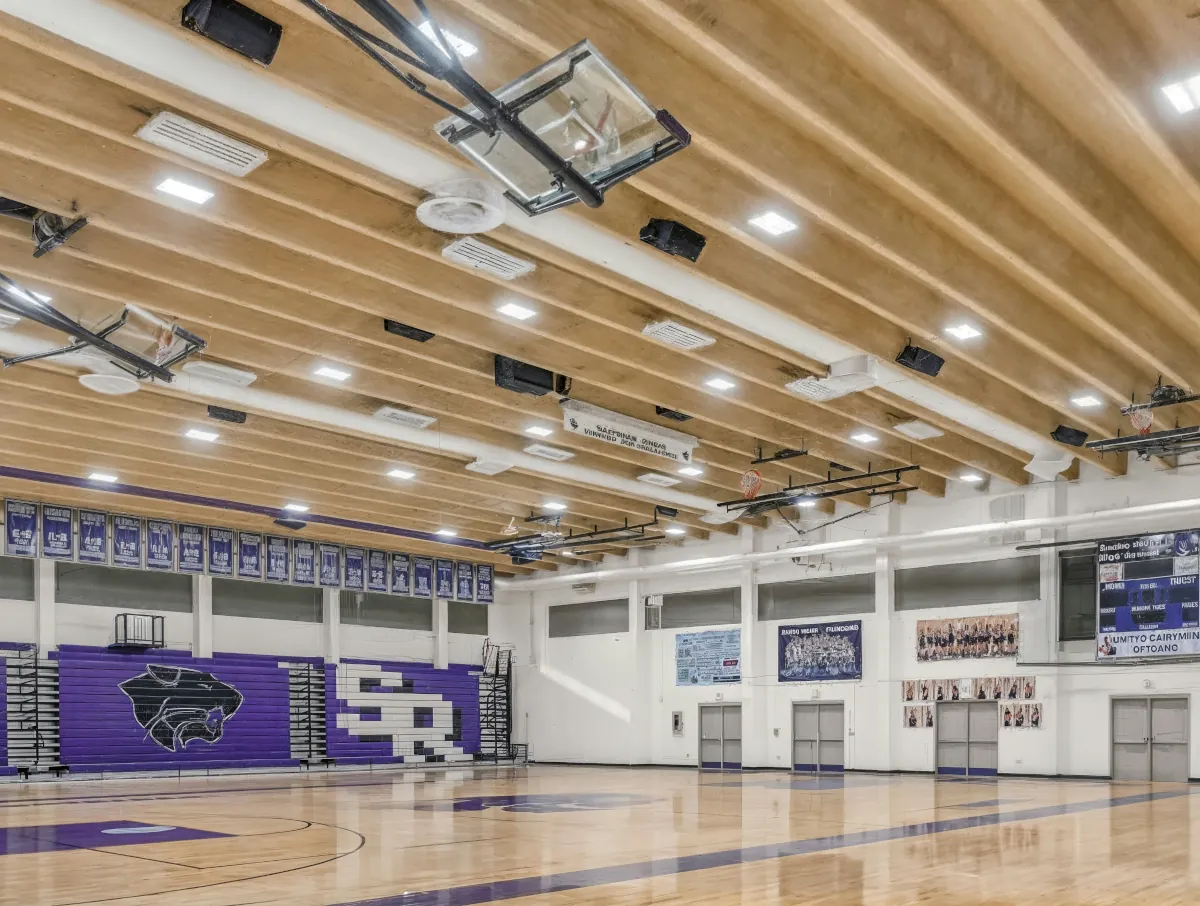
Standard warehouse high bays do not belong in gymnasiums. Players cannot track lobs through fixtures with exposed LED diode arrays. Cheap polycarbonate “low glare” lensing fails the direct-look test the moment an athlete glances up. Generic optical distributions produce uneven light pools and shadow zones that strobe across the playing surface during fast play. Gymnasium lighting is its own engineering discipline, and we have been doing it since 1993.
Our Premium Gym High Bay uses our proprietary LBAT (Lens Beam Augmentation Technology) lens to address what published glare metrics do not measure. The result is significantly easier on athletes’ eyes during play, with diffusion characteristics comparable to T12 fluorescent and the efficacy of modern LED.
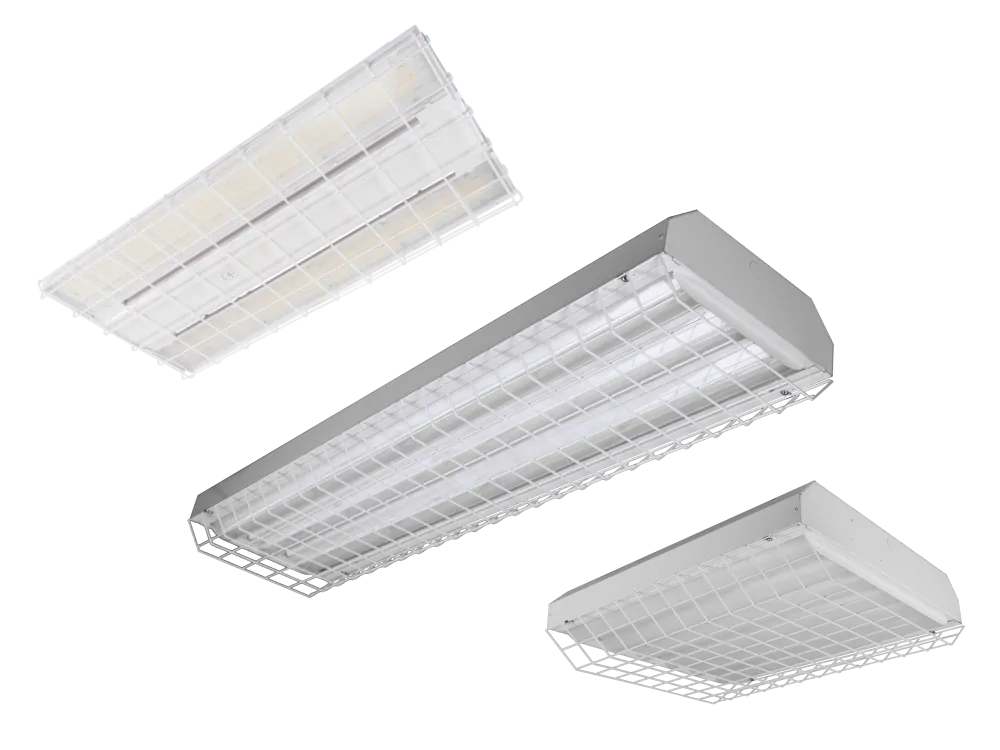
Every gymnasium has different ceiling heights, sport mixes, and budget realities. We engineer three product families to cover the full range of commercial gymnasium applications, from elementary multipurpose rooms to high school competition floors to college recreation centers.
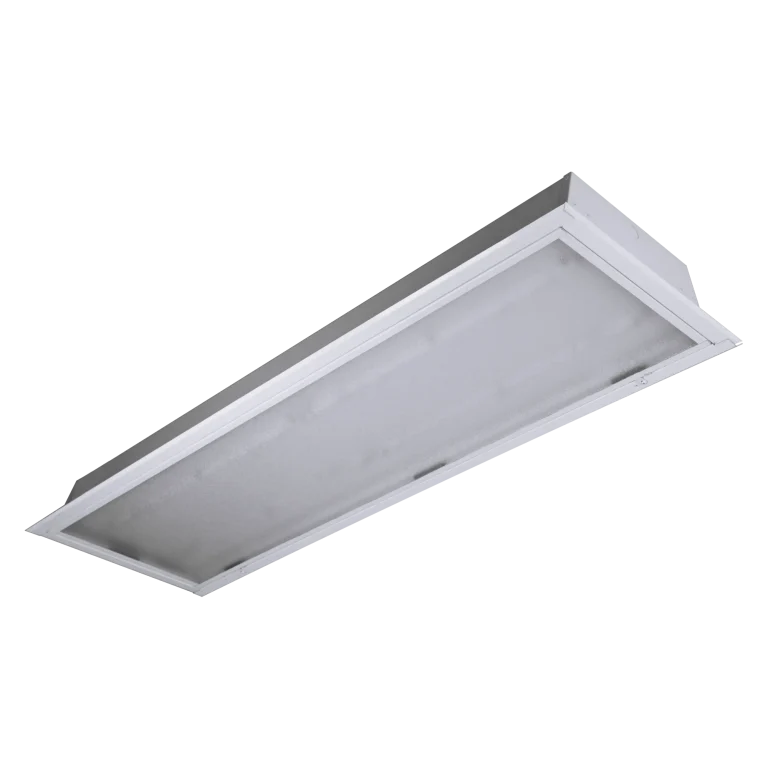
Linear premium flagship with LBAT lens for sports-engineered glare control and ball-tracking visibility.
Best for: Main competition floors, K-12 high school gymnasiums, community recreation centers, college recreation, any facility where lighting quality is the primary buying decision.
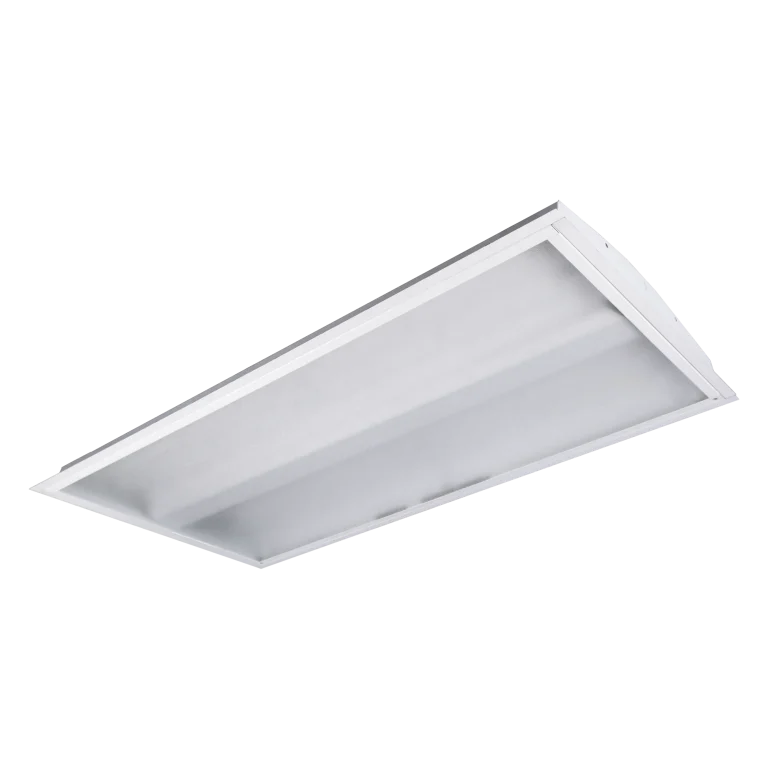
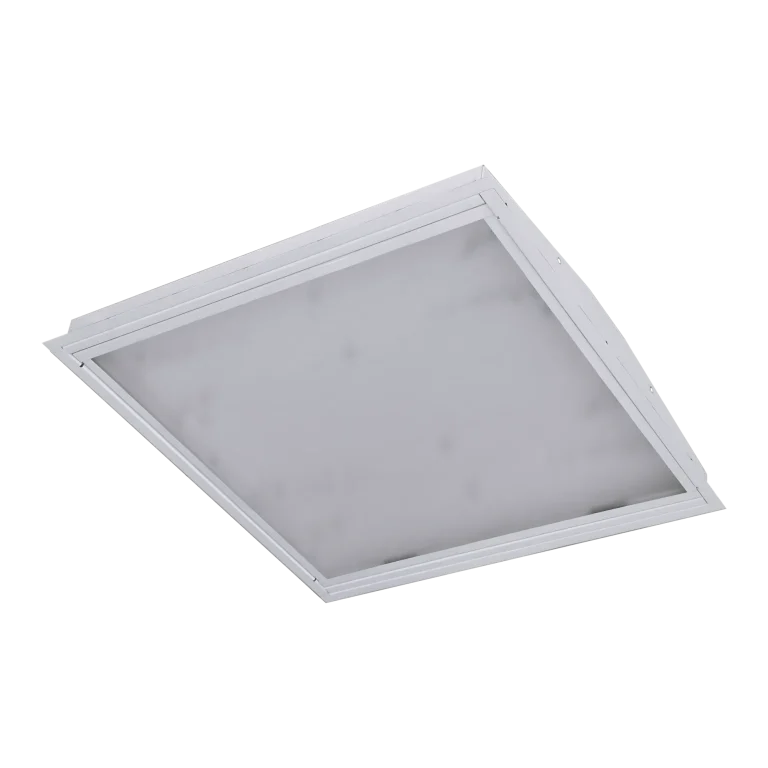
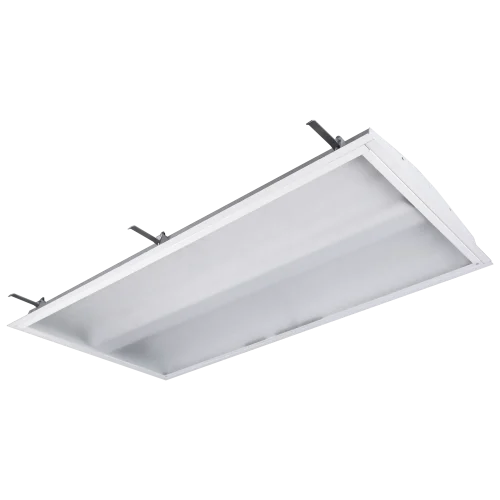
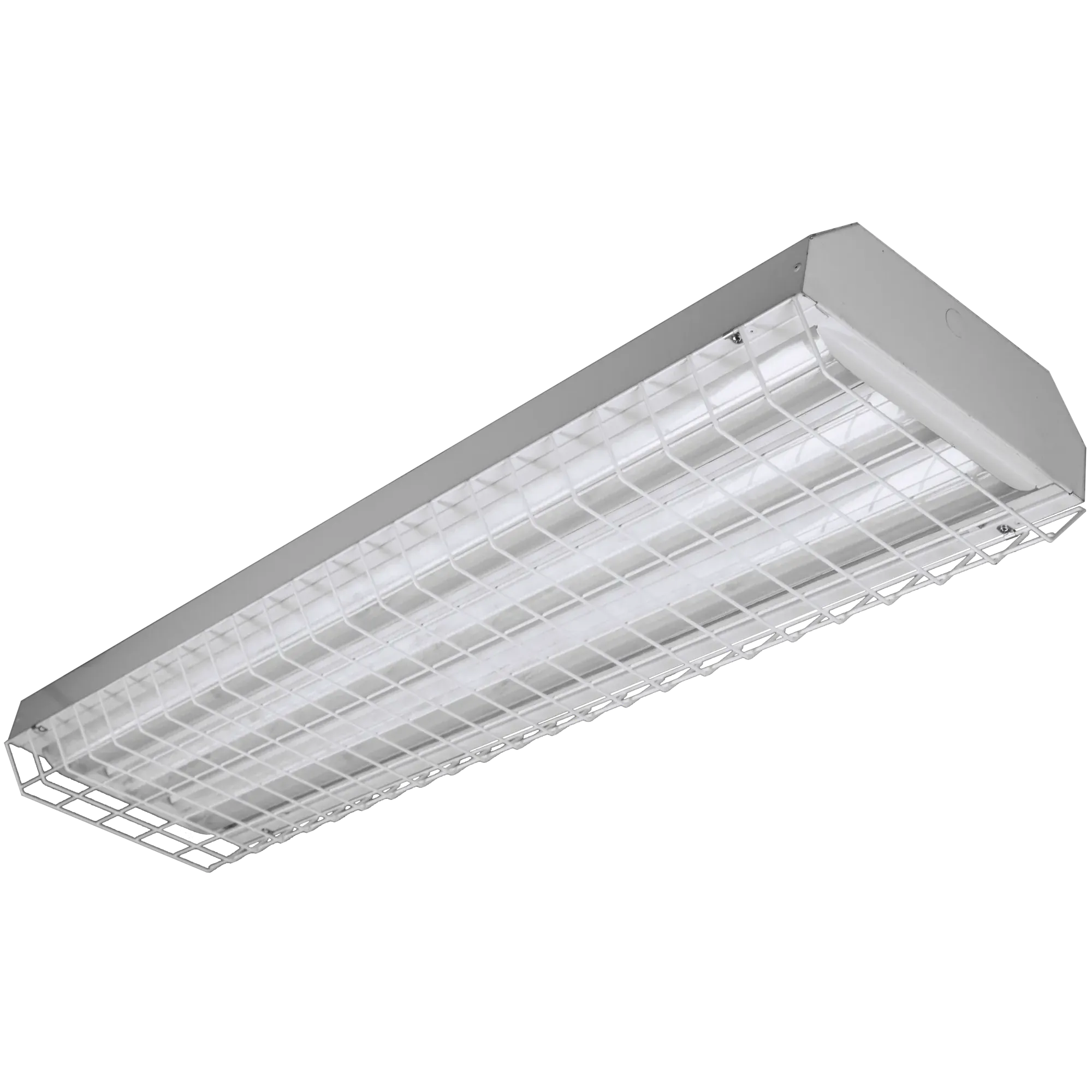
Lay-in fixture for low-ceiling auxiliary spaces and multipurpose rooms with finished drop ceilings.
Best for: Elementary multipurpose rooms, locker rooms, weight rooms, lobby spaces, and back-of-house gymnasium areas with ceilings under 18 feet.
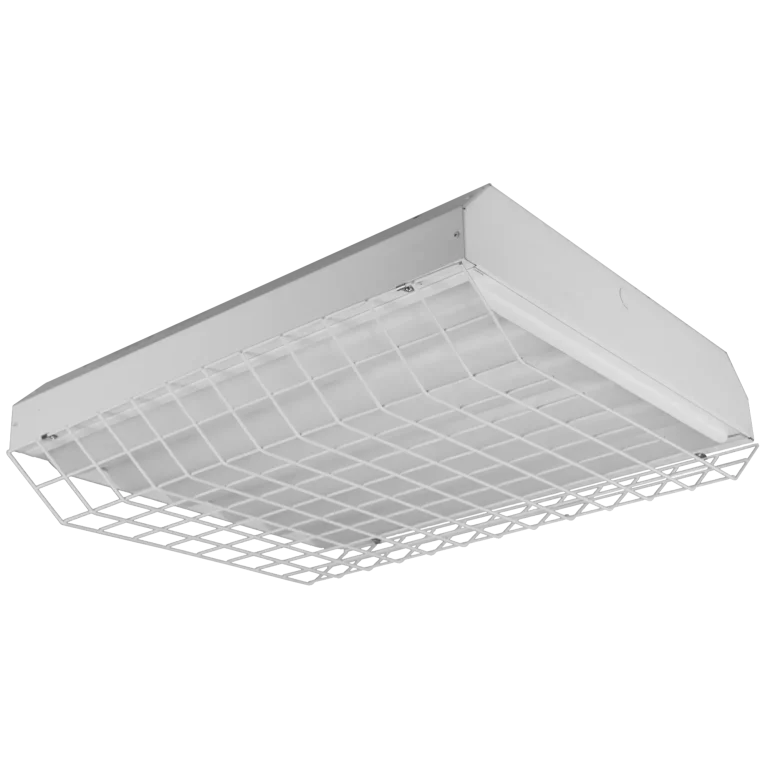
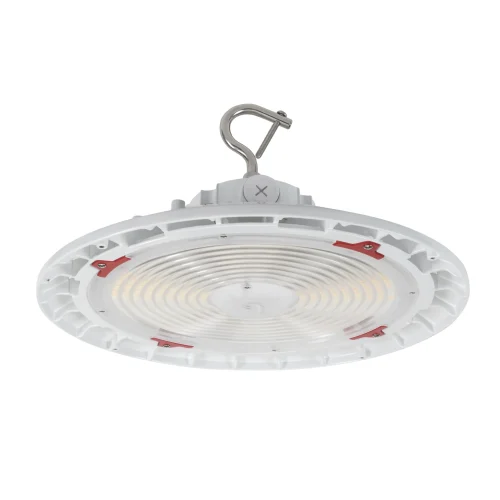
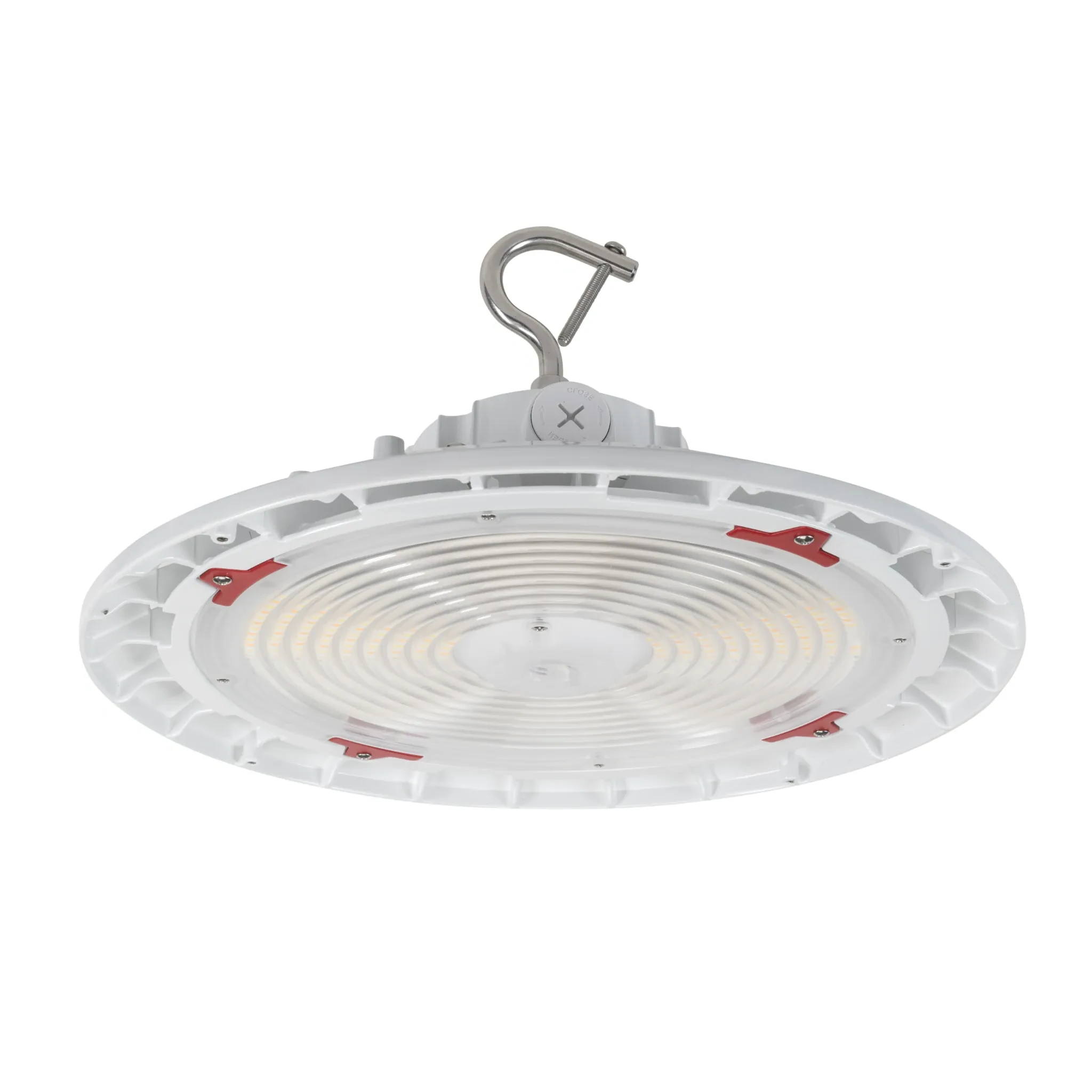
Lower-cost round high bay option. Specify with the drop lens variant for proper glare control in gym applications.
Best for: Budget-constrained retrofits, auxiliary practice spaces, phased projects where main competition floors use the linear premium fixture and auxiliary spaces fit a tighter capital budget.
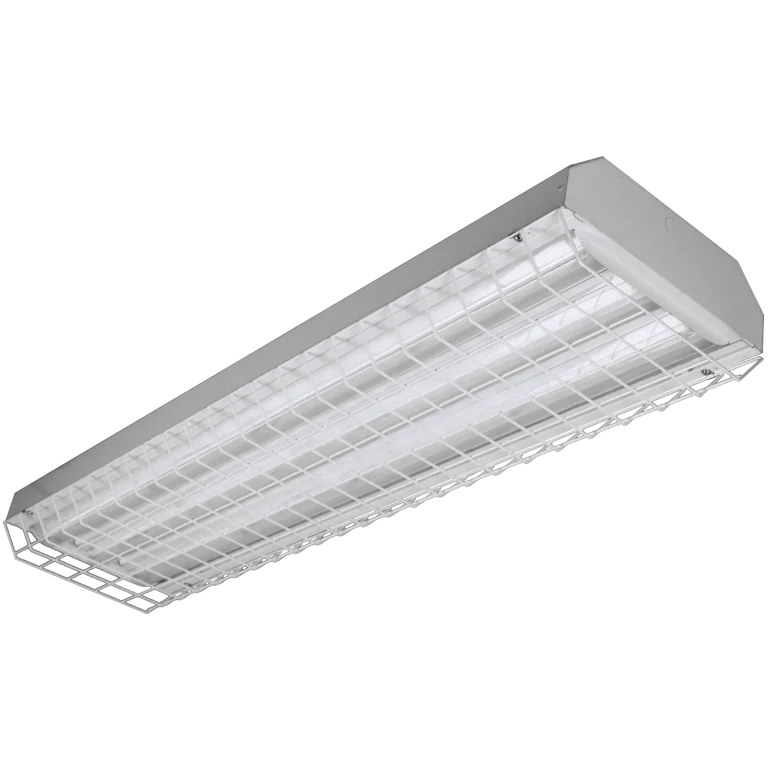
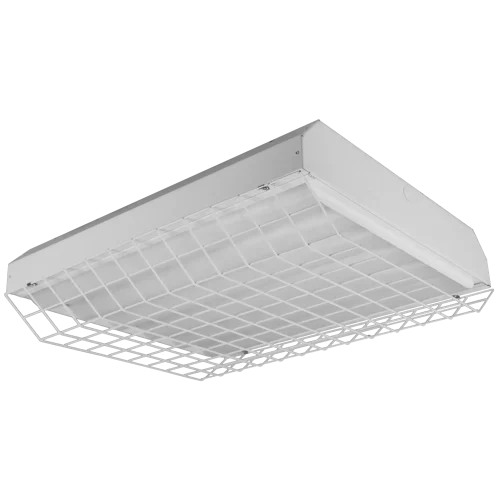
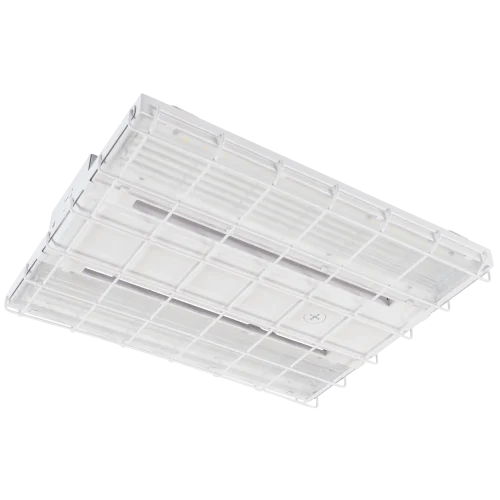
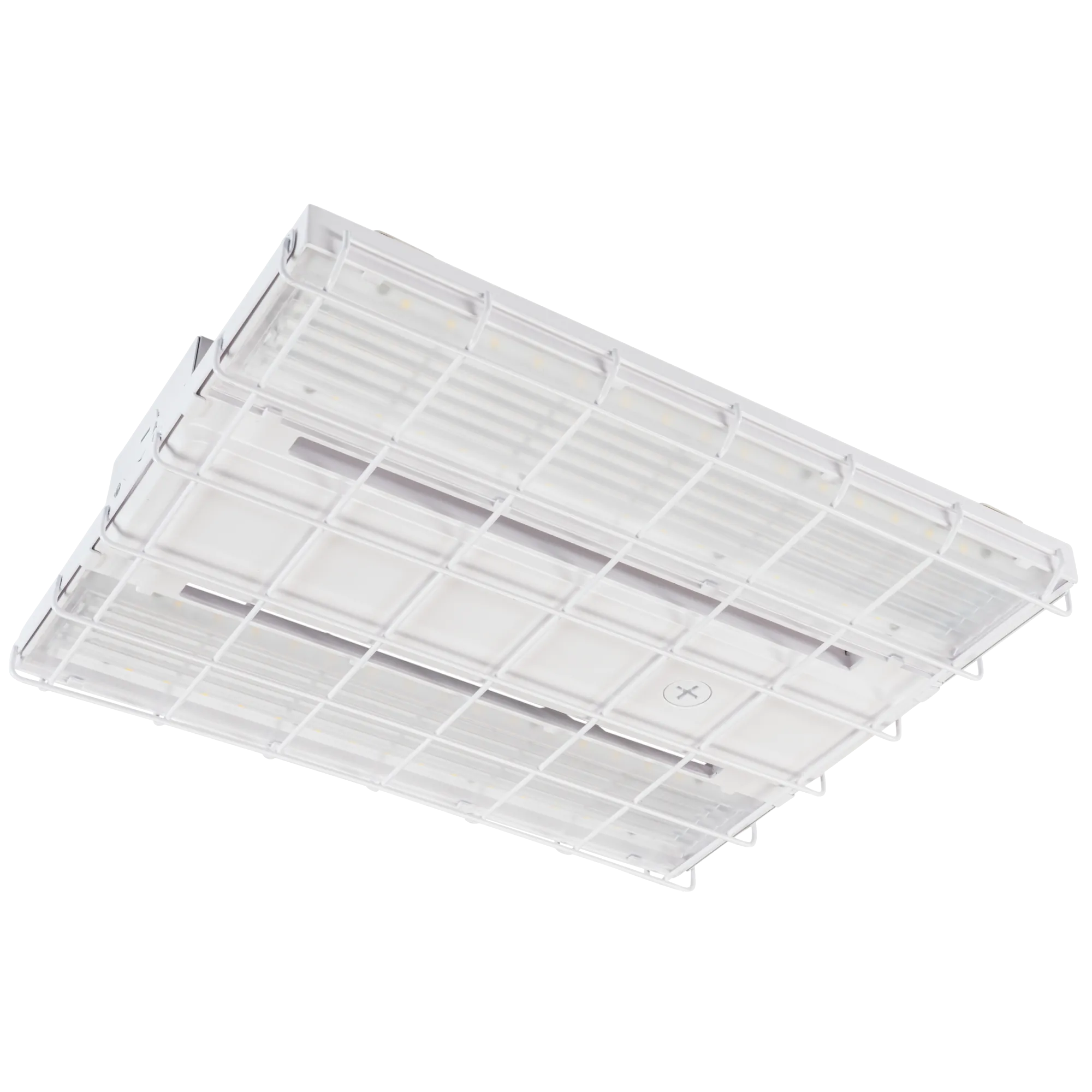
Entry-tier linear high bay with integrated wireguard for impact protection in ball-sport environments.
Best for: Budget-constrained projects in standard rectangular gymnasiums where linear form factor matches the facility, K-12 retrofits with capital cost as the primary buying decision, phased projects pairing entry-tier auxiliary spaces with premium main competition floors.
Generic LED high bays are engineered for warehouses: tall narrow aisles, forklift visibility, and pushing maximum lumens straight down. The engineering choices that make sense for warehouse applications fail in athletic environments. Three specific failure modes show up consistently in post-retrofit complaints.
Warehouse fixtures expose the LED diode array through clear or no-lens designs. Each diode acts as a near-point source of high luminance. Looking up at the fixture, the eye sees a cluster of intense bright spots rather than a uniformly bright fixture face. This is the worst possible visual presentation for athletic environments where players look up frequently to track balls.
Warehouse fixtures use narrow optical distributions calibrated for tall narrow aisles. Apply that distribution to a rectangular court and the result is bright pools directly under each fixture and shadow zones between them. The non-uniform light distribution itself produces a strobing visual effect as players move through alternating bright and dim patches at speed.
Warehouse fixtures rarely include integrated impact protection. In a gymnasium, basketballs and volleyballs make regular contact with overhead fixtures. Without IK-rated lensing or integrated wire cages, fixtures shatter on impact, dropping fragments onto the playing surface and rendering the fixture inoperable. Even before a fixture fails outright, players on the court below subconsciously register the visual presence of an exposed LED array as a hazard.
Most discussions of gymnasium lighting glare lean on a single published metric: Unified Glare Rating (UGR). UGR is real, useful, and necessary for spec compliance, but it is also incomplete for athletic environments. UGR was developed for office and seated-observer use cases, not for athletes who glance directly into fixtures while tracking a ball during play. A fixture can score acceptable UGR while still producing intense direct luminance the moment a player looks up at it. We call this the Zone of Illuminance Discomfort, or ZID. UGR does not measure ZID. The LBAT lens used in our gymnasium fixtures is engineered specifically to address ZID through large surface area combined with high lens diffusion factor.
Lens Beam Augmentation Technology, or LBAT, was originally engineered for the indoor pickleball line, where small fast-moving balls and high-arc lobs make ZID a critical photometric requirement. The same engineering applies to commercial gymnasiums, where basketballs, volleyballs, and badminton shuttlecocks demand equivalent visual clarity. The gymnasium variant carries forward the same diffusion characteristics with a slightly narrower beam angle calibrated for typical gym ceiling heights of 18 to 30 feet.
The LBAT lens material distributes the LED emission across the entire lens surface, so the eye sees a uniformly luminous lens face during direct-look conditions rather than a cluster of intense point sources. The diffusion factor is comparable to T12 fluorescent, where the lens face appears nearly uniformly bright with no visible discrete sources, while the fixture maintains the efficacy of modern LED. This combination, T12-comparable diffusion at modern LED efficacy, is the central engineering achievement of the LBAT lens.
The difference is immediately apparent during a direct-look test. Stand directly under a generic warehouse high bay or a competitor “low glare” fixture, look up, and you can see individual LED diodes as bright points behind the lens. Your pupil contracts, and an afterimage persists when you look back down. Stand under an LBAT-engineered fixture and look up, and you see a soft uniform brightness across the entire lens with no point sources visible. Your pupil does not contract sharply. There is no afterimage.
When a player looks up to track a ball during a play, the eye briefly views the gymnasium ceiling and the fixtures hanging from it. If the fixture face presents intense point-source luminance during that direct-look interval, the pupil contracts to protect the retina from the bright source. When the player’s gaze returns to the dimmer playing surface, the pupil takes one to several seconds to dilate again. During those seconds, ball-tracking visibility is genuinely impaired. A volleyball player who experiences a one-second visual recovery delay after looking into a fixture during a serve is missing the early descent of the ball, which is when set-up reads happen. ZID describes this performance impact directly. UGR does not measure it.
For the complete engineering analysis of why UGR alone is not sufficient for athletic environments and how diffusion factor drives the actual visual experience, read our deep dive on solving glare in gymnasium lighting.
The LBAT lens is the central optical engineering element of our premium gymnasium fixture. The complete premium fixture design adds integrated IK10 impact protection, constant-current driver architecture for zero flicker, and tight color consistency through 3-step or 5-step MacAdam ellipse binning. For projects where capital cost is the primary constraint, we offer two entry-tier options that include integrated wireguard impact protection while accepting the engineering trade-offs that come with white-box pricing.
The default specification for any commercial competition gymnasium with ceilings between 18 and 35 feet. Combines the LBAT lens with integrated IK10 wire cage and constant-current driver architecture. Replaces 6-lamp T8 fluorescent (192-216W including ballast losses) with 125-150W LED at the same or improved light levels. The constant-current driver makes the fixture broadcast-grade by default for facilities streaming high school or college games, no separate broadcast SKU required.

Entry-tier linear option for budget-constrained projects in standard rectangular gymnasiums. Integrated wireguard ships standard, not as an accessory. Engineering trade-offs are honest: standard lensing rather than LBAT, commercial-grade driver rather than the constant-current architecture of the premium fixture. The right specification when the project would otherwise be forced to specify generic warehouse fixtures from another supplier.

Round entry-tier alternative at the same price tier as the Contractor Select Linear. The right specification when the facility has existing round fixture mounting drops, aesthetic preference for round profiles, or one-for-one round retrofits. Always specify with the drop lens variant. Without it, a round UFO produces the same direct glare problems as any generic warehouse fixture.

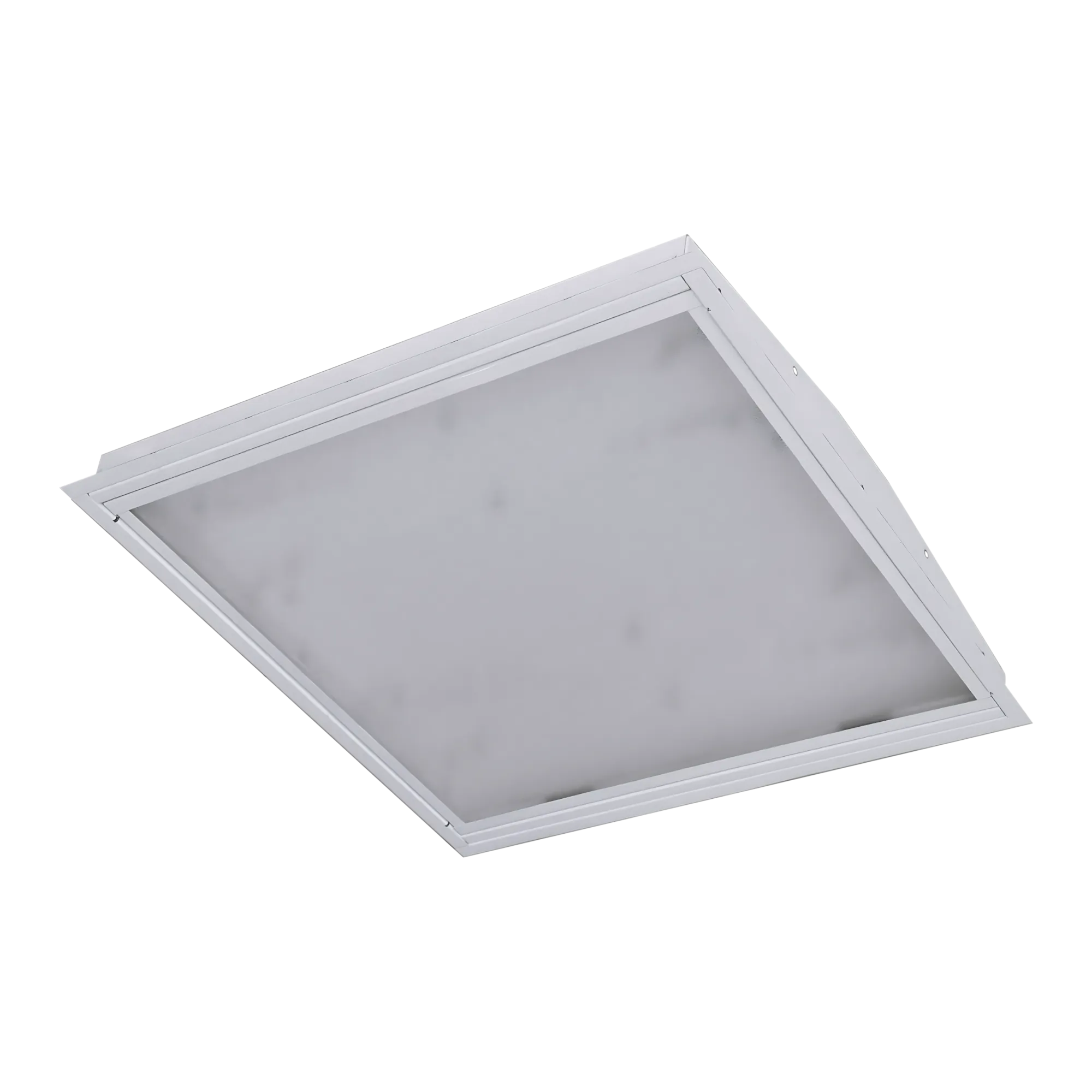
Lay-in fixture for low-ceiling auxiliary spaces and multipurpose rooms with finished drop ceilings under 18 feet. Uses the same LBAT optical principles as the high bay line, scaled to the troffer form factor. Maintains the same color consistency and driver architecture as the Premium Gym High Bay, ensuring visually consistent lighting across facilities combining high bays in main gyms and troffers in adjacent spaces.

The energy savings calculator pitches you have probably seen focus on a single number: percent reduction in lighting power. That is the simplest piece of the financial picture, and it is almost never the part that makes or breaks the project economics. Five financial drivers actually determine whether a gymnasium retrofit pays back in two years, five years, or never.

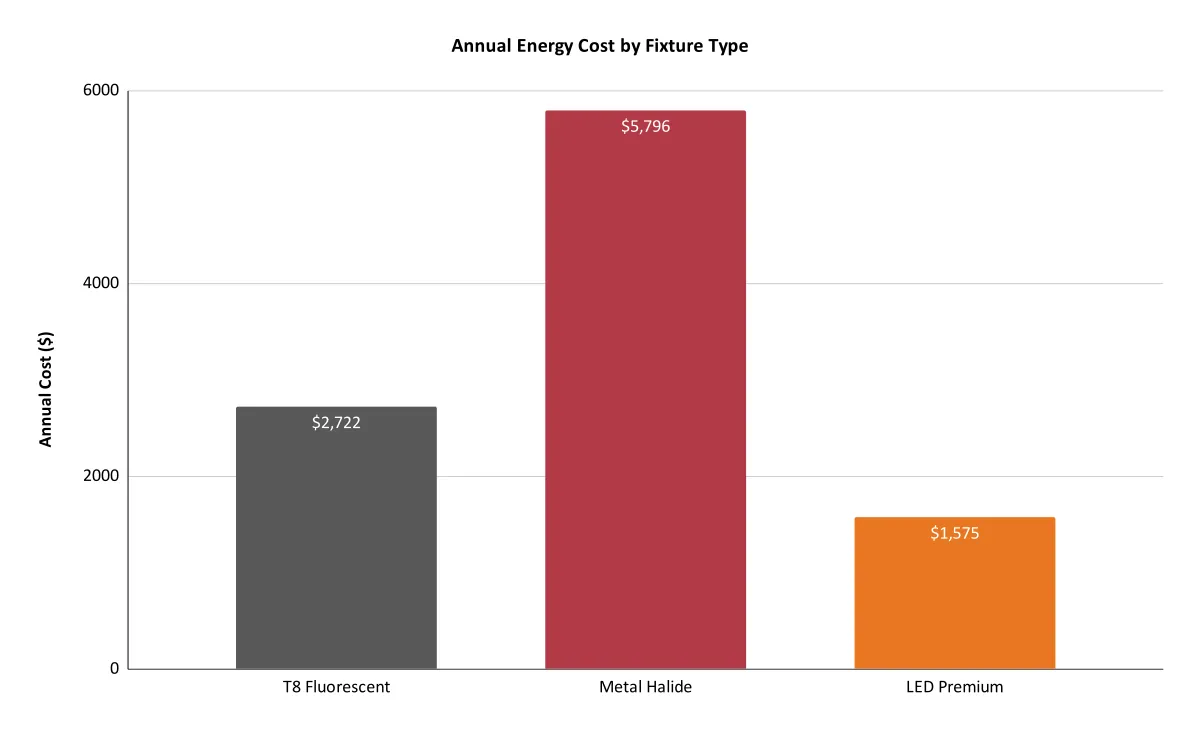
Replacing 6-lamp T8 fluorescent fixtures (192-216W including ballast losses) with the Premium Gym High Bay's 125-150W LED delivers approximately 50% direct power reduction. Metal halide replacements show 65% to 85% reduction. This is the easiest pillar to calculate and rarely the largest driver of total project value.
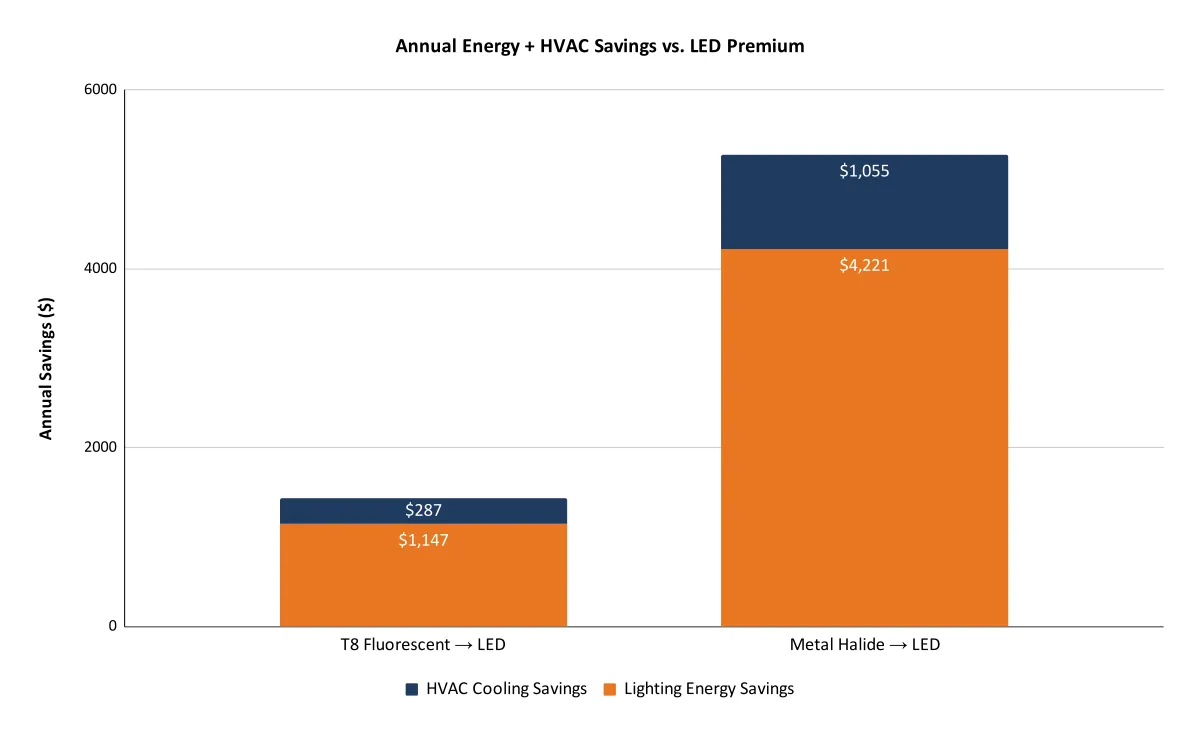
Lower fixture wattage means lower BTU heat output, reducing the cooling load on the gymnasium HVAC system. Every watt of lighting energy not consumed is a watt of heat the HVAC system does not need to remove. In southern climates and large-volume gymnasiums, this secondary savings can match or exceed the direct lighting savings.
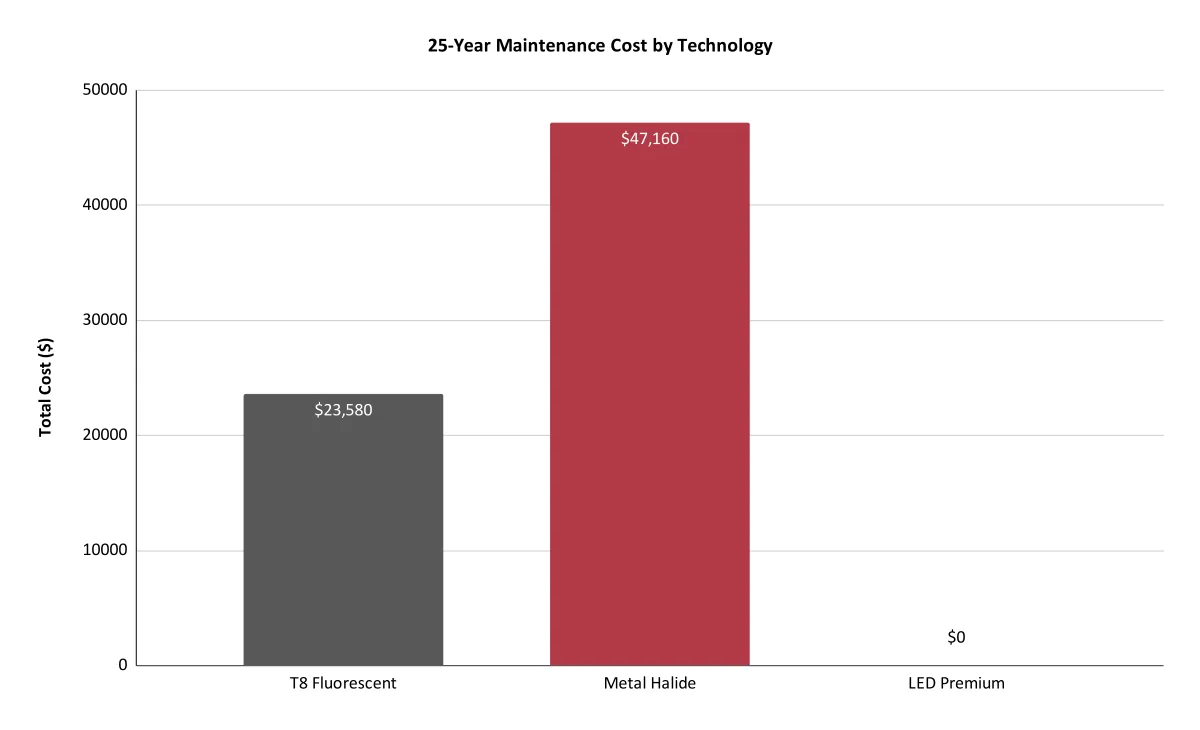
Structurally the most important financial driver for many school districts. LED rated life of 100,000+ hours L70 eliminates the relamping cycle that fluorescent and metal halide installations require every two to five years. The labor cost of accessing fixtures at gymnasium heights, including lift rental, electrician labor, scheduling around the school calendar, and floor protection, frequently exceeds the cost of the lamps themselves.
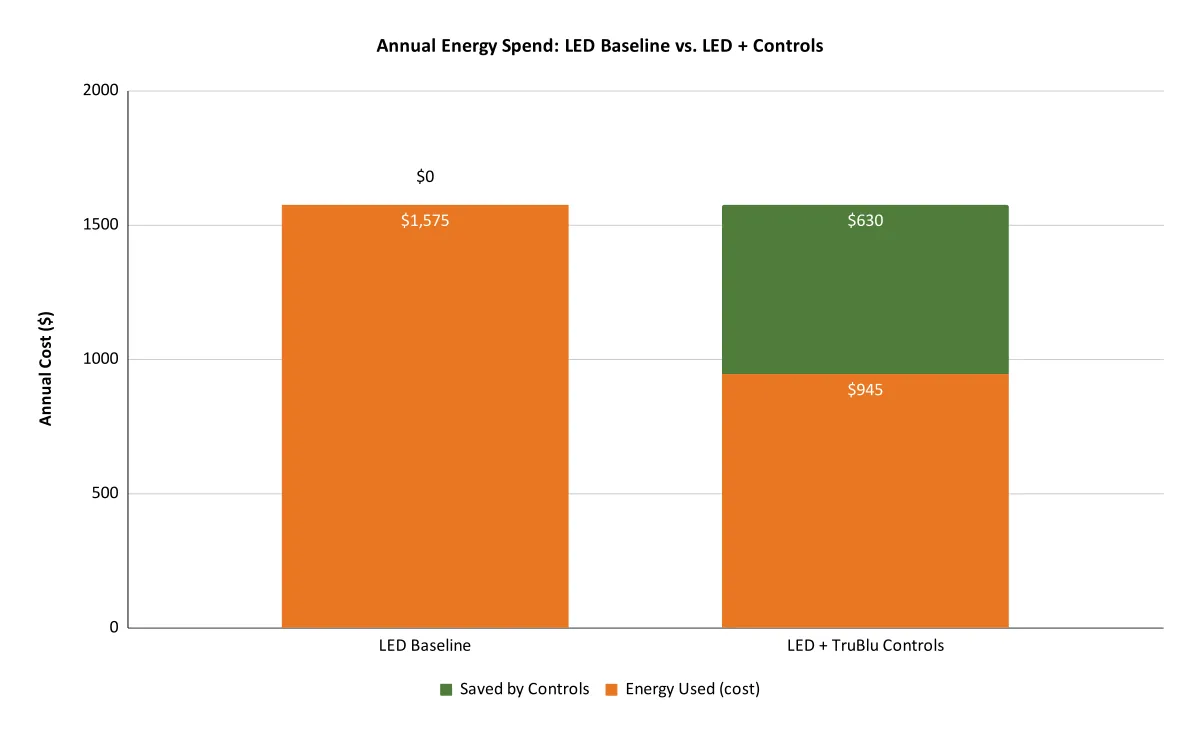
Occupancy sensors, scheduled dimming, and zoned controls reduce energy consumption beyond what fixture wattage alone delivers, AND extend fixture lifespan by reducing total run hours. A multi-purpose gym actively used six hours per day can dim to 20% output during low-occupancy periods, capturing an additional 30% to 50% energy reduction on top of the LED retrofit baseline. Position our TruBlu Mesh wireless controls as integral to the value proposition, not an upsell.
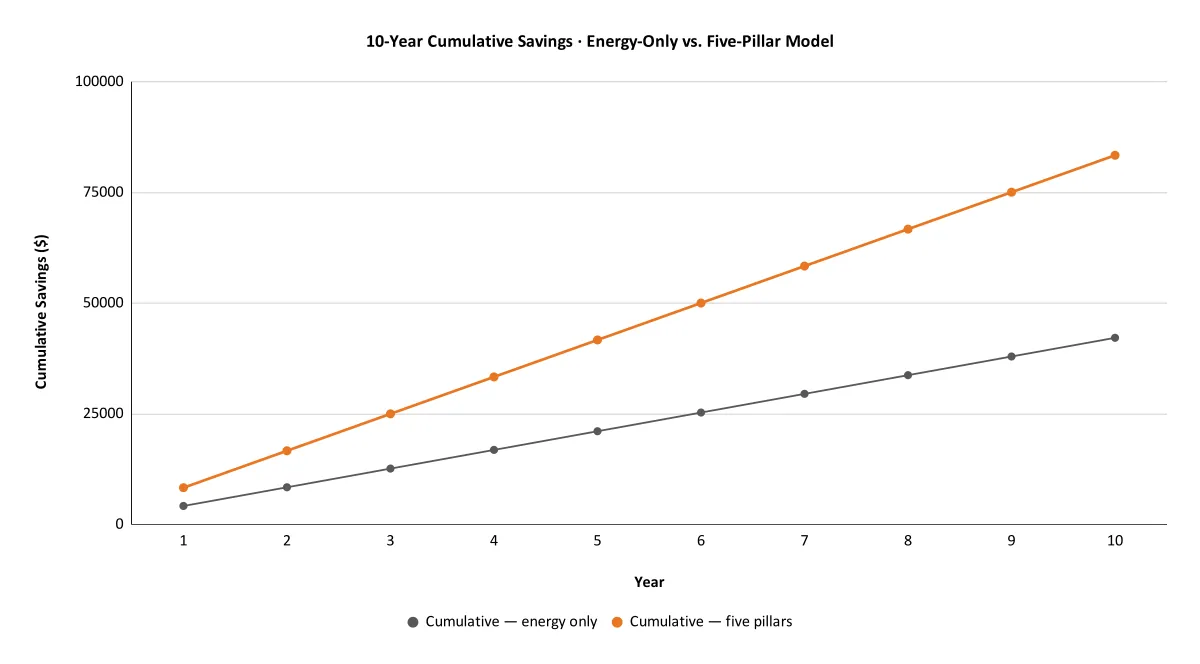
For the complete five-pillar financial model with K-12 procurement pathways, federal funding sources, and detailed payback calculations, read our K-12 gym LED retrofit guide.
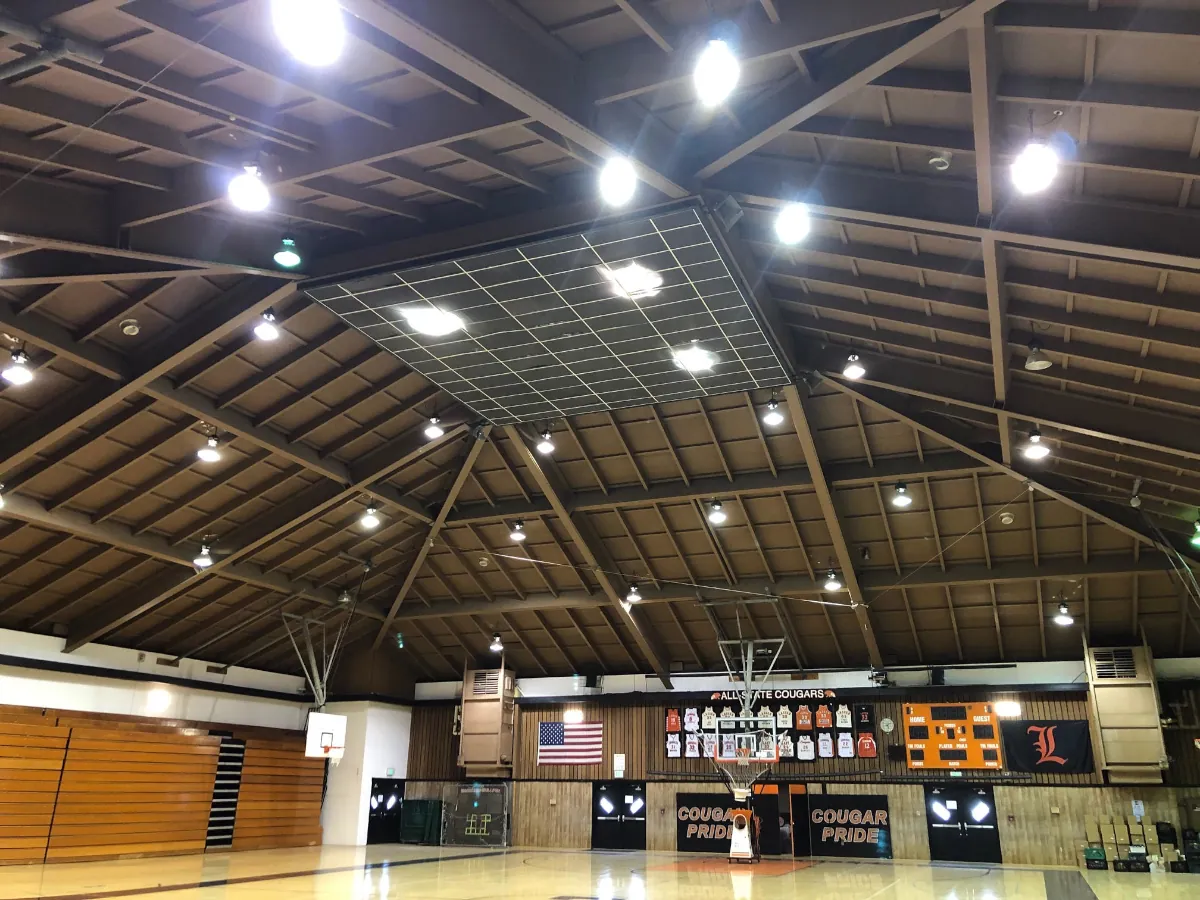
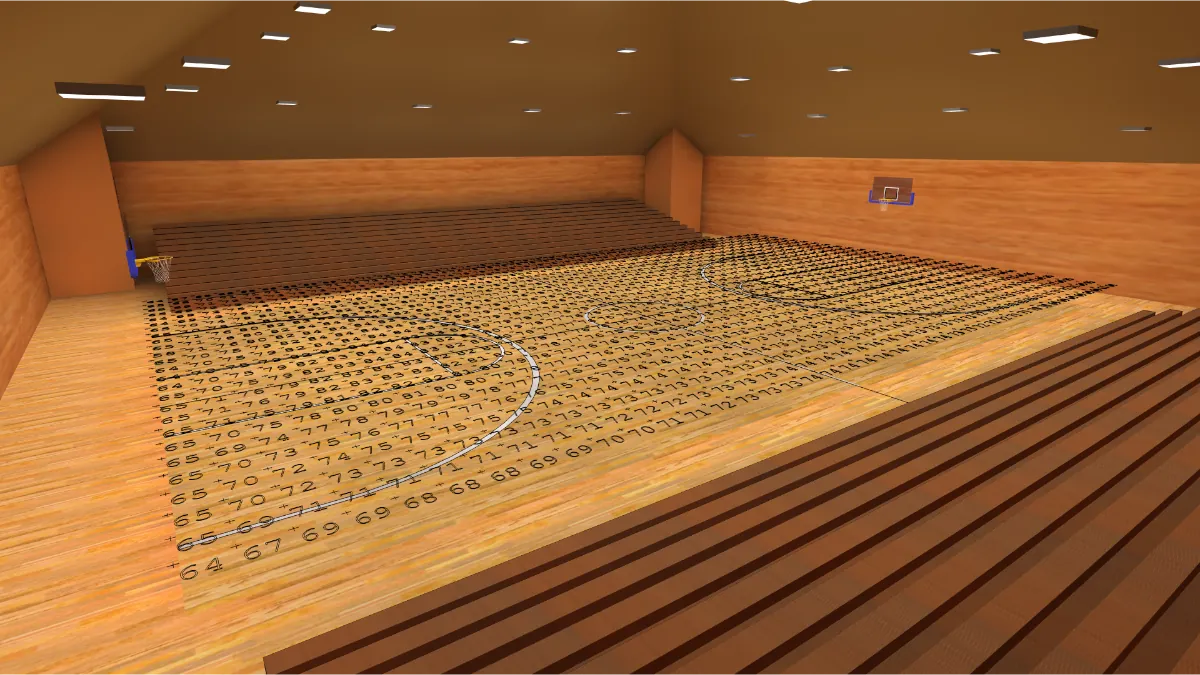
Gymnasium lighting design is too important to leave to assumptions. Every project starts with a photometric layout, an engineering model showing exactly how the proposed fixtures will perform on your specific facility’s dimensions, ceiling height, and intended use. Generic spec sheets cannot tell you how a fixture configuration will perform on your court. We can.
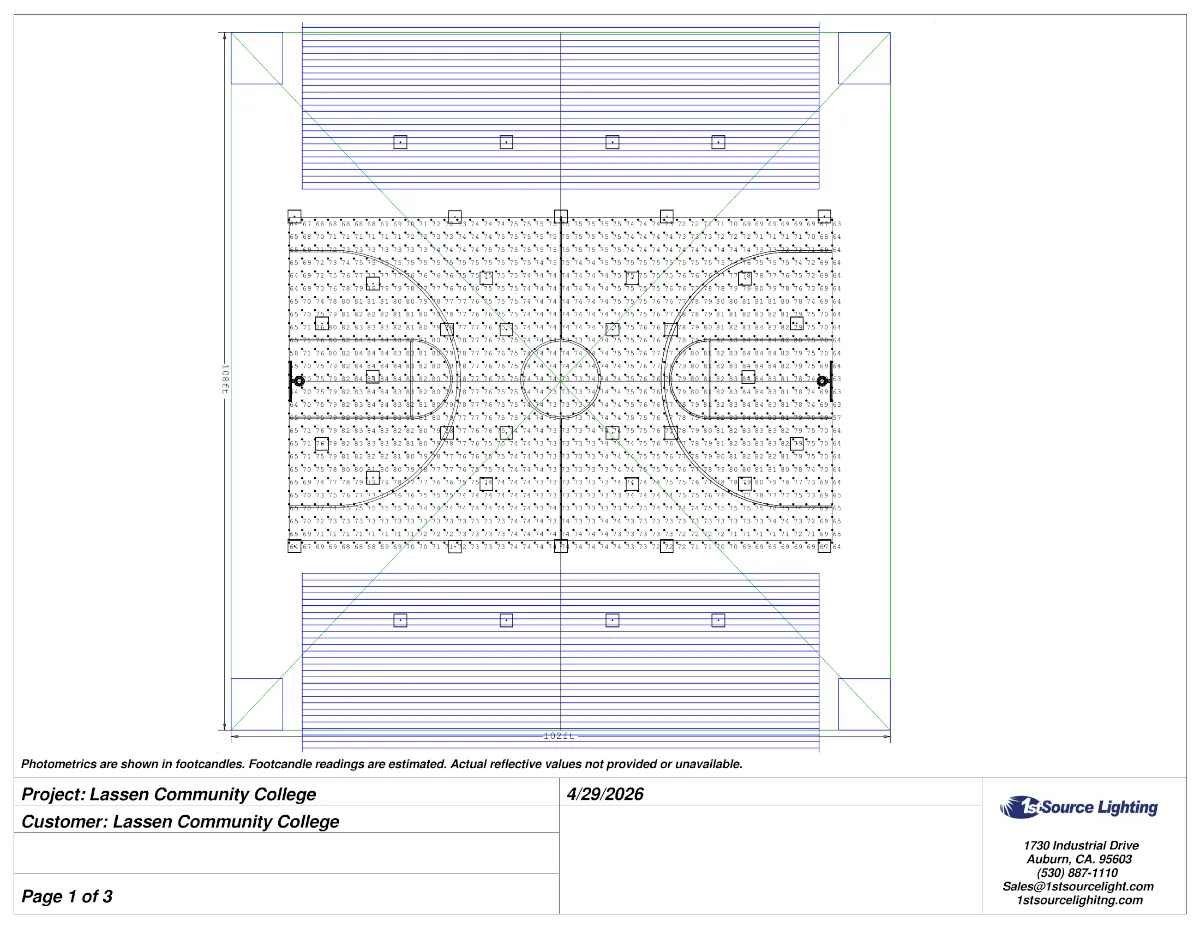
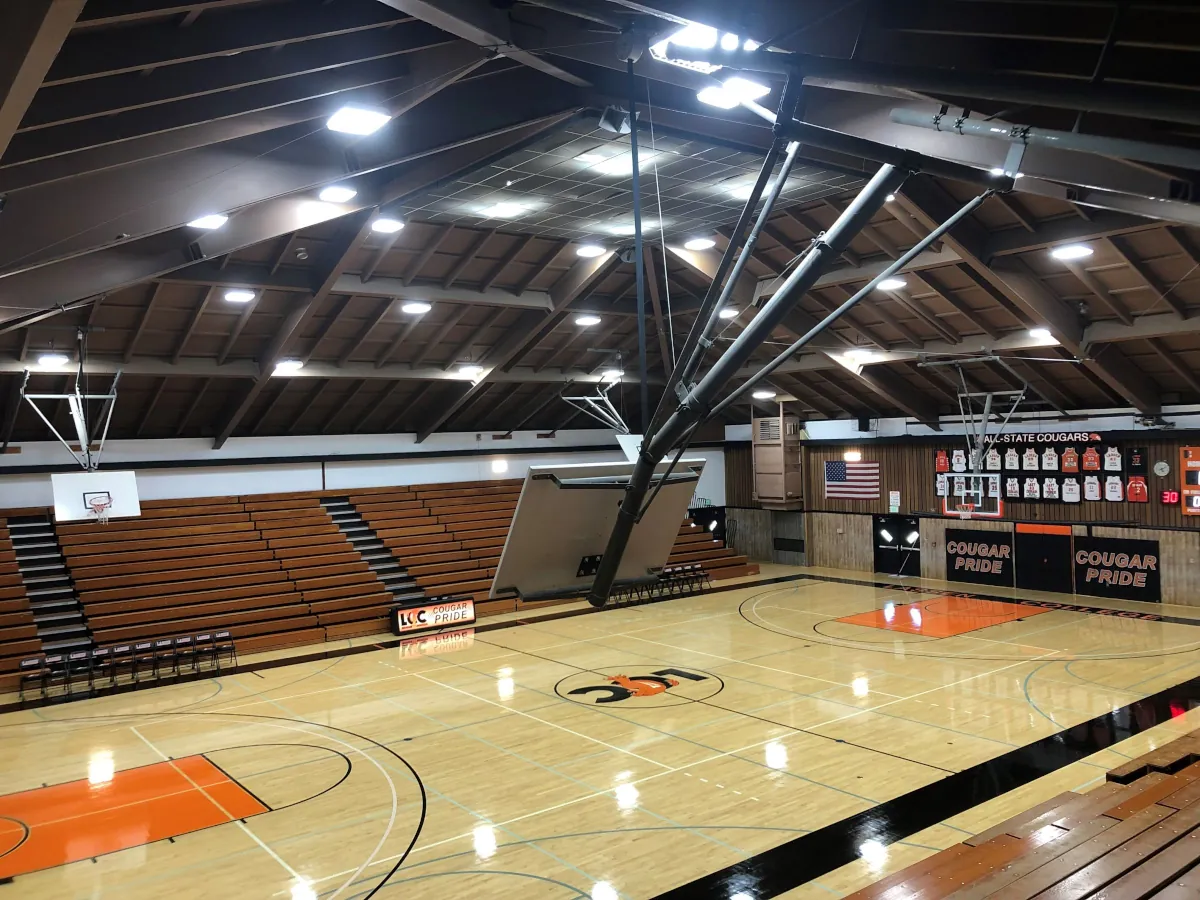
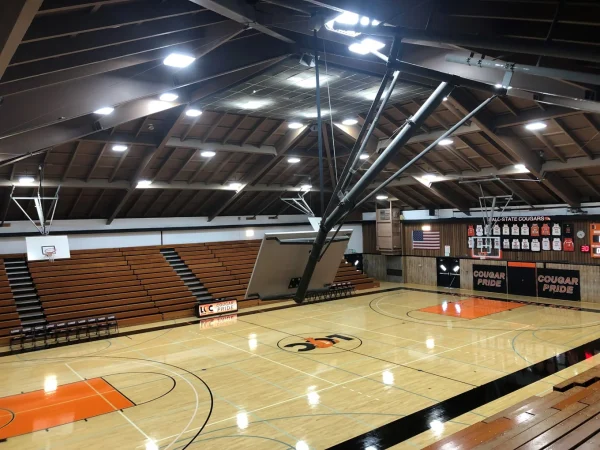
Lassen Community College came to us with a familiar problem: an aging metal halide installation that was actively failing, with degraded light output, color shift, and individual fixture failures accumulating faster than the facility could replace them. Their engineering staff had already developed a fixture pattern drawing for the gymnasium and wanted a retrofit that worked with the existing electrical infrastructure rather than requiring a full rewire.
We started with their existing engineering drawing and modeled the proposed retrofit in AGi32, our photometric design software. The modeled result projected footcandle levels in the 60 to 80 fc range across the playing surface, comfortably meeting NCAA Class II college competition specifications (75 to 80 fc) with appropriate uniformity and adequate vertical illuminance for ball tracking. The modeling work happened before any fixture specification commitment, which gave Lassen full visibility into the projected result before signing off on the order.
The completed installation replaced the aging 400W metal halide fixtures with 40 Premium Gym High Bay fixtures at 150W each. The direct fixture wattage reduction works out to 62.5% lower lighting power consumption at the same or improved light levels, before counting the additional savings from HVAC load reduction (less heat dissipated into the gymnasium volume) and maintenance elimination (no more per-fixture relamping cycles for an installation that had been failing fixtures regularly).
The five-pillar financial framework discussed above plays out concretely on this project. Direct lighting energy savings of 62.5%. HVAC load reduction proportional to the wattage reduction. Maintenance elimination on a fixture rated for 100,000+ hours L70. Integrated controls compatibility for further runtime energy reduction. And critically, proper floor protection during installation that preserved the gymnasium floor through the retrofit. The metal halide installation Lassen replaced was the kind of installation a school district might run for another five to ten years while accumulating maintenance debt; the LED retrofit reset that operational cost trajectory entirely.
The engineering work behind the Lassen project is the same work we run for every project. We start from your facility dimensions or existing engineering drawings, we model the proposed retrofit in AGi32, and we show you the predicted result before any fixture specification commitment. No obligation, no quote until you ask for one.
Send us your facility dimensions, ceiling height, and the sports your gymnasium hosts. We will model a photometric layout for your facility showing horizontal footcandles, vertical illuminance for ball tracking, uniformity ratios, and color performance for multi-sport line visibility.
All values reference ANSI/IES RP-6-24 (2025), the current published version of the recommended practice for sports and recreational area lighting. Where applicable, NFHS, NCAA, FIBA, and USA Volleyball standards are cross-referenced.
| Sport / Application | Recreational | High School / Class III | College / Class II | Broadcast / Class I |
|---|---|---|---|---|
| Basketball | 30 fc | 50 fc | 75-80 fc | 100-125+ fc |
| Volleyball | 30 fc | 50 fc | 75-100 fc | 100+ fc |
| Multi-Sport General Use | 30-50 fc | 50-75 fc | N/A | N/A |
| Pickleball Overlay | 30 fc | 50+ fc | N/A | N/A |
| Badminton | 30 fc | 50 fc | 75 fc | N/A |
| Futsal / Indoor Soccer | 30 fc | 50 fc | 75 fc | N/A |
Sources: ANSI/IES RP-6-24, NFHS facility guidelines, NCAA Best Lighting Practices 2025-2026, FIBA Official Basketball Rules 2024, USA Volleyball 2025-2027 Indoor Rules. Uniformity ratios, vertical illuminance specifications, and broadcast tier requirements vary by sport.
For complete competition tier specifications including uniformity ratios, vertical illuminance requirements for ball tracking, broadcast and FIBA Level 1 specifications, and USA Volleyball minimum standards, read our gymnasium lighting standards explained guide.
For dedicated indoor pickleball facilities rather than gym overlay, see our specialized pickleball court fixtures. Dedicated facilities have different fixture requirements than gym overlay applications.
The technical requirements for commercial gymnasium lighting are remarkably consistent across institutional contexts. K-12 schools, YMCAs, community recreation centers, college programs, and private athletic clubs all face the same fundamental challenge: lighting a daily-use shared space for safe, accurate, durable performance across multiple sports. The differences are operational details and procurement pathways, not photometric requirements.
K-12 facilities range from elementary multipurpose rooms with 12-18 foot ceilings to high school competition gymnasiums with 25-30 foot ceilings. Elementary multipurpose rooms benefit from High Lumen Troffer installations; main competition gyms call for Premium Gym High Bay specifications. Federally-funded retrofit projects require BAA/BABA compliance, which our indoor fixture line meets through Auburn, California assembly. Districts pursuing IIJA infrastructure funding, ESSER residual funding, or state facility bond program funding can request the documentation package configured for formal grant compliance review.
Multi-program use is the defining characteristic of community recreation and athletic club gyms: youth programming, adult fitness leagues, weekend tournaments, summer camps. Integrated controls become especially valuable for scheduling-based dimming and zoned activation. Premium Gym High Bay specifications meet the higher aesthetic and performance expectations these facilities typically have, particularly facilities hosting regional and national tournaments where presentation quality matters as much as competitive accuracy. The 90+ CRI sport-application configuration coming this year suits facilities that emphasize visual experience as part of the member offer.
Church gymnasiums, county recreation facilities, and small college programs often share capital budgets sized for periodic facility upgrades rather than continuous renewal. The retrofit path is straightforward. For projects where lighting quality is the primary buying decision, specify the Premium Gym High Bay. For projects where capital cost is the primary constraint, the LED Contractor Select Linear handles standard rectangular gymnasiums with linear mounting infrastructure, while the LED UFO High Bay with drop lens variant handles facilities with existing round fixture mounting drops. For institutions occasionally streaming local games, the constant-current driver architecture of the Premium Gym High Bay handles broadcast-grade performance without a separate fixture specification.
Gymnasium floor refinishing costs frequently exceed the cost of the lighting retrofit itself. Improper lift access during installation, including wrong tire type, inadequate floor coverings, and careless lift positioning, can damage the wood or synthetic floor surface in ways that require partial or full refinishing. Proper procedure includes specific lift specifications, full floor covering with engineered protection mats, and coordinated scheduling that limits unnecessary lift movement. This is the single most important installation discipline for gym retrofits.
Most gymnasium retrofits get scheduled during summer break or seasonal off-periods because the facility is unusable during the work. Plan for one to three weeks of facility downtime depending on fixture count, electrical work, and controls integration scope. Permanent fixtures in the gymnasium ceiling also require coordination with retracted bleachers, scoreboard equipment, basketball hoop systems, HVAC ducting, and HVLS fans. The photometric layout work upfront identifies these conflicts before fixtures are ordered.
Specifying a fixture that “looks like a high bay” without verifying the engineering. Generic warehouse fixtures and gymnasium-engineered fixtures look broadly similar from a distance. The specification difference is in the lensing, the impact protection, the driver architecture, and the color consistency. Buyers who skip the engineering review usually find out three to six months later when player complaints start. The cost of replacing inadequate fixtures, including the lift access and floor protection cycle a second time, exceeds the cost of specifying correctly the first time.
ANSI/IES RP-6-24 specifies 50 fc maintained horizontal as the average for high school competition (Class III), with a 2.5:1 max-to-min uniformity ratio. Recreational play (Class IV) uses 30 fc. NFHS facility guidelines align with the IES Class III recommendation. For complete specifications by sport and competition tier, see our footcandle reference table above.
Two questions resolve the choice for almost every project:
Is lighting quality the primary buying decision? If yes, specify the Premium Gym High Bay. The LBAT lens addresses Zone of Illuminance Discomfort (ZID) at a level the entry-tier options do not match.
If capital cost is the primary constraint, what form factor matches your facility? Standard rectangular gymnasiums with linear mounting infrastructure: specify the LED Contractor Select Linear High Bay with Wireguard. Existing round fixture mounting drops or aesthetic preference for round profiles: specify the LED UFO High Bay with the drop lens variant.
Both entry-tier options ship with integrated impact protection, properly equipped for ball-sport environments unlike generic warehouse fixtures.
Most likely the retrofit specified a fixture that meets UGR specifications on paper but fails what we call the Zone of Illuminance Discomfort (ZID), the direct-look experience an athlete has when glancing into a fixture during play. Generic warehouse high bays and many “low glare” lensed fixtures show individual LED diodes as bright points behind the lens, even when their UGR scores are technically acceptable. The fix is replacing the fixtures with engineered high-diffusion lensing that produces a uniformly luminous lens face during direct-look conditions.
4000K to 5000K covers most multi-sport applications well. 5000K is increasingly common in newer facilities for crisp, alert visual performance. CRI minimum should be 80+, with 90+ CRI preferred for facilities with heavy multi-sport line overlay. Our 90+ CRI sport-application configuration is launching this year for facilities that want the highest available color rendering performance without sacrificing efficacy.
Typical payback for K-12 gymnasium retrofits modeled with all five financial drivers (lighting energy, HVAC load reduction, maintenance elimination, integrated controls, and avoided floor damage) is two to four years. Payback shortens significantly with wireless lighting controls integrated into the model. Energy-only models tend to overstate payback duration by ignoring the maintenance and floor-protection drivers that often produce more financial value than direct energy savings.
Total project cost for a standard high school competition gymnasium retrofit typically ranges from $40,000 to $400,000 depending on fixture count, controls integration scope, ceiling access requirements, and gym floor protection scope. The Premium Gym High Bay is the higher upfront investment with lower lifetime cost. The LED Contractor Select Linear and the LED UFO High Bay are the lower upfront entry-tier options for budget-constrained projects. Send us your facility dimensions and we can model the specific project cost.
Yes. The Premium Gym High Bay meets broadcast specifications by default. The constant-current driver architecture eliminates flicker that destroys high-frame-rate camera capture; the tight 3-step or 5-step MacAdam ellipse color binning maintains white balance consistency across multiple cameras; and the 100+ fc capability at competition specification range supports broadcast-grade illuminance for high school streaming, NCAA Class II, and similar tiers. No separate broadcast SKU required.
Our gymnasium product family ships with a 7-year limited warranty covering manufacturing defects in materials and workmanship. Combined with 100,000+ hour L70 rated life and integrated impact protection that prevents most lens-related field failures, the practical service life of installed fixtures typically exceeds the warranty term significantly.