
Commercial pickleball facilities with 4 or more courts run on highly variable utilization. Morning drop-in fills 2 to 3 courts, afternoon leagues book out every court, evening open play partially rebounds, and late-night hours often run empty. Running all courts at full lighting output through that pattern wastes 30 to 60 percent of lighting energy and creates operational headaches around curfew compliance, court-by-court adjustments, and front-desk staff manually managing lights that should manage themselves. Pre-commissioned wireless lighting control systems solve the problem by shipping plug-and-play sensor nodes, gateway-based remote management, and API integration with court reservation platforms that automate the entire operational layer. This guide covers the commercial case for pickleball facility controls, how pre-commissioning actually works, the wireless Bluetooth SIG Mesh protocol, court-level dimming strategies, reservation system integration, and outdoor-specific considerations for HOA and municipal installations.
Commercial pickleball lighting control systems combine wireless Bluetooth SIG Mesh protocol, pre-commissioned plug-and-play sensor nodes, gateway-based remote management, and API integration with court reservation platforms like CourtReserve and PodPlay to deliver court-level control, tiered scene dimming, automated curfew enforcement, and 30 to 60 percent additional energy savings on top of the LED baseline. Pre-commissioning means sensor nodes arrive pre-mapped to specific court zones, individually bagged and labeled by location, eliminating the on-site programming time and commissioning agent costs that typically add 15 to 25 percent to traditional controls project budgets.
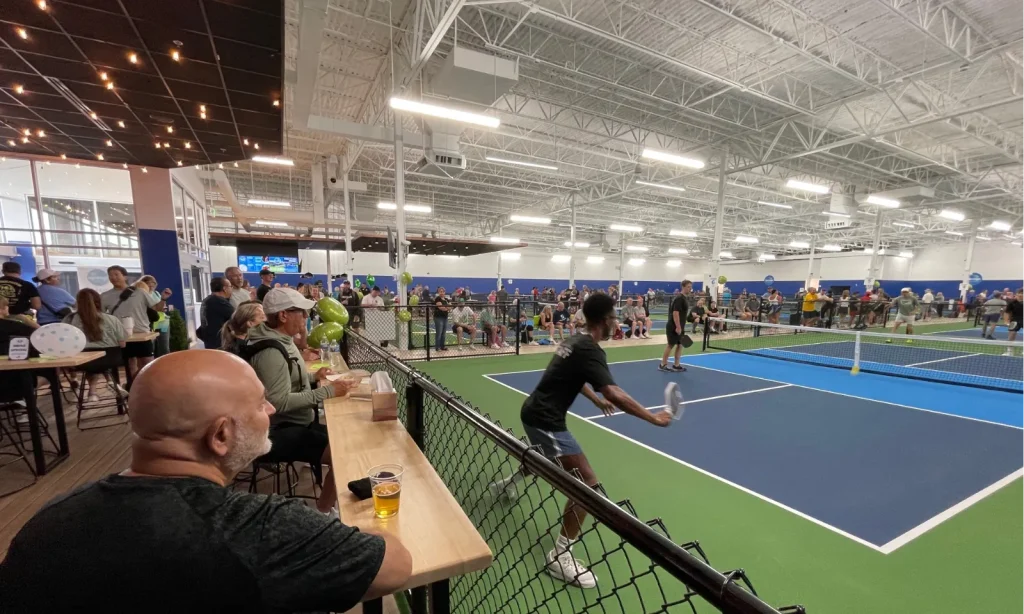
Lighting is typically the second- or third-largest operating expense for an indoor pickleball facility, behind rent and staffing. On a 10-court indoor facility running 14 hours a day, the difference between always-on full output and a well-configured control system is roughly $8,000 to $15,000 annually in electricity alone, before accounting for utility demand charges or extended fixture life from reduced run-time. Outdoor HOA and municipal courts face a different cost: complaints, fines, and mandated shutdowns when lights run past curfew or spill onto residential property.
The operational problems that controls solve are equally important:
A pre-commissioned wireless control system addresses every one of these problems at install, not through post-install reconfiguration. Our complete guide to pickleball court lighting covers the fixture specification side of the problem; this guide covers the controls layer that sits on top.
Commissioning is the on-site programming and configuration step that turns a pile of lighting controls hardware into a working system. Traditional commissioning requires a qualified commissioning agent on site with a laptop and the manufacturer’s software, walking each sensor node, addressing it to a specific zone, testing coverage, programming scenes, and debugging connectivity issues. On a 10-court pickleball facility, traditional commissioning takes 2 to 4 days of specialized labor, typically adding 15 to 25 percent to the controls portion of the project budget. It is also the step most likely to produce post-install issues when nodes get placed wrong, scenes get mis-programmed, or wireless coverage proves inadequate.
Pre-commissioning moves the configuration work off the job site and into the design and manufacturing process. For a pickleball facility project, the workflow is:
Engineering begins with a lighting analysis zone map showing the facility floor plan, court layout, and fixture positions. Zones are drawn on the map: typically one zone per court plus zones for common areas, restrooms, circulation, and entry. Each fixture is mapped to the sensor node that will control it. The map becomes the single source of truth for how the system is configured, and it ships with the installation package so the installer and the operator both have it.
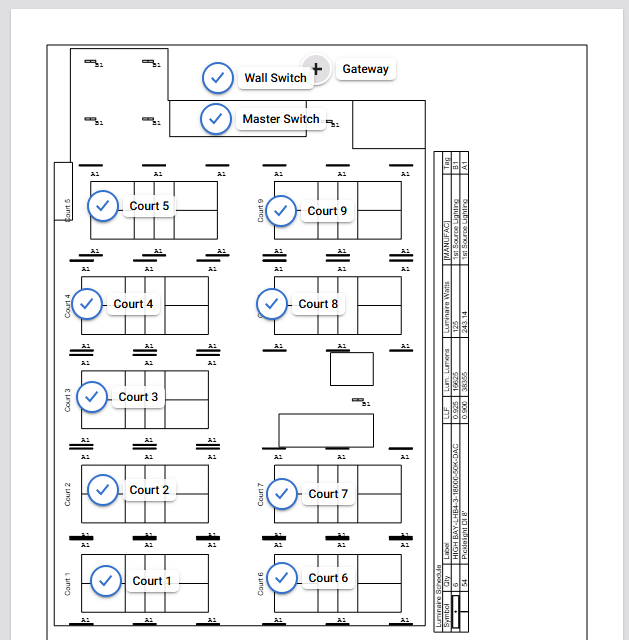
Every sensor node is bagged individually and labeled with its zone and court location before shipping. When the installer opens the box on site, there is no addressing, no node-to-fixture matching, and no guessing. The bag labeled “Court 4, Southwest Fixture” goes where the zone map says it goes. An electrician without controls specialization can install the entire sensor network by following the labels. This eliminates the commissioning agent visit and compresses the install timeline from days to hours.
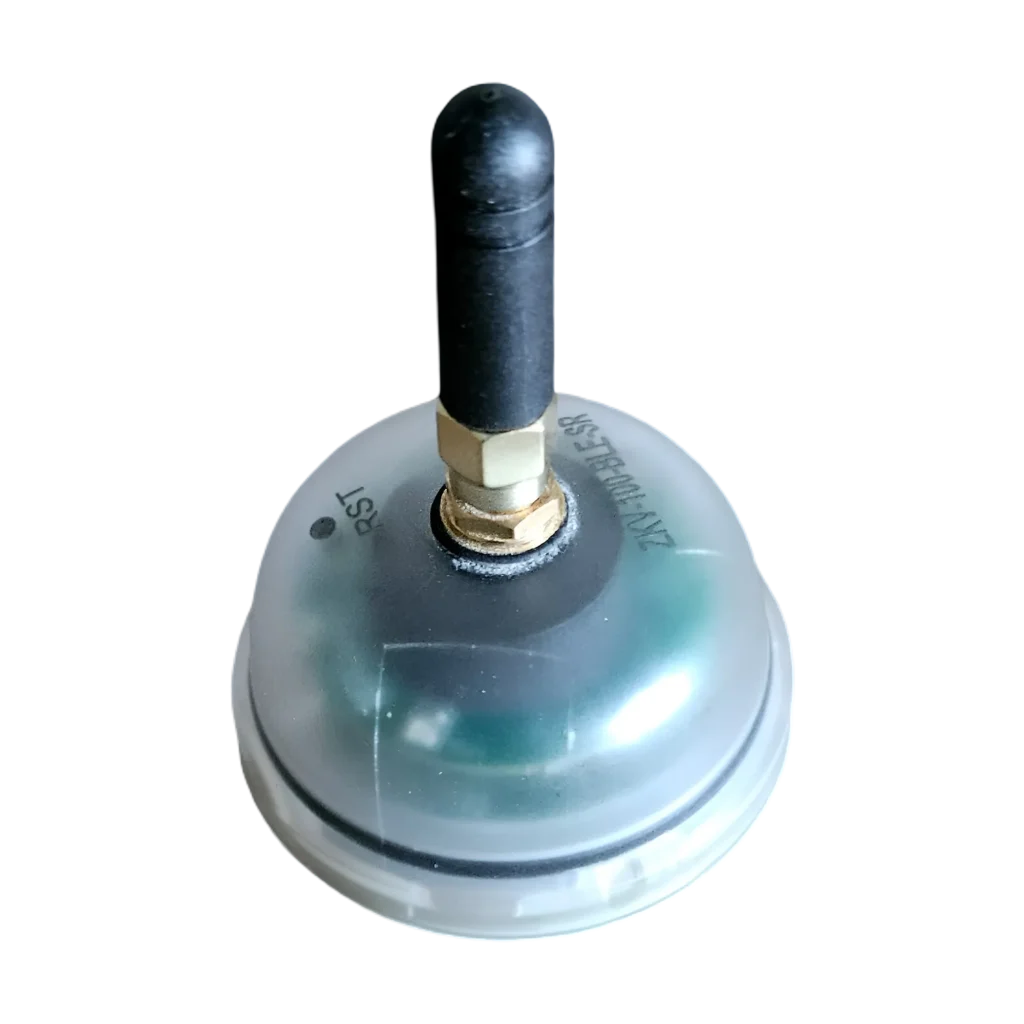
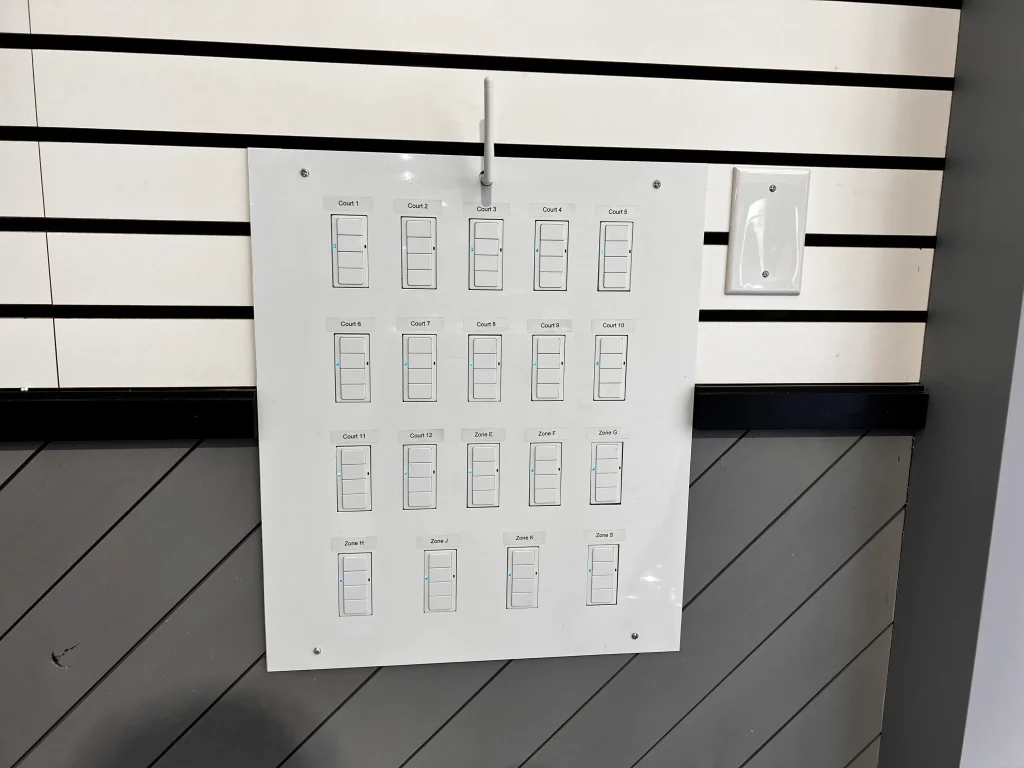
The system ships with a wall switch box that houses 4-button wireless switches configured for scene selection. Front-desk or court-side staff press one button to change from league mode to open-play mode to drill-and-warmup mode, or to turn off a specific court zone. The box includes a custom faceplate that calls out each court or zone by name, so staff do not need training to operate the system. A built-in wireless range extender ensures connectivity reliability across the facility, eliminating the dead-zone troubleshooting that plagues unaugmented mesh installations.
Because the system ships pre-configured, the facility operator walks into an operational control system the day power comes on. No learning curve, no commissioning delay, no “we’ll finish the programming next week.” Fixtures pair to their mapped nodes automatically, the gateway comes online, the scenes work, and the reservation integration connects. This is why pre-commissioning is the fastest-growing approach in commercial lighting controls and why customers who have lived through traditional commissioning on a previous project refuse to go back. The approach is described in more depth in our commercial wireless lighting controls guide, and our mwConnect control products are available in our lighting controls category.
Bluetooth SIG Mesh is the commercial-grade mesh networking protocol standardized by the Bluetooth Special Interest Group specifically for commercial and industrial applications. It differs meaningfully from the Bluetooth found in consumer devices: SIG Mesh is designed for many-to-many device communication, self-healing network topology, commercial security standards, and reliable performance across hundreds of devices in a single facility. It is the dominant protocol for commercial mesh lighting in 2026.
For pickleball facilities, the practical advantage is that the entire control network operates wirelessly over the existing power infrastructure. No low-voltage control cabling, no new conduit runs, no cable tray additions, no dedicated low-voltage distribution closet. The implications for each facility type:
Self-healing mesh topology is the reliability story. If one node fails or is blocked, mesh traffic automatically routes around it through adjacent nodes. There is no single point of failure at the network level. For facility operators accustomed to wired control systems that go down when one run gets damaged during a floor refinish or HVAC service, the reliability improvement is substantial.
The operational layer of a pickleball controls system is built around two concepts: granular court-level addressing and scene-based operation.
Every court is an independently addressable zone. The system can run Court 1 at 100 percent for a league match, Courts 2 and 3 at 75 percent for open play, Courts 4 through 6 at 50 percent for a drills clinic, and Courts 7 through 10 at zero percent because they are not booked. The energy savings math is simple: an unused court at zero spend represents the single largest controls-driven savings line item, typically 20 to 40 percent of total facility lighting energy over a year depending on utilization patterns.
Occupancy or vacancy sensing at the court zone level automates the unused-court case. When a court sits idle for a configured time window, the system dims to standby or turns off entirely. When a player enters for pickup play or a reservation activates, lights ramp up automatically.
Full Category II output is not needed for all play types, and specifying distinct scenes matched to use type reduces both energy use and apparent source brightness during lower-intensity sessions:
Scene changes happen through the wall switch box (one button press), through the gateway interface, or automatically through the reservation system integration described below. Staff do not need to know which fixtures are affected, which dimming level each scene represents, or how to program the system. They press “Open Play” and the facility runs in open play configuration.
The gateway is the cloud-connected device that brings the mesh network onto the broader internet. Its role is twofold: remote management for facility owners and operators, and API integration with external systems like court reservation platforms.
Through the gateway, a facility owner can check lighting status, adjust scenes, verify curfew compliance, and troubleshoot issues from a smartphone or laptop anywhere in the world. For facility owners with multiple locations, a single gateway interface can manage controls across all of them, providing consolidated visibility and the ability to roll out scene changes or schedule updates across a portfolio. For absent-owner operations, the remote management capability means a problem at 9:00 PM does not require driving to the facility; it requires opening an app and adjusting a setting.
Pickleball facilities increasingly run on dedicated court reservation platforms including CourtReserve and PodPlay, which handle booking, payment, membership management, and scheduling. The gateway’s API connectivity lets the lighting controls subscribe to reservation events from these platforms, creating automatic behaviors:
The result is a facility where lighting matches reservations automatically, front-desk staff do not manage lights, and energy spend tracks actual utilization rather than operating hours. For facilities integrating with other platforms, the API-based approach means most modern reservation software can be supported; the CourtReserve and PodPlay integrations are the most common today, with additional platforms added as the reservation software market matures.
Outdoor controls use the same pre-commissioning process, same Bluetooth SIG Mesh protocol, and same gateway architecture as indoor. The sensor nodes used in outdoor installations are IP-rated waterproof for direct weather exposure, and the installation and operational experience is identical to indoor from the facility operator’s perspective. The environment-specific capabilities that matter for HOA, municipal, and park pickleball installations are:
HOA and municipal ordinances commonly require outdoor court lighting to shut off at 10:00 PM, 9:00 PM in some residential-adjacent zones, or earlier by agreement. Manual enforcement depends on someone being at the facility every night to flip a switch, which is unreliable and creates complaint risk every time it fails. Automated curfew through the controls system enforces shutdown at the configured time every day, with override capability for sanctioned events that have variance approval. Complaints and fines associated with curfew violations effectively go to zero.
Outdoor sensor nodes can tie to photocells for true dusk-to-dawn operation, turning lights on at calculated astronomical dusk rather than by fixed clock schedule (which drifts across seasons), and turning them off at curfew or dawn. This eliminates the winter-vs-summer schedule mismatch that produces either wasted operation in summer or missed turn-on in winter.
Outdoor controls integrate with dimming capability to support dark-sky and light-trespass compliance strategies. During late-evening hours near curfew, output can be reduced to minimize any property-line spill in residential-adjacent zones, supporting International Dark Sky Association-modeled ordinance compliance without sacrificing evening playability during the primary operating window. For facilities where spill complaints have been an issue, the ability to dim the side of the facility facing the complaining property during sensitive hours is a pragmatic operational tool.
For municipal parks departments and HOA boards managing outdoor courts as part of a broader facility portfolio, remote gateway access lets a single administrator verify that courts are operating within approved hours, troubleshoot issues without site visits, and respond to complaints with documented operating logs. Our outdoor pickleball lighting category includes fixtures designed for integration with these controls, and the controls category covers both indoor and outdoor sensor node options.
Traditional wired controls on a 10-court pickleball facility typically add 2 to 4 weeks to the construction timeline for cable pulls, panel work, and on-site commissioning. Pre-commissioned wireless controls add 3 to 5 days for fixture installation, node placement by zone map, gateway commissioning, and integration testing. The schedule delta is usually the difference between opening before or after a targeted league season or tournament.
Installation proceeds in a straightforward sequence:
Day one of operation is day one of full functionality. There is no commissioning lag, no “we’ll finish programming next week,” and no controls-related issues waiting to surface. For facility operators who have managed traditional controls projects, this is the most consistently praised aspect of the pre-commissioned approach.
The financial case for pickleball facility controls combines energy savings (30 to 60 percent additional reduction on top of LED baseline), labor savings (no front-desk time managing lights), maintenance savings (lower run-time extends fixture life), and complaint avoidance (automated curfew compliance). For a typical 10-court indoor facility, simple payback on the controls portion of the project is 2 to 4 years counting energy alone, and 1 to 2 years when utility rebates are coordinated. Outdoor municipal and HOA facilities typically see similar or faster paybacks driven by the elimination of curfew-violation fines and manual operations costs.
Retrofit timing for existing facilities is worth noting. Many legacy pickleball installations ran without meaningful controls, and retrofitting pre-commissioned wireless controls onto existing LED fixtures is a common scope. The wireless approach is particularly suited to retrofit because it avoids new cabling through existing structure, and pairs cleanly with other retrofit scope like the fluorescent-to-LED conversions covered in our warehouse LED conversion guide.
Pickleball facility lighting controls follow the same commercial wireless lighting control principles that apply across commercial facilities. For broader context on commercial lighting control systems, see our lighting control systems guide and our commercial wireless lighting controls guide. For the complete commercial LED specification process that integrates controls with fixture selection and certifications, see our commercial LED buyer’s guide.
Bluetooth SIG Mesh is the commercial mesh networking protocol standardized by the Bluetooth Special Interest Group for commercial and industrial applications. It differs from consumer Bluetooth in supporting many-to-many device communication, self-healing network topology, commercial security, and reliable performance across hundreds of devices. For pickleball facilities, SIG Mesh enables wireless control of every court, every fixture, and every sensor without pulling new low-voltage cable. Self-healing mesh topology means the network continues operating if individual nodes fail or are obstructed, routing traffic around the failure automatically.
Yes. Wireless Bluetooth SIG Mesh controls install without any new low-voltage cabling. Sensor nodes mount at fixture locations using the existing power supply, the gateway connects to facility internet over Wi-Fi or ethernet, and the wall switch box installs at any convenient location. This is the single biggest advantage of wireless controls for retrofit scenarios: warehouse conversions, gym conversions, and outdoor municipal facilities can add full facility controls without opening structure to run cable.
Through gateway API connectivity. The controls gateway subscribes to reservation events from platforms including CourtReserve and PodPlay, and automatically adjusts court lighting based on booking activity. Courts ramp up before a reservation starts, hold at the appropriate scene during the reservation, and drop to idle after the reservation ends. No front-desk intervention is required. API-based integration supports additional reservation platforms as the market evolves.
Yes, outdoor sensor nodes are IP-rated waterproof for direct weather exposure, but the control protocol, gateway, and operational experience are identical to indoor. The same pre-commissioning process (zone map, individually bagged and labeled nodes, wall switch box with faceplate) applies. Indoor and outdoor courts at a single facility integrate into one control system, managed from one gateway.
Pre-commissioning is the process of performing all system configuration, zone mapping, and sensor-to-fixture addressing before hardware ships to the job site. Sensor nodes arrive individually bagged and labeled by location; the installer places them according to the zone map, and the system self-configures when powered on. Pre-commissioning eliminates the 2 to 4 days of on-site commissioning agent labor typical of traditional controls projects, compresses install timeline, and delivers a fully operational control system on day one of facility opening. It also eliminates the post-install configuration errors that are the most common source of controls-related issues.
Yes. Gateway-based cloud connectivity lets an operator manage controls across multiple facilities from a single interface, regardless of geographic distribution. Multi-site facility chains, municipal parks departments managing multiple park locations, and franchise operations use this capability for consolidated monitoring, centralized scene configuration updates, and remote troubleshooting.
1st Source Lighting manufactures commercial LED fixtures in Auburn, California and partners with mwConnect for Bluetooth SIG Mesh commercial lighting controls. For pickleball facility projects we provide free photometric design, lighting analysis zone mapping, pre-commissioned sensor node kits with individually bagged and labeled nodes, wall switch boxes with custom court-labeled faceplates and built-in range extenders, gateway hardware with API integration to major court reservation platforms, and commissioning-free installation that delivers operational controls on day one. Our fixtures and controls qualify for DesignLights Consortium (DLC) utility rebates, BAA and BABA compliance for federal, state, and municipal grant-funded projects, and 5 to 10 year commercial warranties apply.
Lighting controls are the difference between a pickleball facility that operates profitably and one where energy costs, manual operations burden, and curfew complaints erode the business model. Pre-commissioned wireless controls eliminate the traditional commissioning cost and schedule risk, deliver court-level energy management, integrate with the court reservation systems facility operators already use, and support the same plug-and-play installation experience indoor or outdoor. 1st Source Lighting provides free photometric and zone-map design, pre-commissioned mwConnect Bluetooth SIG Mesh control systems, DLC-listed fixtures and controls for utility rebate eligibility, BAA and BABA compliant documentation, and engineering support for dedicated facilities, gym conversions, warehouse conversions, and outdoor municipal and HOA pickleball installations nationwide.