
Building a commercial pickleball facility is a $500,000 to $5,000,000 decision that touches zoning, engineering, construction sequencing, regulatory compliance, neighbor relations, capital finance, and ongoing operations. First-time owners and operators frequently encounter the complexity mid-project, at the point where site selection or permitting reveals constraints that should have shaped decisions two phases earlier. The difference between facilities that open on schedule and operate profitably and those that run over budget, miss opening dates, or face operational restrictions after launch usually traces back to decisions made before the first shovel hit dirt. This guide is adapted from a piece 1st Source Lighting originally contributed to the International Association of Pickleball & Padel Facilities (IAPPF) magazine, substantially expanded with the practical detail that first-time owners most often tell us they wish they had known earlier.
Commercial pickleball facility construction follows a predictable sequence: market analysis and site selection, facility type decision (indoor dedicated, outdoor dedicated, or conversion), architect and design team partnership, project budgeting and financing, permitting and regulatory compliance, contractor sourcing through RFP, lighting plan integration, construction sequencing with the critical rule of installing overhead lighting before court surfaces go down, controls and reservation systems, coordinated noise and lighting mitigation, and opening through ongoing operations. Typical timelines run 4 to 12 weeks for indoor conversions after approvals and 2 to 6 months for outdoor facilities. Budget ranges from $30,000 to $80,000 per outdoor court installed and $150 to $400 per square foot for indoor dedicated facilities, with controls, acoustic mitigation, and operations infrastructure as distinct scope lines that often surprise first-time owners.
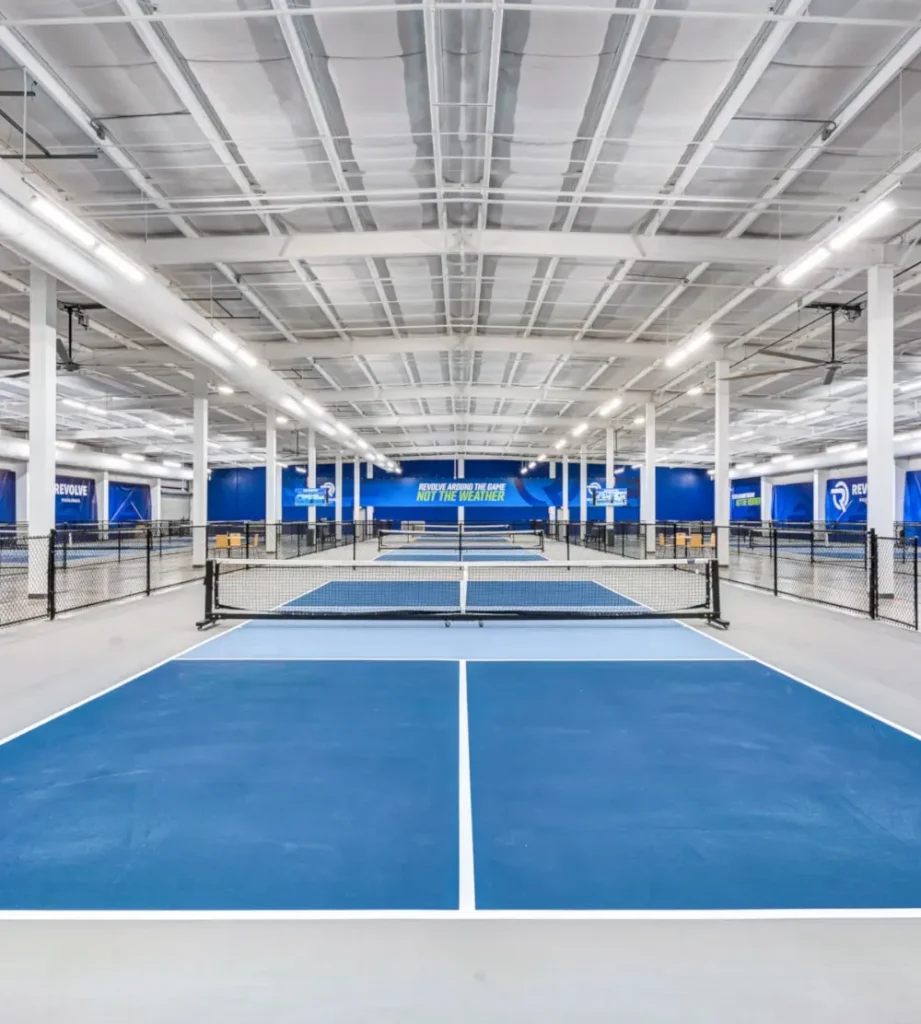
Location selection ranks as the single most important early decision because it determines every downstream constraint: capital cost, permitting complexity, neighbor relations, market demand, and long-term operational profitability. A site that saves 15 percent on acquisition cost but adds 60 percent to permitting and community-engagement scope is not a savings.
Pickleball participation reached 24.3 million American players in 2025 per Sports & Fitness Industry Association data, with year-over-year participation growth of 22.8 percent and three-year growth of 171.8 percent. This is the fastest-growing sport in the United States, but growth distribution is uneven. Sunbelt, East Coast, West Coast, and Great Lakes markets are more developed than Midwest and Mountain West; some metro areas are approaching court saturation for current demand, while others remain substantially underserved. Before site selection, work through:
Once the target market is defined, evaluate candidate sites against:
Complete a formal site walk with an experienced architect or owner’s representative before committing. The wrinkles revealed by a thoughtful two-hour walk (unexpected easements, utility location conflicts, floor slope that complicates surfacing, ceiling obstructions that preclude optimal fixture positioning) are cheap to resolve at site selection and expensive to resolve mid-construction.
The facility type decision shapes every downstream specification. The four common configurations have substantially different capital profiles, operating economics, and long-term business characteristics.
| Facility type | Typical per-court capital (installed) | Operating characteristics | Common applications |
|---|---|---|---|
| Outdoor dedicated courts | $30,000 to $80,000 per court | Weather-dependent, 6 to 9 month prime operating season in most climates, lower build cost | Municipal parks, HOA amenity, recreational clubs, budget-constrained markets |
| Indoor ground-up dedicated | $150 to $400 per sq ft of facility; $80,000 to $200,000+ per court all-in | Year-round operation, highest premium market, longest construction timeline | Premium club, destination facility, high-density metro |
| Indoor warehouse/retail conversion | $40 to $100 per sq ft; $50,000 to $150,000 per court all-in | Year-round, faster to market, constrained by existing structure | Fastest-growing segment, club and league focus, metropolitan gap-filling |
| Gymnasium conversion | $20 to $60 per sq ft; $30,000 to $80,000 per court all-in | Often multi-sport shared use, institutional setting, lowest capital | YMCA, schools, community recreation, campus facilities |
Warehouse and retail conversions represent the fastest-growing segment of commercial pickleball construction by unit count, driven by speed to market and the availability of suitable existing structures. A 40,000 square foot warehouse can open with 8 to 12 courts in 6 to 12 months from signed lease, compared to 18 to 36 months for ground-up dedicated construction. Conversion economics also benefit from existing electrical service, HVAC capacity, and structural shell, though each of these requires verification against pickleball operating requirements. Our warehouse LED conversion guide covers the lighting retrofit portion of conversion projects specifically.
Outdoor dedicated facilities dominate municipal and HOA segments. Weather seasonality and neighbor-impact management are the primary trade-offs against lower capital cost. For the full outdoor specification framework, see our outdoor pickleball court lighting guide.
Engaging an experienced architect early ranks as the single most leveraged decision in the buildout process. The architect is the coordinator who ensures that lighting, surfacing, HVAC, acoustic, structural, and code scope all resolve into one integrated design rather than competing for resolution mid-construction.
Engage the architect during or immediately after site selection, before site purchase commitment if possible. An experienced sports facility architect will identify site-specific constraints (ceiling heights, span widths, floor leveling, utility locations, zoning considerations) that affect whether the site is viable for the intended facility type. This pre-commitment site analysis routinely saves owners from buying sites that cannot economically support their facility vision.
The architect coordinates, but specialized consultants are routinely engaged for specific scopes:
The architect’s coordination role is what justifies their fee, typically 6 to 12 percent of construction cost for full-service architectural engagement on a commercial sports facility project. Attempting to coordinate these specialists directly as an owner usually adds more cost through scope gaps and rework than the architect fee saves.
Realistic financial modeling before committing capital separates facilities that reach profitability from those that run into capital-raise complications mid-build or cash-flow issues post-opening.
A complete pickleball facility capital budget includes:
Commercial pickleball facility financing typically combines several sources:
Profitability depends on five interlocking variables:
Lighting quality directly affects member retention through several mechanisms: poor glare control drives evening play complaints, inadequate footcandles limit evening utilization, flicker causes fatigue and headaches, and lack of dimming precludes the scene flexibility that differentiates premium facilities from budget operations. The operational savings from LED plus controls typically pays for itself in 2 to 4 years; the retention benefit compounds indefinitely.
Permitting is the single most common source of schedule slippage on pickleball facility projects. Jurisdictions have become increasingly attentive to outdoor pickleball applications specifically due to noise and light complaint patterns from earlier projects, and some municipalities have adopted pickleball-specific ordinance language. Plan for permitting to take 3 to 9 months depending on jurisdiction complexity and project type.
Commercial lighting energy codes apply to pickleball facilities and enforce Lighting Power Density limits, controls requirements, and efficacy minimums. The codes in force vary by state:
LED lighting with proper controls easily meets current energy codes; the specification question is which LED approach and controls architecture fits the facility, not whether LED applies. Our ultimate footcandle lighting guide covers the foundational footcandle framework that underlies compliance calculations.
Most jurisdictions impose numerical or qualitative limits on noise and light at property lines. Typical limits:
Submitting photometric and acoustic analyses with the permit application significantly accelerates review. Jurisdictions that would otherwise require lengthy discretionary review often approve projects quickly when complete compliance documentation accompanies the initial submittal. Our pickleball court noise reduction guide and outdoor pickleball court lighting guide cover the specification detail for both vectors.
Sourcing the right general contractor and subcontractors is often the most friction-laden phase of facility buildout. Pickleball-experienced contractors remain relatively rare outside mature pickleball markets, and generalist commercial contractors without pickleball experience can miss specification details that cost money to correct post-install.
The single most effective sourcing strategy is networking with operators of existing pickleball and padel facilities, particularly those built within the last 24 months. Ask who delivered reliable work on time and within budget, what went well, what did not, and who they would hire again. Industry associations including American Sports Builders Association maintain lists of certified sports facility builders who specialize in court construction.
For formal procurement, an RFP that solicits competitive bids should specify:
Best-value evaluation scoring performance, total cost of ownership, and vendor support capability routinely produces better outcomes than pure lowest-bid selection on pickleball projects. Bidders who propose aggressive prices by substituting non-sports-specific fixtures or skipping photometric design typically generate rework, complaints, and operational issues that exceed the bid savings.
Lighting specification integrates with facility design, not after it. The sequence of lighting decisions that should happen during the architect’s design phase, before contractor selection:
Define target footcandle levels (Category I, II, or III), uniformity requirements, vertical illuminance targets, CCT preference, and CRI minimums. Commercial pickleball facilities typically specify Category II at 50 fc average for competitive and league play, Category III at 30 fc for recreational, with Category I considered for tournament-hosting facilities. The full framework is covered in our complete guide to pickleball court lighting.
Indoor ceilings below 30 feet generally require direct-indirect fixtures or perimeter-mounted linear fixtures to avoid the zonal cone of luminance glare that direct UFO high bays produce on lob play. Outdoor facilities use pole-mounted sports optics with cutoff distributions for dark-sky and trespass compliance. More lumens does not mean better play; lighting quality (uniformity, diffusion, absence of hot spots) consistently outperforms raw quantity for player experience. Our indoor pickleball lighting category and outdoor pickleball lighting category include fixtures engineered specifically for pickleball court sports.
A stamped photometric design shows fixture placement, aiming, expected footcandle levels across the Primary Playing Area, uniformity ratios, and property-line spill calculations. Many commercial lighting manufacturers including 1st Source Lighting provide photometric design as a free service on commercial projects. Submit photometric plans with permit applications to accelerate review.
Controls decisions should happen during lighting specification, not as an afterthought. Modern commercial pickleball facilities use wireless Bluetooth SIG Mesh control systems with court-level dimming, scheduled curfew enforcement, and API integration with court reservation platforms. Tiered dimming allows 100 percent output for sanctioned tournaments, 75 to 80 percent for open play, and 50 to 60 percent for drills and casual drop-in, trimming energy without sacrificing experience. Pre-commissioned systems eliminate on-site commissioning labor entirely. Our pickleball facility lighting controls guide covers the full architecture including reservation software integration.
Lighting is one of the most technically demanding components of pickleball facility construction. For a systematic approach to specifying commercial LED fixtures that meet pickleball-specific requirements alongside broader commercial lighting standards, see our commercial LED lighting buyer’s guide. For the foundational concepts, see our footcandle guide for illumination standards.
Construction timelines vary widely based on permitting pace, supply chain, equipment lead times, and contractor availability:
One sequencing decision materially affects both budget and schedule on every pickleball facility project: install overhead lighting fixtures before the final court surface goes down. Low-impact sport surfaces popular with pickleball players can be damaged by the lifts and equipment needed to reach overhead fixtures after floor installation. The alternative is extensive floor protection (plywood overlay, plastic sheeting, delicate lift paths) that adds labor cost and extends schedule. Early fixture install eliminates these costs entirely.
This decision should be locked during initial project planning so that fixture lead times align with pre-surface construction phases. Typical LED pickleball fixture lead times run 6 to 12 weeks, so fixture order needs to happen before interior construction reaches the overhead phase, not after. Controls hardware follows similar lead times and should be ordered with fixtures.
Modern commercial pickleball facilities integrate lighting controls with reservation platforms, access control systems, and facility management software. Treating these as separate scope silos produces operational friction and missed efficiency opportunities.
The integrated operations layer typically includes:
Wireless Bluetooth SIG Mesh controls avoid pulling new low-voltage cabling through structure, which reduces electrical contractor scope and speeds conversion timelines. Pre-commissioned systems with individually bagged, zone-mapped sensor nodes eliminate on-site commissioning labor entirely. Our commercial wireless lighting controls guide covers the control protocol tradeoffs in detail. For pickleball facility-specific controls including reservation integration and outdoor curfew automation, see our pickleball facility lighting controls guide and lighting controls category.
Outdoor pickleball facilities face two parallel neighbor-complaint vectors: light trespass and noise. Commercial facility specifications that address only one frequently fail neighbor scrutiny on the other. Coordinated planning for both during the design phase is the current commercial standard.
Full-cutoff luminaires with house-side shielding keep spill below property-line limits (typically 0.1 to 1.0 fc). Dark-sky compliance per International Dark Sky Association-modeled ordinances caps uplight at 1 percent of fixture output. Automated lighting curfew enforced through the controls system eliminates the manual-operation failures that drive complaints.
Pickleball paddle impact generates disproportionate complaints due to frequency content (1,000 to 2,000 Hz, where human hearing is most sensitive), rhythmic burst patterns, and long daily operating hours. Mitigation combines setbacks (100 to 150+ feet from residential property lines), acoustic barrier fencing (8 to 10 feet tall, 15 to 25 dBA reduction), USA Pickleball Quiet Category paddle policies, scheduled quiet hours aligned to lighting curfew, and vegetative buffers. Specialized systems including acoustic glass fencing have become preferred specification for facilities balancing acoustic performance with aesthetic quality.
Engage acoustic consultants and lighting designers simultaneously during the design phase. Photometric plans and acoustic analyses should be developed against the same site survey with cross-review for interactions (tall acoustic barriers affect lighting aiming; fixture pole heights affect acoustic line-of-sight). Our pickleball court noise reduction guide and outdoor pickleball court lighting guide cover the full specification detail for both vectors.
Launch is the beginning of the operation, not the end of the project. Facilities that open well develop operational patterns that drive long-term profitability; facilities that rush through launch often struggle to recover from first-90-day missteps.
First-facility operators routinely encounter:
Mature facility operation optimizes continuously around utilization, retention, energy cost, and member satisfaction. Lighting controls data (provided by gateway-connected systems) shows which courts run which scenes at which hours, enabling data-driven decisions about programming, pricing, and operational scheduling. Reservation platform analytics show utilization patterns that can inform facility expansion or contraction decisions.
Patterns from first-time owner experiences, compiled from consultations and post-opening diagnostics:
Treating lighting as a commodity. Budget fixtures without photometric design typically produce 10 to 20 percent below target footcandle, uniformity failures, and glare complaints. The savings versus proper specification are usually 10 to 20 percent of fixture cost; the cost of rework and reputation damage easily exceeds this.
Installing lighting after court surface. Surface damage during fixture install, extensive floor protection costs, or rework. This mistake appears in roughly one in four first-time conversions.
Ignoring acoustic mitigation until post-opening complaints. Retrofitting acoustic barriers, paddle policies, and operational changes after neighbor complaints start is substantially more expensive than planning for both noise and light during design.
Under-budgeting controls. Treating controls as an afterthought or specifying “just dimming” without full controls architecture. Controls typically pay back in 2 to 4 years through energy savings alone, with additional operational and retention benefits.
Skipping peer reference checks on contractors. Generalist commercial contractors without pickleball experience routinely miss specification details. Peer networking with operators of recently-opened facilities is the most effective contractor sourcing approach.
Inadequate pre-opening operational rehearsal. Launching without staff trained on controls, reservation systems, and incident response produces preventable complaints in the first 30 days that affect initial reputation.
Confusing fixture count with lighting quality. More fixtures at inadequate specification produces worse results than fewer correctly-specified fixtures. Photometric design backed by appropriate fixture optics is what delivers Category II or III performance, not pole count or wattage totals.
Indoor warehouse or retail conversions typically open 4 to 12 weeks after permit approval, with total timelines of 6 to 12 months from signed lease to opening. Indoor ground-up dedicated facilities take 9 to 18 months from groundbreak. Outdoor facilities take 2 to 6 months from permit approval. Permitting itself commonly adds 3 to 9 months before construction starts, depending on jurisdiction complexity, zoning work required, and whether noise and light analyses accompany the initial submittal.
Per-court installed cost ranges: outdoor dedicated $30,000 to $80,000 per court, indoor ground-up dedicated $80,000 to $200,000+ per court (typically $150-$400 per square foot of facility), indoor warehouse conversion $50,000 to $150,000 per court ($40-$100 per square foot), gymnasium conversion $30,000 to $80,000 per court. Total project costs for 8 to 12 court facilities commonly run $500,000 to $5 million or more depending on type, location, and amenity level. Add 10 to 15 percent contingency to hard costs, plus soft costs (architecture, engineering, permits, legal, pre-opening capital).
Typical permit requirements include zoning verification or variance, site plan approval, building permit, electrical permit, photometric submittal for lighting, acoustic analysis for sites with residential adjacency, and architectural review (HOA or some municipal). Some jurisdictions now require specific noise analysis for pickleball applications. Submit complete compliance documentation with the initial permit application to accelerate review; incomplete submittals drive the longest review cycles.
The most effective approach is peer networking with operators of recently-opened facilities in your market, asking who delivered reliable work on time and within budget. Industry associations including the American Sports Builders Association maintain lists of certified sports facility builders. RFPs should specify performance requirements (ASBA Category levels, DLC-qualified fixtures, photometric submittal), warranty minimums (5-10 years commercial), and evaluation criteria weighted toward best value rather than lowest bid.
Site selection ranks first because every downstream constraint (capital cost, permitting complexity, neighbor relations, market demand, long-term profitability) traces back to location. Engaging an experienced sports facility architect before site purchase commitment prevents buying sites that cannot economically support the intended facility. The architect identifies site-specific constraints (span widths, ceiling heights, utility locations, zoning, residential adjacency) that affect viability.
Lighting, every time. Low-impact sport surfaces popular with pickleball players can be damaged by the lifts and equipment needed to install overhead fixtures after flooring is in place. Installing overhead fixtures before the court surface is down eliminates floor protection costs and schedule extensions. Fixture lead times of 6 to 12 weeks mean the fixture order needs to happen before interior construction reaches the overhead phase.
1st Source Lighting manufactures commercial LED fixtures in Auburn, California and provides free photometric design services for pickleball facility projects. For new construction and conversion projects we provide indoor direct-indirect fixtures engineered specifically for court sports, outdoor sports-optic fixtures with cutoff and backlight control for dark-sky compliance, pre-commissioned wireless lighting control systems with reservation platform API integration, DLC-listed fixtures for utility rebate eligibility, 5 to 10 year commercial warranties, and engineering support for specification, rebate coordination, and code compliance documentation. Our engineering team works alongside architects, general contractors, and facility owners through the full project lifecycle.
Building a commercial pickleball facility successfully means integrating every decision from site selection through ongoing operations into one coordinated plan. Lighting is one layer of the specification; controls, acoustic mitigation, and neighbor impact management are parallel layers that succeed or fail together. 1st Source Lighting provides free photometric design, commercial LED fixtures engineered for pickleball court sports (indoor direct-indirect and outdoor sports-optic), pre-commissioned wireless lighting control systems, DLC-listed fixtures for utility rebate eligibility, and engineering support for architects, general contractors, and facility owners through the full project lifecycle. Whether you are specifying a ground-up indoor club, a warehouse conversion, a multi-court outdoor municipal facility, or an HOA amenity, coordinated lighting integration during the design phase is the most leveraged decision you make.
Contact us for a free pickleball facility lighting consultation