
Smart wireless lighting controls have fundamentally changed how commercial buildings manage illumination, energy consumption, and occupant comfort. Where earlier generations of commercial lighting required extensive control wiring, dedicated dimmer switches, and manual zone management, today’s wireless systems let a facility manager adjust lighting across an entire building from a smartphone app, configure automated schedules for hundreds of zones, and track real-time energy consumption down to individual fixtures. This transformation is happening across warehouses, offices, manufacturing facilities, retail stores, healthcare buildings, and schools.
Smart wireless lighting controls for commercial buildings deliver energy savings of 30-70% beyond what LED fixtures alone provide, through automated occupancy sensing, daylight harvesting, scheduled dimming, and demand response participation. Wireless systems eliminate the cost and complexity of running dedicated control wiring, making them particularly well-suited to retrofits of existing fluorescent or HID installations. Modern wireless protocols including Bluetooth mesh, Zigbee, and manufacturer-specific wireless systems support hundreds of fixtures per network with minimal installation disruption. This guide explains how smart wireless controls work in commercial applications, the benefits they deliver, and considerations for specifying and implementing them.
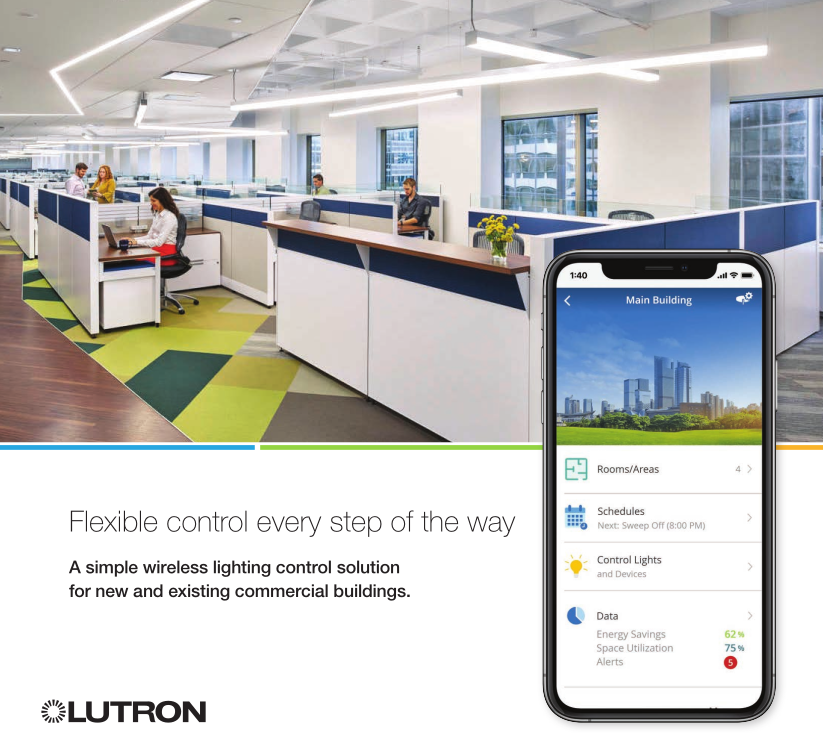
At the most basic level, wireless lighting controls replace traditional wall switches and wired dimmers with wireless devices that communicate over a radio network. That’s the mechanical description. The functional reality for commercial facility managers is much broader.
A modern smart wireless lighting control system typically includes:
Unlike wired systems where changing a zone layout typically requires pulling new control wiring, wireless systems support zone changes through software reconfiguration. A facility that rearranges its office floorplan can update the lighting control zones the same day, not schedule an electrician for rework.
The business case for smart wireless controls goes beyond “save energy.” For commercial facility operators, the benefits stack across multiple operational concerns.
Wireless controls layered on LED lighting typically deliver additional 30-50% energy savings beyond what the LEDs alone achieve. Occupancy sensing shuts off lights in unused zones. Daylight harvesting dims fixtures when windows and skylights provide sufficient ambient light. Scheduled dimming reduces output during predictable low-occupancy periods. For a commercial facility that already cut lighting energy in half by moving from fluorescent to LED, adding smart controls typically cuts the remainder again.
Wireless controls are particularly valuable for retrofits of existing facilities because they eliminate the need to pull new control wiring through finished ceilings, walls, and occupied spaces. A retrofit that would require weeks of conduit and wire work with a traditional wired control system can often install over a weekend with wireless devices. For occupied commercial facilities, the reduced disruption is as valuable as the direct installation cost savings.
Modern energy codes including ASHRAE 90.1, California Title 24, and IECC 2021 mandate specific lighting control capabilities: automatic shutoff, occupancy sensing, daylight-responsive controls, and dimming in many space types. Retrofitting older facilities to meet current code with wired controls is often cost-prohibitive. Wireless controls make code compliance achievable as part of routine lighting upgrades rather than a separate capital project.
Many commercial utilities offer substantial rebates specifically for networked lighting control systems, often layered on top of the rebates available for LED fixtures themselves. The DesignLights Consortium’s Networked Lighting Controls Qualified Products List is the standard reference for rebate eligibility. Properly specified wireless controls often qualify for rebates that cover a meaningful portion of the total installed system cost.
Commercial facilities change over time. Offices rearrange. Retail spaces reconfigure. Warehouses expand or repurpose zones. Wired control systems force expensive electrical work for each change. Wireless systems let facility managers update zones, schedules, and control assignments through software, often in minutes rather than days.
Networked wireless systems generate data that legacy lighting never could: occupancy patterns, energy consumption by zone, fixture health status, maintenance alerts. For facility managers, this visibility transforms lighting from an invisible infrastructure cost into a managed asset with measurable performance. Mapping occupancy data across a facility often reveals underutilized spaces that can be consolidated or repurposed, creating value beyond the lighting savings themselves.
Beyond operational benefits, smart wireless controls improve the experience of the people using the space. Automated lighting responds to occupancy without requiring manual switching. Daylight-responsive dimming maintains consistent illumination as natural light varies. Tunable-white fixtures can shift color temperature throughout the day to support circadian rhythm. Individual workspace controls give office workers influence over their personal environment, which studies consistently link to improved productivity and satisfaction.
Different wireless protocols have different strengths. Commercial specifiers generally encounter several options, each with specific advantages for different facility types and scales.
Bluetooth mesh is the most common wireless protocol for commercial lighting controls at the building-level scale. Fixtures communicate directly with each other through a self-forming mesh network, with each fixture acting as both an endpoint and a relay. This allows Bluetooth mesh systems to cover large facilities (hundreds of fixtures, multi-building campuses) without requiring dedicated controllers or access points throughout. 1st Source Lighting stocks the Wireless Bluetooth SIG Mesh Gateway designed by our partner mwConnect, a Sacramento-based American manufacturer specializing in commercial and industrial Bluetooth mesh lighting controls.
Zigbee is another mesh networking protocol common in commercial lighting controls. It operates on different radio frequencies than Bluetooth mesh and typically requires dedicated Zigbee hubs or bridges. Zigbee has been widely adopted in commercial lighting controls from several major manufacturers.
Lutron’s Clear Connect is a proprietary wireless protocol operating on an uncongested RF band specifically optimized for lighting control. It forms the foundation of Lutron’s Vive wireless lighting control system, which is widely deployed across commercial buildings, educational facilities, healthcare, and retail applications. 1st Source Lighting offers factory-integrated Lutron Vive connectivity as an alternative to Bluetooth mesh, particularly well-suited to projects where the specifier or facility already standardizes on the Lutron Vive ecosystem. Vive supports push-button association, scales from a single space to an entire campus, and integrates with building management systems through BACnet. For commercial projects in the Lutron ecosystem, specifying fixtures with factory-installed Vive connectivity eliminates field commissioning complexity.
Several lighting control manufacturers use proprietary wireless protocols optimized for specific performance characteristics. These proprietary systems sometimes offer advantages in signal reliability, commissioning ease, or integration with the manufacturer’s complete product ecosystem, but they create vendor lock-in that can constrain future expansion or mixed-vendor projects.
Some commercial lighting controls connect directly to existing Wi-Fi infrastructure. This can simplify deployment in facilities with robust Wi-Fi but creates more load on the IT network and depends on Wi-Fi reliability for lighting operation. Wi-Fi-based systems work well for smaller commercial spaces (single-floor offices, retail stores) where the existing network can handle the additional traffic.
For larger commercial facilities with existing DALI wired controls, hybrid systems use wireless gateways to connect DALI zones without running dedicated control wiring across the facility. This approach combines the granular control of DALI within zones with the installation flexibility of wireless between zones. It’s increasingly common for multi-building campuses and large industrial facilities.
Our complete guide to lighting control systems covers these protocols and their tradeoffs in more technical depth, including DALI, 0-10V dimming, and the components of a complete commercial control system.
Wireless lighting controls benefit every commercial facility type, but the specific benefits and ideal configurations vary by application.
Warehouses gain some of the largest percentage savings from wireless controls. Most warehouse space is occupied intermittently, with specific aisles active only when pickers or forklifts are present. Occupancy sensors that dim unused aisles to 10-20% output (rather than shutting off completely for safety) typically cut lighting energy by 60-80% beyond the savings from LED fixtures. For a warehouse already running LED high bay lighting, wireless occupancy controls can be the difference between a 2-year and a 5-year payback on the total retrofit.
Office environments benefit from occupancy sensing in private offices, conference rooms, and restrooms where people enter and leave throughout the day. Daylight harvesting at perimeter workstations with window access reduces artificial lighting proportionally with available daylight. For commercial offices using LED panel lights or recessed troffers, networked wireless controls enable zone-by-zone management that matches lighting to actual usage patterns.
Classrooms, hallways, gymnasiums, and auditoriums in schools and universities have highly variable occupancy patterns. Wireless controls enable class-schedule-based automation (lights follow the bell schedule), occupancy-based automation for off-hours (after-school activities, evening events), and centralized scheduling across buildings on a campus. The combined effect typically reduces educational facility lighting energy by 40-60% compared to manual switching.
Retail operators use wireless controls to manage lighting differently during opening, operating, and closing hours. Higher-intensity display and accent lighting runs only during sales hours. Security-level lighting takes over overnight. Daylight harvesting at storefront areas reduces artificial lighting during bright days. Wireless systems make these time-based and occupancy-based strategies achievable without expensive control wiring through finished retail spaces.
Manufacturing plants benefit from zone-based control aligned to production schedules and shift patterns. Production lines get full illumination during active shifts and reduced lighting during changeovers, maintenance windows, and between shifts. Wireless controls also support rapid zone reconfiguration as production lines change, which is significantly more disruptive with wired systems.
Hospitals, clinics, and healthcare buildings use wireless controls to support both energy management and patient experience. Examination rooms get bright task lighting when occupied and dim to night mode when empty. Patient rooms include individual controls for occupant preference. Corridors support circadian lighting strategies that shift color temperature throughout the day to support healing.
For commercial specifiers planning a wireless control deployment, several decisions significantly affect both upfront cost and long-term value.
Wireless controls can be integrated into fixtures at the factory (fixture-integrated) or added to existing fixtures through retrofit modules. Factory-integrated controls offer tighter integration, cleaner aesthetics, and typically simpler commissioning. Retrofit controls preserve existing fixtures and are less expensive for upgrading recently-installed LED lighting to smart control. For new installations, factory-integrated is typically the better value; for retrofits of existing LED fixtures, retrofit modules are often more cost-effective.
Wireless control networks can be standalone (purpose-built for lighting) or integrated with existing IT infrastructure. Standalone networks avoid loading IT systems with lighting traffic but require dedicated hardware. Integrated networks simplify infrastructure but create dependencies that IT departments often resist. For most commercial deployments, a hybrid approach with a lighting-specific mesh network bridging to the IT network through a gateway is the current best practice.
Occupancy sensors need to cover the actual areas where people work, not theoretical whole-space areas. Daylight sensors need to be placed where they measure daylight the fixtures should respond to, not arbitrary points that may not correlate with actual workspace illumination. Proper sensor placement requires commercial experience and often photometric analysis. Sensors placed incorrectly can dim lights unpredictably or fail to capture the occupancy patterns the system is supposed to optimize.
Initial commissioning (assigning fixtures to zones, configuring schedules, calibrating sensor thresholds) determines how well the system performs in actual use. Properly commissioned systems deliver the energy savings in the specification; poorly commissioned systems deliver a fraction. Many commercial deployments benefit from manufacturer-assisted or factory-commissioned configurations where the system arrives pre-programmed for the specific facility layout.
Utility rebate programs for networked lighting controls are substantial but require specific documentation and DLC-listed products. Coordinating with your utility’s rebate program before finalizing the product selection ensures the specified fixtures and controls qualify for maximum available rebates. In many cases this coordination can cover 30-50% of system cost.
Smart lighting controls integrate with overall commercial LED specification decisions. For the complete workflow that positions controls alongside fixture selection, photometric design, and certification requirements, see our commercial LED lighting selection guide.
Beyond the technical specifications, several operational practices help commercial facilities extract maximum value from wireless control investments.
Smart wireless lighting controls are networked systems that let facility managers control commercial lighting remotely through wireless communication protocols like Bluetooth mesh or Zigbee. These systems typically include occupancy sensors, daylight sensors, wireless wall controls, and central management software. They automate lighting based on occupancy, daylight availability, and scheduled patterns, delivering substantial energy savings while improving occupant experience.
Wireless controls typically deliver 30-50% energy savings beyond what LED fixtures alone provide, through automatic occupancy sensing, daylight harvesting, and scheduled dimming. Applied to a commercial facility that already reduced lighting energy 50% by moving from fluorescent to LED, adding wireless controls typically cuts the remainder by another 30-50%. Total savings from combined LED plus smart controls usually reach 60-80% compared to legacy fluorescent or HID systems.
Yes, modern commercial wireless lighting control systems are highly reliable. Mesh networking protocols including Bluetooth mesh and Zigbee self-heal around individual device failures and provide redundant communication paths. Commercial wireless systems are deployed in mission-critical environments including hospitals, data centers, and 24/7 manufacturing facilities. Reliability depends on proper initial specification, appropriate wireless protocol for the facility size, and quality manufacturer products, not on wireless technology itself being less reliable than wired.
Wireless controls are particularly well-suited to retrofits because they eliminate the need to pull new control wiring through occupied commercial spaces. Retrofit control modules can be added to existing LED fixtures, or new LED fixtures with factory-integrated wireless controls can be installed as part of the retrofit. Many commercial wireless control retrofits complete over a weekend rather than the weeks that wired controls would require. For facilities with recent LED installations, retrofit wireless controls are often the most cost-effective upgrade.
The terms are often used interchangeably, but there’s a technical distinction. “Wireless lighting controls” specifically refers to the use of radio communication instead of control wiring. “Smart lighting” is a broader term that includes automated, networked, or app-controlled lighting regardless of whether the underlying communication is wired or wireless. Most smart commercial lighting systems today are wireless because wireless installation is significantly faster and less expensive, but the terms aren’t strictly equivalent.
Wireless controls work with LED fixtures and most dimmable fluorescent and HID fixtures, though compatibility varies by control system and fixture driver. Older fixtures without 0-10V or DALI dimming capability typically require fixture replacement or driver upgrades to support wireless controls. For commercial facilities considering wireless controls, verifying fixture compatibility with the chosen control system is an essential first step. Many commercial facilities combine fixture upgrades and wireless control installation in a single retrofit project for maximum efficiency.
Commercial wireless control devices typically carry warranties of 5-10 years and rated service lives of 10-15 years or longer. The wireless protocols themselves are stable standards that don’t become obsolete; devices continue to work as long as the hardware functions. Battery-powered sensors may require periodic battery replacement (typically 5-10 years depending on usage). The management software and gateway devices generally receive ongoing updates from manufacturers throughout the system’s operational life.
Commercial wireless lighting control systems use encryption and authentication protocols designed for network security. Bluetooth mesh and Zigbee both support strong encryption at the network level. The most common security risks come from poor operational practices (default passwords, no firmware updates, unsegmented networks) rather than from weaknesses in the wireless protocols themselves. Work with IT on gateway placement, network segmentation, password management, and firmware update schedules to maintain security over the system’s lifetime.
1st Source Lighting has been designing and manufacturing commercial and industrial LED fixtures since 1993. We integrate smart wireless lighting controls through multiple platforms, including factory-integrated Lutron Vive connectivity and Bluetooth mesh controls engineered by our partner mwConnect. This gives commercial specifiers flexibility to match the wireless control ecosystem to existing facility standards or specifier preferences. Our engineering team provides free photometric layouts for every project and can coordinate the lighting and controls specification together, including utility rebate documentation to maximize project value.
For commercial facility managers considering a lighting retrofit or new installation, we can help identify the right combination of fixtures and wireless controls for your specific application, facility size, and budget.