
K-12 school district gymnasium lighting retrofits are different from commercial retrofits in three meaningful ways: the procurement process involves more stakeholders and longer timelines, the funding pathways are specific to public education and federal infrastructure programs, and the operational priorities of school administrators differ from those of private facility operators. This guide is written for facility managers, athletic directors, business managers, and superintendents responsible for K-12 gymnasium lighting decisions. It covers the actual cost ranges school districts encounter, the five financial drivers that determine whether a retrofit pays back in two years or six years, the funding pathways available through federal infrastructure programs and state bond initiatives, and the procurement realities of school district decision-making. For product-level information, our commercial gymnasium lighting category is the primary reference.
K-12 school district gymnasium retrofits typically cost $40,000 to $400,000 depending on facility size, fixture count, controls integration, and floor protection scope. Total project payback in the two to four year range is achievable when all five financial drivers are modeled: direct lighting energy reduction, HVAC load reduction, maintenance elimination, integrated controls, and avoided floor damage during installation. Federal funding pathways including IIJA infrastructure funding, residual ESSER funds, and state facility bond programs frequently apply to K-12 gymnasium retrofits, and projects pursuing federal funding require BAA/BABA compliance documentation. Specifying engineering-grade fixtures matters even at constrained school district budgets because the cost of replacing inadequate fixtures (a second lift access cycle, second floor protection, second contractor mobilization) typically exceeds the capital savings of underspecifying the first time.
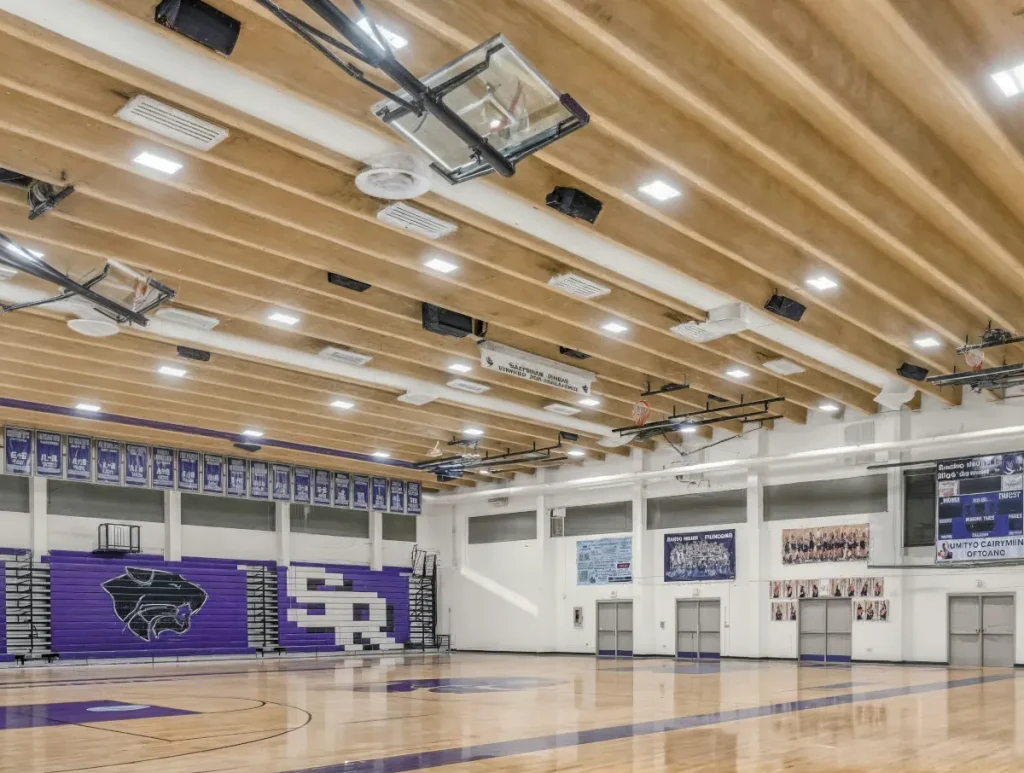
Total project cost for a K-12 gymnasium lighting retrofit varies more than most procurement guides acknowledge. The headline range we quote in conversations is $40,000 to $400,000, but that range covers two very different project types and the differences matter for budget planning.
Elementary multipurpose rooms typically range from 2,000 to 4,000 square feet with ceiling heights of 12 to 18 feet. The fixture choice is usually our High Lumen Troffer in lay-in configuration rather than hanging high bays, since the lower ceiling and finished drop ceiling do not accommodate suspended fixtures. Fixture count typically runs 12 to 24 troffers depending on room size and target footcandle level. Total project cost for elementary multipurpose retrofits typically lands in the $40,000 to $80,000 range including fixtures, controls, electrical work, and installation labor.
Middle and high school competition gymnasiums typically range from 6,000 to 10,000 square feet of playing surface with ceiling heights of 22 to 30 feet. The fixture choice is the Premium Gym High Bay in 125 to 200 watt configurations depending on ceiling height and target footcandle level. Fixture count typically runs 16 to 32 high bays for the main competition floor, with additional fixtures for adjacent multipurpose spaces, locker rooms, and back-of-house areas. Total project cost for high school competition gymnasium retrofits typically lands in the $150,000 to $400,000 range including fixtures, controls integration, electrical work, gym floor protection during installation, and installation labor.
Within those ranges, the specific cost of any individual project depends on:
Most school district payback calculations focus exclusively on direct lighting energy reduction, which produces conservative payback estimates of five to seven years. The complete payback picture includes five drivers, only one of which is direct energy savings. Modeling all five drivers typically produces payback estimates in the two to four year range for K-12 gymnasium retrofits.
Replacing 6-lamp T8 fluorescent fixtures (typically 192 to 216 watts including ballast losses) with our 125 to 150 watt Premium Gym High Bay LED fixtures delivers approximately 50% reduction in direct lighting power consumption at the same or improved light levels. Metal halide replacements (rare in current K-12 installations but still present in older facilities) show even larger reductions, typically 65% to 85%. Annual energy savings from this driver alone typically run $1,500 to $5,000 per gymnasium depending on fixture count, run hours, and local electricity rates.
Lower fixture wattage means lower BTU heat output, which reduces the cooling load on the gymnasium HVAC system. The relationship is direct: every watt of lighting energy not consumed is a watt of heat the HVAC system does not need to remove. In southern climate districts and in large-volume gymnasiums where summer cooling represents a significant operating cost, HVAC load reduction can match or exceed direct lighting savings. Annual HVAC savings from this driver typically run $500 to $3,000 per gymnasium depending on climate zone and building envelope.
This is structurally the most important financial driver for many school districts. LED fixtures rated for 100,000+ hours L70 eliminate the routine relamping cycle that fluorescent and metal halide installations require every two to five years. The labor cost of accessing fixtures at gymnasium heights, including lift rental, electrician labor, scheduling around the school calendar, and gymnasium floor protection during access, frequently exceeds the cost of the lamps themselves. For a typical high school gymnasium with 20 to 30 fixtures running 60 to 80 hours a week year-round, eliminated maintenance saves $2,000 to $5,000 per year, with the savings concentrated in years three, six, nine, and twelve when relamping cycles would otherwise occur.
Occupancy sensors, scheduled dimming, and zoned controls reduce energy consumption beyond what the fixture wattage alone delivers, AND extend fixture lifespan by reducing total run hours. A K-12 gymnasium actively used six hours per day during the school year, plus additional hours for athletic events and community use, can dim to 20% output during low-occupancy periods, capturing an additional 30% to 50% energy reduction on top of the LED retrofit baseline. Annual savings from this driver typically run $1,000 to $4,000 per gymnasium when properly integrated with district scheduling systems.
Our TruBlu Mesh wireless lighting controls integrate with the Premium Gym High Bay without additional wiring, eliminating the conduit and wire pulling that traditional 0-10V control systems require. This is operationally important for retrofits because adding control wiring to an existing gymnasium is significantly more expensive than installing controls in new construction.
This is not a savings line in the traditional sense. It is an avoided cost. Gymnasium floor refinishing costs for a high school competition gymnasium typically run $20,000 to $80,000, and improper lift access during a lighting retrofit can cause floor damage requiring partial or full refinishing. We have seen retrofit projects where the floor refinishing cost exceeded the lighting upgrade cost by a significant margin because the contractor used the wrong lift type or inadequate floor coverings. Specifying proper floor protection up front (with engineered protection mats, appropriate lift specifications, and coordinated scheduling) prevents this catastrophic outcome and is included in our standard project specifications.
Total annual savings from a complete K-12 gymnasium retrofit typically run $5,000 to $15,000 per gymnasium when all five drivers are modeled, plus the avoided floor damage cost. For a $200,000 high school competition gymnasium retrofit, the resulting payback period typically lands in the two to four year range. School district business managers running energy-only payback calculations consistently underestimate payback duration because they miss the maintenance, HVAC, controls, and avoided-damage drivers that often produce more financial value than direct energy savings alone.
K-12 school districts have access to funding pathways that private facility operators do not. Several of these pathways have specific compliance requirements (notably BAA/BABA for federal funds) that must be addressed in fixture selection and procurement documentation.
Most states administer facility bond programs that provide capital funding for school district infrastructure projects, including gymnasium lighting retrofits. Bond program requirements vary by state but typically include energy efficiency standards, ADA compliance, and sometimes domestic content preferences. Bond program timelines are long (typically 18 to 36 months from initial proposal to project completion) and the procurement processes are formal. Districts pursuing bond funding for gymnasium lighting should begin documentation work 12 to 18 months before the planned project start.
The Infrastructure Investment and Jobs Act (IIJA) includes funding pathways that apply to K-12 facility infrastructure improvements, including energy efficiency upgrades. IIJA-funded projects require BAA/BABA compliance documentation for the manufactured products specified in the project. Our gymnasium fixtures are BAA / BABA compliant for federally-funded projects with final assembly in Auburn, California and domestic content meeting the 55% threshold required for BABA-compliant manufactured products.
Elementary and Secondary School Emergency Relief (ESSER) funds, originally appropriated during the COVID-19 response, included infrastructure improvement allowances. Most ESSER funds have been obligated, but some districts have residual ESSER funds that can be applied to facility infrastructure projects including gymnasium lighting retrofits if the district can demonstrate the project supports student health, safety, or learning outcomes. Documentation requirements are similar to other federal funding pathways. Districts with residual ESSER funds should consult their state education agency for current allowability guidance.
Many K-12 gymnasium retrofits are funded through district capital reserves, multi-year capital improvement plans, or operating budget allocations rather than external funding pathways. The advantage of internally-funded projects is faster timelines and simpler procurement processes; the disadvantage is that capital reserves are usually limited and competing with other facility priorities. For internally-funded projects, the five-driver payback model is the most useful tool for justifying the project to the school board.
Local utility programs offer rebates for commercial lighting retrofits in many service territories. Rebate amounts vary significantly by utility and program, and rebate-eligibility requirements typically focus on fixture efficacy and qualified product status. Districts pursuing utility rebates should contact their utility provider early in the project planning process to confirm rebate availability and required documentation. The rebate amount is typically not the deciding factor for whether a retrofit makes economic sense (the five-driver payback usually justifies the project regardless of rebate availability), but rebates do shorten payback periods when available.
School district projects funded through federal infrastructure programs require Buy American Act (BAA) and Build America, Buy America (BABA) Act compliance for the manufactured products specified in the project. The compliance requirements affect fixture selection and procurement documentation in specific ways.
BABA, established by the IIJA in 2021, requires that iron, steel, manufactured products, and construction materials used in federally-funded infrastructure projects be produced in the United States. For manufactured products including LED lighting fixtures, the requirement is that the cost of the components manufactured in the United States exceed 55% of the total cost of all components, and that final assembly occur in the United States.
BAA, the older statute that BABA built upon, applies to direct federal procurement and sets similar but distinct domestic content standards. Most federal funding pathways that affect K-12 facilities use BABA as the primary compliance framework, with BAA applicable to specific direct federal projects.
For a K-12 gymnasium retrofit funded through any federal pathway requiring BAA/BABA compliance, the procurement documentation typically includes:
Our gymnasium fixtures ship with this documentation available on request for any federally-funded project. Districts pursuing federal funding should request the compliance package early in the procurement process so that bid documentation can incorporate the required language up-front.
Many commercial LED fixtures are imported or assembled with significant foreign-manufactured component costs that exceed the BABA threshold. Districts pursuing federal funding should specifically verify BAA/BABA compliance with their selected fixture manufacturer rather than assuming compliance based on the manufacturer’s domestic presence. Our final assembly in Auburn, California and domestic component sourcing meet the BABA 55% threshold, which is one of the reasons our fixtures are appropriate for federally-funded K-12 projects.
School district procurement is more formal and involves more stakeholders than commercial procurement. Understanding the procurement process before starting a gymnasium lighting retrofit project saves significant time and prevents the most common project delays.
A typical K-12 gymnasium lighting retrofit involves:
From initial project identification to fixture installation, a K-12 gymnasium lighting retrofit typically takes 6 to 18 months. The phases are:
Federally-funded projects on the longer end of this range often add three to six months for grant compliance documentation and procurement officer review.
The bid documentation for a K-12 gymnasium lighting retrofit determines whether the district receives competitive bids that align with the project’s actual requirements or receives a wide range of unequal bids that complicate selection. Three documentation strategies improve bid quality:
First, include photometric performance requirements rather than just fixture wattage and lumen output. Requiring bidders to demonstrate that their proposed fixtures meet ANSI/IES RP-6-24 specifications including UGR limits, uniformity ratios, and CRI requirements forces apples-to-apples comparison rather than spec sheet shopping. For the engineering reasons UGR alone is necessary but not sufficient, see our deep dive on solving gymnasium glare.
Second, specify floor protection requirements explicitly. Bidders who do not include proper floor protection in their initial bid will quote lower than bidders who do, but the unprotected installation can cost more in the long run if the gym floor is damaged.
Third, require BAA/BABA compliance documentation from all bidders for federally-funded projects. This eliminates non-compliant bidders early in the process rather than discovering compliance gaps after contract award.
The temptation in K-12 procurement is to specify the cheapest fixture that meets minimum spec sheet requirements. The economics of this approach almost always work out worse than specifying engineering-grade fixtures up front, for three specific reasons.
If the initial retrofit specifies fixtures that fail to address direct-look discomfort (Zone of Illuminance Discomfort, or ZID) for the athletes using the gymnasium, the district will eventually face replacement decisions when player and parent complaints accumulate. The cost of replacing inadequate fixtures includes a second lift access cycle, a second floor protection cycle, a second contractor mobilization, and a second period of facility downtime. This second-cycle cost typically exceeds the capital savings of underspecifying the first time, and the district has lost three to five years of opportunity in the meantime.
Cheaper fixtures with poor optical distribution produce non-uniform light across the playing surface, which players experience as strobing during fast play. Uniformity problems can be partially mitigated by adding more fixtures (which adds capital and operating cost) but cannot be fully resolved without replacing the underperforming fixtures. Specifying fixtures with proper beam distribution from the start avoids the compounding cost of working around uniformity problems for the lifetime of the installation.
School district facility decisions are visible to parents, athletic boosters, community members, and the school board. A gymnasium lighting retrofit that produces complaints reflects on the facility manager, the business office, and the administration. Conversely, a retrofit that is broadly recognized as well-executed becomes a reference point that supports future facility investment requests. Specifying engineering-grade fixtures up front protects both the educational outcome and the district’s institutional reputation for capital project execution.
Total project cost for K-12 gymnasium lighting retrofits typically ranges from $40,000 for elementary multipurpose rooms to $400,000 for high school competition gymnasiums. The dominant cost variables are fixture quantity, controls integration scope, electrical work, gym floor protection, and installation labor. For a specific cost estimate, send us your facility dimensions and intended use and we can model the project scope.
From initial project identification to fixture installation typically takes 6 to 18 months for K-12 gymnasium retrofits. Federally-funded projects requiring BAA/BABA compliance documentation and grant procurement processes tend toward the longer end of the range. Internally-funded projects with capital reserves available can sometimes complete in 4 to 6 months if the district has prior experience with similar retrofits.
Yes. Our gymnasium product family is compliant with the Buy American Act (BAA) and Build America, Buy America (BABA) Act for federally-funded projects. Final assembly occurs in Auburn, California with domestic content meeting the 55% threshold required for BABA-compliant manufactured products. Compliance documentation is available on request for any federally-funded project.
Two to four years is the typical payback period for K-12 gymnasium retrofits when all five financial drivers are modeled (lighting energy, HVAC load reduction, maintenance elimination, integrated controls, and avoided floor damage). Energy-only payback calculations typically produce conservative estimates in the five to seven year range and underestimate the actual financial value of the retrofit. The five-driver model is the more accurate financial framework for school board presentations.
For straightforward fixture replacement with similar electrical configuration, an architect or MEP engineer may not be required. For retrofits involving controls integration, new electrical drops, or facility modifications, professional design services typically improve project outcomes and may be required by local jurisdiction. Districts unsure about professional services requirements should consult their AHJ early in the project planning process.
Most K-12 gymnasium retrofits are scheduled during summer break or seasonal off-periods because the facility is unusable during the work. Plan for one to three weeks of facility downtime depending on fixture count, electrical work, and controls integration scope. Districts running summer camps or year-round programming may require phased installations completing one section at a time rather than the whole gym at once.
Yes. The labor and lift access cost is largely the same whether the contractor is working on the main competition gym alone or also on adjacent multipurpose rooms, locker rooms, and back-of-house areas. Bundling auxiliary space retrofits with the main gymnasium project significantly reduces the per-fixture installation cost compared to a separate later project. The High Lumen Troffer is appropriate for low-ceiling auxiliary spaces; the Premium Gym High Bay covers main gymnasium and any high-ceiling auxiliary spaces.
If your gymnasium hosts basketball, volleyball, pickleball overlay, or other multi-sport applications, the fixture specification needs to address all sports the facility hosts using the higher-of-any-single-sport design rule. For details on multi-sport gymnasium design including color rendering for line visibility and vertical illuminance for ball tracking, see our guide on multi-sport gymnasium lighting design.
K-12 gymnasium lighting retrofits are substantial capital projects that affect athletic programs, facility operations, energy budgets, and institutional reputation simultaneously. The decisions you make during project scoping shape outcomes for the next decade or longer. Specifying engineering-grade fixtures up front, modeling the complete five-driver financial picture rather than energy-only payback, and identifying the right funding pathway early in the process are the three steps that separate well-executed retrofits from projects that produce ongoing maintenance issues and complaints.
We have worked with K-12 school districts across multiple states on gymnasium lighting projects ranging from elementary multipurpose rooms to high school competition gymnasiums. Send us your facility dimensions, ceiling height, intended use, and any federal or state funding pathway you are pursuing. We will prepare a free photometric layout showing the recommended fixture configuration, photometric performance verification, and project scope estimate appropriate for school board presentation.
For a deeper conversation about your specific district’s procurement process, funding pathway, or project timeline before requesting a layout, contact our engineering team directly. We have been doing this work since 1993 and we approach each district project with the procurement, technical, and operational considerations specific to K-12 facility decision-making.