
Glare is the most common complaint that lands on a facility manager’s desk after a gymnasium LED retrofit. Players cannot track lobs, referees report eye strain during long tournaments, and parents in the stands shield their eyes from overhead fixtures. The complaints almost always trace to the same root cause: the retrofit specified a fixture that meets a published glare metric but does not actually solve the visual experience problem in athletic environments. Solving gymnasium glare requires looking past spec sheet compliance to the engineering reality of what an athlete’s eye experiences when glancing directly into a fixture during play. This guide covers the limits of the standard glare metric (Unified Glare Rating, or UGR), introduces the concept that actually matters for athletic environments (Zone of Illuminance Discomfort, or ZID), explains the optical engineering that addresses ZID, and provides a practical diagnostic walkthrough for facilities experiencing player complaints. For product-level information on sports-engineered gymnasium fixtures, our commercial gymnasium lighting category is the definitive reference.
UGR is the published metric for indoor lighting glare. ANSI/IES RP-6-24 specifies UGR less than 22 for gymnasium use and less than 19 for broadcast applications. But UGR was developed for office and seated-observer environments, and it is gameable. A fixture can score acceptable UGR by manipulating fixture position, solid angle, and viewing assumptions, while still producing intense direct luminance from any LED diodes visible through the lens. Athletes do not view the fixture from a seated office position. They glance directly into the fixture while tracking a lob or a serve, and that direct-look experience is what we call the Zone of Illuminance Discomfort, or ZID. UGR does not measure ZID. The LBAT lens used in our gymnasium fixtures addresses ZID through large surface area and high lens diffusion factor, producing a uniformly luminous lens face during direct-look conditions rather than a cluster of bright LED point sources. The result is significantly easier on the eyes during active play, with diffusion characteristics comparable to T12 fluorescent and the efficacy of modern LED.
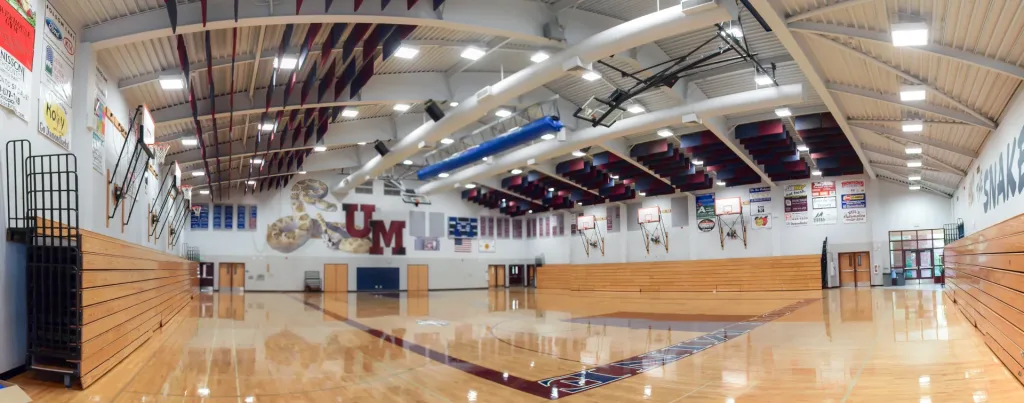
Most discussions of gymnasium lighting glare miss the most important distinction in the entire topic: the difference between illuminance and luminance. Footcandles, the unit you typically see on a fixture spec sheet, measure illuminance. Illuminance describes how much light is falling on a surface, like the gymnasium floor. Glare, by contrast, is a luminance phenomenon. Luminance describes how bright a source appears to the eye, measured in candelas per square meter. A 30,000-lumen fixture with a clear lens has dramatically higher luminance per square inch of fixture face than the same 30,000-lumen fixture with a high-diffusion lens, even though both deliver identical illuminance to the playing surface. This distinction matters because every published glare metric is fundamentally trying to predict luminance experience, and some metrics succeed at this better than others depending on how the observer actually uses their visual system.
The human eye responds to luminance contrast more than to absolute brightness. When a player on the court looks up to track a high lob, the eye briefly views the gymnasium ceiling and the fixtures hanging from it. If the fixture face has dramatically higher luminance than the surrounding ceiling, the contrast triggers a pupillary contraction response. The pupil narrows to protect the retina from the bright source. When the player’s gaze returns to the dimmer playing surface to follow the ball, the pupil takes one to several seconds to dilate again. During those seconds, ball-tracking visibility is genuinely impaired, not just uncomfortable. Repeat this cycle hundreds of times over the course of a basketball or volleyball game and players experience continuous low-grade visual degradation, fatigue, and the diffuse complaint of “the lights bother me.”
Generic warehouse LED high bays are engineered for a specific job: pushing maximum lumens straight down to illuminate forklift aisles. Three engineering choices that make sense for warehouses fail in gymnasium environments.
First, warehouse fixtures expose the LED diode array through a clear or no-lens design. Each diode acts as a near-point source of high luminance. Looking up at the fixture, the eye sees a cluster of intense bright spots rather than a uniformly bright fixture face. This is the worst possible visual presentation for athletic environments where players look up frequently.
Second, warehouse fixtures use narrow optical distributions calibrated for tall, narrow aisles. Apply that distribution to a rectangular court and the result is bright pools directly under each fixture and shadow zones between them. The non-uniform light distribution itself produces a strobing visual effect as players move through alternating bright and dim patches at speed.
Third, warehouse fixtures rarely include integrated impact protection. In a gymnasium, basketballs and volleyballs make regular contact with overhead fixtures. Without IK-rated lensing or integrated wire cages, fixtures shatter on impact, dropping fragments onto the playing surface and rendering the fixture inoperable. Even before a fixture fails outright, players on the court below subconsciously register the visual presence of an exposed LED array as a hazard, which compounds the discomfort the engineering produces.
Before we can discuss what actually matters for gymnasium lighting glare, we have to address the metric the industry has standardized on and explain why it falls short in athletic environments. Unified Glare Rating, or UGR, is the published metric for indoor lighting glare codified by the Illuminating Engineering Society. ANSI/IES RP-6-24 specifies UGR less than 22 for gymnasium use and less than 19 for broadcast applications. UGR is real, useful, and necessary. It is also incomplete, and an honest engineering discussion of gymnasium glare requires acknowledging where the metric falls short.
UGR values typically range from approximately 10 (negligible glare) to 30 (intolerable glare), with lower values representing less perceived glare. The metric is calculated using the luminance of each light source visible to the observer, the position of each source relative to the line of sight, the size of each source, and the background luminance of the surrounding space. The math is sound for what it measures. The problem is the assumptions baked into the calculation about who the observer is and how they are using their visual system.
UGR was developed for office and indoor commercial environments, where the observer is typically seated, looking horizontally with occasional upward glances, and viewing the lighting from typical room positions over extended periods. The calculation assumes a static observer at a typical seated viewing position. The “glare” the metric is trying to predict is the cumulative visual fatigue that develops over hours of office work, not the acute visual experience of an athlete looking directly into a fixture during play.
The first problem with UGR for gymnasium specification is that the metric can be optimized through engineering choices that improve the calculated value without significantly improving the actual visual experience. A fixture can score acceptable UGR through several paths:
Increasing the mounting height. UGR drops as the fixture moves further from the observer line of sight, so a fixture mounted at 30 feet will score better UGR than the same fixture at 18 feet, even though the actual visual experience for someone looking up at it has not changed proportionally.
Reducing the apparent solid angle. The metric considers the angular size of the source as visible to the observer. A fixture with a smaller visible face (even if the underlying LED array is unchanged) can score better UGR.
Manipulating the assumed observer position. UGR is calculated for a specific viewing position. Choose a position where the fixture is not in the typical line of sight and the calculated UGR drops, even though the fixture has not changed.
“Low glare” lensing. Some fixtures meet acceptable UGR specifications through polycarbonate or acrylic lenses that diffuse light somewhat but still allow individual LED diodes to be visible as bright points through the lens. The UGR calculation captures the average luminance of the lens face, not the peak luminance of the visible diode points. A fixture with “low glare” lensing can score UGR less than 22 while still producing intense direct luminance the moment an athlete looks directly into it.
The deeper problem is that UGR is designed for a use case that does not match athletic environments. Athletes are not seated office workers viewing fixtures from typical seated positions. They are dynamic. They look up frequently and at sharper angles than the UGR calculation assumes. They glance directly into fixtures while tracking a high lob, a serve, or a jump shot. They depend on rapid pupillary recovery to maintain visual lock on small fast-moving objects after looking back down.
A fixture configuration with acceptable UGR for a seated spectator may still cause significant complaints from players who depend on direct-look visual recovery for ball tracking. UGR is necessary but not sufficient for athletic environments. The gymnasium specification community has been treating UGR as a complete answer for too long, and the post-retrofit complaints we hear from facility managers are direct evidence of the gap.
What UGR misses is the experience an athlete has when glancing directly into a fixture during play. We call this the Zone of Illuminance Discomfort, or ZID. ZID is not a published metric. It is a description of a real engineering problem that has been hiding behind UGR compliance for years.
The Zone of Illuminance Discomfort is the visual experience an athlete has when their line of sight passes directly through a fixture during active play. UGR is calculated for occasional upward glances by a static observer. ZID is what happens when an athlete looks directly into the fixture face while tracking a ball, holding that direct-look orientation for the second or two it takes to complete the tracking task, and then needing to immediately recover visual lock on the small fast-moving object as it descends.
If the fixture face presents intense point-source luminance during that direct-look interval, the eye experiences pupillary contraction, brief retinal afterimage, and recovery delay. The athlete experiences this as glare even if the fixture’s published UGR value is well within specification. The recovery delay is what makes this an athletic-performance problem rather than just a comfort problem. A volleyball player who experiences a one-second visual recovery delay after looking into a fixture during a serve is missing the early descent of the ball, which is when set-up reads happen.
ZID is fundamentally driven by the luminance distribution across the fixture face. A fixture with discrete bright points (individual LED diodes visible through clear or low-diffusion lensing) produces severe ZID even at modest total fixture output, because the per-square-millimeter luminance at each visible diode is extremely high. A fixture with a uniformly luminous lens face (high diffusion factor across a large surface area) produces dramatically lower ZID at the same total output, because the same lumens are spread across a much larger emitting surface.
The diffusion factor of the fixture lens is the central engineering variable. Diffusion factor describes how thoroughly the lens material spreads point-source LED emission across the lens face. Old-school T12 fluorescent tubes had naturally high diffusion factor because the emission came from phosphor coating across the entire tube length. T8 fluorescent had slightly less diffusion because the tube diameter was smaller, concentrating the emission into a narrower line. Modern LED is the worst diffusion case if presented through clear lensing, because the emission comes from discrete chip-scale point sources rather than a distributed phosphor surface.
Many commercial LED fixtures marketed as “low glare” achieve their UGR compliance through polycarbonate or acrylic lenses that reduce the calculated UGR value but do not achieve high diffusion factor. These lenses scatter light enough to soften the apparent shape of the LED array from typical viewing angles, but when an athlete looks directly into the fixture, the individual diodes are still visible as bright points through the lens. UGR drops on paper. ZID stays painful. This is the engineering gap that drives the post-retrofit complaints we keep hearing about from facility managers who specified to UGR alone.
The LBAT lens used in our gymnasium fixtures is engineered specifically to address ZID. The acronym stands for Lens Beam Augmentation Technology, which is a fancy way to describe the actual engineering principle: large surface area combined with high lens diffusion factor. The technology was originally developed for our indoor pickleball line, where small fast-moving balls and high-arc lobs make ZID a critical photometric requirement. The gymnasium variant carries forward the same diffusion characteristics with a slightly narrower beam angle calibrated for typical gymnasium ceiling heights of 18 to 35 feet.
The LBAT lens material distributes the LED emission across the entire lens surface, so the eye sees a uniformly luminous lens face during direct-look conditions rather than a cluster of intense point sources. The diffusion factor is comparable to T12 fluorescent, where the lens face appears nearly uniformly bright with no visible discrete sources. The difference between LBAT and clear-lens or low-diffusion LED fixtures is immediately apparent when you stand under each fixture and look directly up. Clear-lens fixtures show the LED array as visible bright points behind the lens, even when the marketing copy describes the lensing as “low glare.” LBAT shows a soft uniform brightness across the entire lens with no point sources visible.
Diffusion typically comes at a cost. Heavy diffusion lensing in older fluorescent and HID systems reduced delivered output by 15% to 30% compared to clear-lens equivalents, because the diffusion process scatters light in directions that miss the intended target. The LBAT lens engineering keeps the diffusion factor high while maintaining the efficacy of modern LED, which is what makes the lens commercially viable for high-output gymnasium applications. The fixture delivers competition-class footcandle levels at the playing surface while maintaining T12-comparable diffusion at the lens face. T12 diffusion behavior with modern LED efficacy is the central engineering achievement.
The same diffusion that addresses ZID also produces a smoother light distribution at the floor level. Beam patterns from adjacent LBAT fixtures overlap evenly, eliminating the bright-pool-and-shadow pattern that warehouse fixtures and narrow-beam UFO fixtures create. Photometric measurements consistently show tight max-to-minimum uniformity ratios across the playing surface, typically meeting or exceeding the 2:1 to 2.5:1 ratios specified by ANSI/IES RP-6-24 for competition-tier indoor sports lighting. ZID-driven diffusion engineering and uniformity-driven distribution engineering are not separate problems. Both flow from the same lens design.
ANSI/IES RP-6-24, published in 2025 as the current version of the IES Recommended Practice for Sports and Recreational Area Lighting, is the controlling reference document for gymnasium lighting in the United States. The document specifies maintained horizontal illuminance, uniformity ratios, vertical illuminance, color rendering, and UGR limits for indoor sports facilities organized into four classes of play. The illuminance and uniformity specifications are sound and useful. The UGR specifications are a starting point that should be combined with direct-look ZID evaluation, not treated as a complete glare answer.
| Class | Application | Avg Maintained Horizontal fc | Max:Min Uniformity | UGR Limit |
|---|---|---|---|---|
| Class IV | Recreational and practice play | 30 fc | 3:1 | UGR < 25 |
| Class III | High school competition | 50 fc | 2.5:1 | UGR < 22 |
| Class II | College and tournament competition | 75 to 80 fc | 2:1 | UGR < 22 |
| Class I | Pro and broadcast | 100 to 125+ fc | 1.5:1 to 1.7:1 | UGR < 19 |
The pattern is straightforward: as the class of play moves toward broadcast and top-tier competition, both the illuminance requirements and the UGR limits become more stringent. NFHS facility guidelines align with the IES Class III recommendation for high school competition, and NCAA Best Lighting Practices reference Class II values for college competition. For multi-sport gymnasium facilities, the design target is the higher of any single sport’s requirements.
A fixture that meets the published UGR requirement for the intended class of play has cleared the necessary threshold for spec compliance. Whether the fixture also addresses ZID is a separate engineering question that requires direct-look evaluation, not just photometric calculation.
When complaints reach the facility manager, the practical question is which engineering element is actually causing the problem. Complaints described as “glare” can trace to fixture-level ZID, non-uniform light distribution, color rendering issues, or vertical illuminance shortfalls. Each requires a different remediation approach. Five practical diagnostic methods help identify the underlying cause before specifying a fix.
Stand on the court at a position where you would naturally look up to track a high lob. Look directly at the nearest fixture. Hold your gaze for two to three seconds. Note what you see and what your eye experiences. With a properly engineered LBAT fixture, the lens face appears as a uniformly bright soft surface. No individual LED diodes are visible. Your pupil does not contract sharply, and there is no afterimage when you look back down at the playing surface. With a generic warehouse fixture or a “low glare” lensed competitor fixture, you can see individual diode arrays as point sources of intense brightness, your pupil contracts noticeably, and there is a brief afterimage when you look away. The direct-look test is the most diagnostic single observation you can make. It captures ZID directly in a way that no UGR calculation can replicate.
Walk the playing surface from end to end with a basic light meter. Read horizontal footcandles at the brightest point (typically directly under a fixture) and at the dimmest point (typically the midway between two fixtures, or at corners). Calculate the max-to-minimum ratio. For Class III high school competition, the ratio should not exceed 2.5:1. For Class IV recreational, 3:1 is acceptable. Ratios of 4:1 or higher indicate the fixture spacing or the optical distribution is creating zones of inadequate light, even if the average footcandle level looks acceptable. The strobing effect players experience moving through alternating bright and dim zones often gets reported as glare even when the underlying issue is uniformity.
Have a player or coach toss balls in normal play patterns while you watch from courtside. Note the player’s facial expressions and tracking behavior. If the player squints when looking up to track a high arc, the issue is likely ZID. If the player tracks the ball through most of its arc but loses it near the peak, vertical illuminance at ball-tracking heights is inadequate. If the player tracks the ball cleanly but cannot find the line markings on serve return, color rendering or line visibility is the issue. The player’s actual visual experience is more diagnostic than any single number from a meter.
Stand directly under each fixture. Look up. Note what you see. With a properly engineered sports fixture using high-diffusion lensing, the lens face appears uniformly bright across the entire surface. Individual LED diodes are not visible. The brightness contrast between the fixture and the surrounding ceiling is moderate, not extreme. With a generic warehouse fixture or a competitor “low glare” fixture, you can see the individual diode arrays as point sources of intense brightness. If the diodes are visible as separate bright points behind the lens, the fixture is producing significant ZID regardless of any spec sheet UGR value.
Sometimes well-engineered fixtures are spaced poorly, creating uniformity problems that no fixture replacement will solve. Sometimes fixtures with good UGR specs but poor ZID are spaced well, producing acceptable photometric uniformity but causing direct-look discomfort during play. A complete diagnostic uses photometric verification for layout and uniformity issues combined with the direct-look test for ZID issues. Without both, retrofit decisions get made on incomplete information, and the second retrofit often costs more than the first because the fundamental diagnostic was wrong.
Facility managers who have inherited a glare problem from a previous retrofit have three practical paths forward, ranked by long-term effectiveness and capital cost.
Specifying the Premium Gym High Bay or equivalent LBAT-engineered fixture and replacing the existing inadequate fixtures is the most effective and longest-lasting solution. The new fixtures bring engineered high diffusion (addressing ZID directly), integrated impact protection, constant-current driver architecture for zero flicker, and tight color consistency standards across the installation. The 7-year limited warranty and 100,000+ hour rated life mean the replacement decision does not need to be revisited for decades. Capital cost is higher upfront, but the per-year cost across the fixture lifespan is typically lower than the alternative of repeated partial mitigations.
When the capital budget for full replacement does not yet exist, drop lens accessories provide partial ZID mitigation for existing round UFO high bay fixtures. The drop lens reduces the per-diode visible luminance by adding a diffusing layer between the LED array and the observer. This path is useful for facilities planning to replace fixtures during a future renovation cycle but needing immediate complaint reduction. Important caveat: drop lens accessories do not match the diffusion factor of LBAT-engineered lensing built into the fixture design. They reduce ZID rather than fully addressing it. They also do not address uniformity, color rendering, or impact protection failures common in generic UFO fixtures. Document the drop lens approach as a bridge rather than a final solution.
Whichever path you choose, verify the proposed fixture layout with a photometric model AND require a sample fixture for direct-look ZID evaluation under realistic conditions before committing capital. Photometric verification reveals whether the proposed fixture count and spacing will deliver the required maintained illuminance and uniformity. The direct-look evaluation reveals whether the fixture actually addresses ZID rather than just meeting UGR on paper. Both are necessary. We provide free photometric layouts for any commercial gymnasium project. Send us your facility dimensions, ceiling height, and intended use, and we will model the specific configuration for your court. We will also send a sample fixture if you want to verify the LBAT lens performance directly before specifying.
UGR less than 22 is the published threshold for general competition and recreational play in gymnasiums per ANSI/IES RP-6-24. It is necessary for spec compliance but not sufficient for athlete visual comfort. UGR is calculated for a static observer and does not measure ZID, the direct-look experience an athlete has when glancing into a fixture during play. A fixture meeting UGR less than 22 can still cause significant ZID-driven complaints if the lens has low diffusion factor and individual LED diodes remain visible through the lensing. Combine UGR compliance with direct-look ZID evaluation when specifying.
ZID stands for Zone of Illuminance Discomfort. It is the visual experience an athlete has when glancing directly into a fixture during play. ZID is not a published industry metric, because the industry has standardized on UGR despite the gap between UGR’s static-observer assumptions and the dynamic visual demands of athletic environments. We use ZID as a named concept because the engineering reality it describes is what facility managers actually experience as post-retrofit complaints. Calling it out by name lets specifiers ask the right questions before committing capital.
The most direct method is to request a sample fixture and run the direct-look test. Stand on a court or comparable space, look directly into the fixture face for two to three seconds the way you would when tracking a high lob, and observe what your eye experiences. A fixture engineered for athletic environments shows a uniformly bright lens face with no visible discrete sources, your pupil does not contract sharply, and there is no afterimage when you look away. A fixture meeting UGR specs through “low glare” lensing rather than true high diffusion will show visible LED diodes through the lens, your pupil will contract, and you will see an afterimage. The difference is immediate and unmistakable.
Fluorescent fixtures (especially T12 tubes) had naturally high diffusion factor because the light emission came from phosphor coating across the entire tube length, producing a uniformly luminous tube face. Modern LED is the worst diffusion case if presented through clear or low-diffusion lensing, because the emission comes from discrete chip-scale point sources rather than a distributed phosphor surface. When the LED retrofit specified a fixture with clear or “low glare” polycarbonate lensing rather than LBAT-equivalent high diffusion engineering, the much higher peak luminance at each visible diode produces ZID that the older fluorescent system did not. The fix is replacing the LED fixtures with engineered high-diffusion designs, not returning to fluorescent.
Heavy diffusion lensing in older fluorescent and HID systems reduced delivered output by 15% to 30% compared to clear-lens equivalents. The LBAT lens engineering achieves T12-comparable diffusion factor while maintaining the efficacy of modern LED, which is what makes the technology commercially viable for high-output gymnasium applications. The fixture delivers competition-class footcandle levels at the playing surface while maintaining diffusion characteristics at the lens face that fluorescent systems delivered at much lower efficacy.
Drop lens accessories are available for many round UFO high bay fixtures and provide partial ZID mitigation. They reduce per-diode visible luminance by adding a diffusing layer between the LED array and the observer. They do not match the diffusion factor of LBAT-engineered lensing built into the fixture design, and they do not address uniformity, color rendering, or impact protection issues. Drop lenses are useful as a bridge solution while planning a more complete retrofit, not as a permanent equivalent to fixtures engineered for athletic environments from the design stage.
Dimming reduces the absolute light output of the fixture, which lowers the peak luminance of each visible source proportionally. However, dimming a fixture from 30,000 lumens to 20,000 lumens does not change the fundamental diffusion factor of the lens or the visibility of individual LED diodes through the lensing. ZID scales with diode visibility and lens diffusion, not just total output. Dimming also creates a different problem: insufficient illuminance for the intended class of play. Dimming is not an effective solution to fixture-level ZID. It is sometimes useful as a temporary partial mitigation while planning a proper retrofit.
Solving gymnasium glare is fundamentally an engineering decision about lens diffusion factor and surface area. UGR compliance is necessary but not sufficient. The fixtures that actually solve athlete visual experience problems are the ones engineered to address ZID directly through high diffusion lensing across a large surface area, not the ones that meet UGR specs through clever fixture positioning or “low glare” polycarbonate lensing that still allows individual LED diodes to be visible.
Every gymnasium has different dimensions, ceiling heights, and intended use. The right fixture choice for your specific facility depends on factors that generic spec sheets cannot capture. Send us your facility dimensions, ceiling height, and the sports your gymnasium hosts, and we will model a free photometric layout showing exactly how a properly-specified gymnasium lighting system performs at every point on your playing surface, including UGR verification, uniformity ratios, vertical illuminance for ball tracking, and color rendering performance for multi-sport line visibility. We can also send a sample LBAT-engineered fixture so you can run the direct-look ZID test under realistic conditions before specifying.
No obligation. No quote until you ask for one. No pressure to specify our fixtures over alternatives. Just engineering work we know how to do, applied to your project specifics. For a deeper conversation about your facility before requesting a layout, contact our engineering team directly.