
Commercial and industrial lighting uses technical terminology that can confuse anyone new to the industry. This glossary defines the terms you’ll encounter when specifying, purchasing, or maintaining commercial LED lighting. Whether you’re a facility manager evaluating a retrofit, an architect specifying fixtures, or a business owner comparing quotes, understanding these terms helps you make informed decisions and avoid costly mistakes.
Common lighting terms every commercial specifier should know include lumens (total light output), lux and footcandles (illumination on a surface), Kelvin (color temperature), CRI (color rendering index), efficacy (lumens per watt), beam angle (light distribution), and certification marks like UL, CSA, DLC, and BAA. This guide covers these and dozens more commercial lighting terms in plain language, with practical context for when each term matters in real projects.
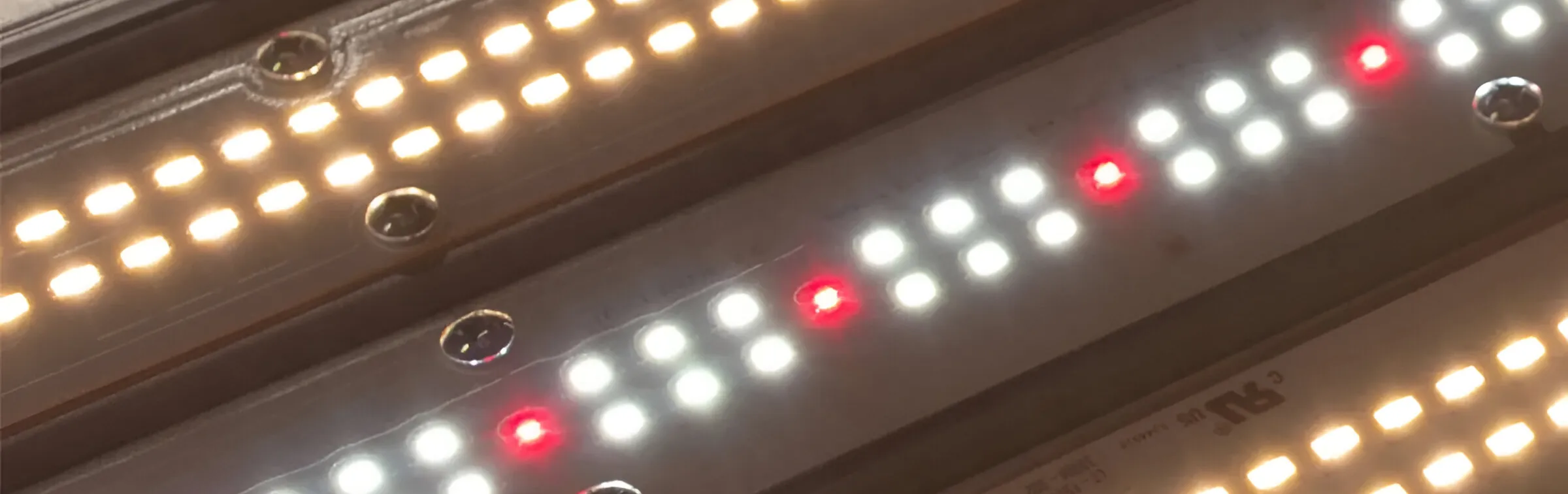
Understanding lighting terminology is essential for commercial specification. For practical application of these terms in the commercial LED selection process, see our step-by-step guide to choosing commercial LED lighting.
A lumen is the standard unit of measurement for the total amount of visible light emitted by a light source. Lumens indicate the brightness of a fixture, independent of how efficiently it produces that light. The higher the lumen output, the more light a fixture produces overall.
When comparing commercial fixtures, lumen output is the starting point for specification. A typical LED high bay might produce 12,000 to 44,000 lumens depending on wattage configuration. A standard 2×4 LED panel light produces 4,000 to 6,000 lumens for office applications. Understanding lumen output allows you to calculate whether a proposed fixture will deliver the illumination your space requires.
Lux measures illuminance, the amount of light falling on a surface, expressed as lumens per square meter. Lux indicates how brightly a specific surface is illuminated rather than how much light the source produces overall. Lux is the standard unit in most of the world. In the United States, footcandles are more commonly used for commercial applications.
A footcandle is the U.S. unit for illuminance, equal to one lumen per square foot. Commercial lighting specifications in the U.S. are typically given in footcandles at the work surface or floor. The Illuminating Engineering Society (IES) publishes recommended footcandle levels for every type of commercial space. Typical values include 20 fc for warehouse aisles, 40 fc for office desks, 50-75 fc for pickleball courts, and 100+ fc for precision inspection tasks. Our complete footcandle lighting guide covers IES recommendations for every common commercial application.
One footcandle equals approximately 10.76 lux. When comparing international and domestic specifications, it helps to know the conversion: 50 fc is roughly 540 lux.
Efficacy measures how efficiently a light source converts electrical power into visible light, expressed as lumens per watt (LPW). Higher efficacy means more light for less energy. Modern LED fixtures typically deliver 100-170+ LPW, compared to 80-100 LPW for fluorescent, 70-115 LPW for HID, and just 10-15 LPW for incandescent. Efficacy is the single most important metric when comparing the energy cost of different fixture options.
Illuminance is the amount of light falling on a surface, measured in lux or footcandles. Don’t confuse illuminance with luminance (the amount of light emitted or reflected from a surface) or luminous intensity (the amount of light emitted in a specific direction). For commercial lighting design, illuminance is the practical metric used to verify that a space has adequate light for the tasks performed there.
Kelvin (K) is the unit used to describe the color temperature of white light. Lower Kelvin values produce warmer, more yellow light. Higher Kelvin values produce cooler, more blue-white light. Understanding color temperature is essential for commercial specification because it affects how a space feels and how accurately colors appear.
| Color Temperature | Appearance | Common Commercial Applications |
|---|---|---|
| 2700K-3000K | Warm white, yellowish | Hospitality, restaurants, residential common areas |
| 3500K | Neutral warm | Retail, offices, hospitality accent |
| 4000K | Neutral white | Offices, classrooms, retail, general commercial |
| 5000K | Cool white, daylight-like | Warehouses, manufacturing, sports, cold storage |
| 6500K | Cool daylight | Inspection, medical, specialty industrial |
CRI measures how accurately a light source reveals the true colors of objects compared to natural daylight, on a scale from 0 to 100. Natural sunlight has a CRI of 100. Most commercial LED fixtures deliver 80+ CRI, which is adequate for general commercial applications. High-CRI fixtures (90+ CRI) are recommended for applications where accurate color perception matters: retail, healthcare, food preparation, quality inspection, broadcast and photography studios, and art galleries.
Low-CRI lighting (below 80) can make merchandise look washed out, skin tones appear unhealthy, and manufactured products appear differently from their intended finish. For commercial applications where color accuracy affects revenue or safety, specify high-CRI fixtures from the start.
CCT is the formal term for color temperature as perceived by humans. CCT and Kelvin are used interchangeably in most commercial contexts. When a fixture spec sheet lists “4000K CCT,” it means the fixture produces white light with a correlated color temperature of 4000 Kelvin.
Tunable white (also called color-tunable or CCT-adjustable) fixtures can shift their color temperature across a range, typically from 2700K to 5000K. This capability supports human-centric lighting designs where color temperature changes throughout the day to align with natural circadian rhythms: warm and dim in the morning, bright and cool at midday, warm and dim again in the evening.
Beam angle is the angular spread of light emitted from a fixture, measured in degrees. It’s defined as the angle at which the light intensity falls to 50% of the maximum output at the center of the beam. A narrow beam angle (10-25 degrees) concentrates light into a focused spot, ideal for accent lighting. A medium beam angle (25-60 degrees) balances coverage and intensity, common for general commercial spot lighting. A wide beam angle (60-120 degrees) spreads light over a larger area, typical of area lighting and ambient illumination.
Field angle is related to beam angle but measured at 10% of maximum intensity (rather than 50% for beam angle). Field angle is always wider than beam angle for the same fixture. Commercial specifications occasionally reference field angle when light falloff at the edges of coverage matters, such as for sports lighting uniformity calculations.
Distribution type describes how a fixture emits light. Direct fixtures send light downward toward the work surface. Indirect fixtures send light upward to reflect off the ceiling and create a diffuse, glare-free environment. Direct-indirect fixtures combine both, typically with 60% downlight and 40% uplight or similar ratios. Direct-indirect lighting is the preferred approach for high-ceiling commercial applications like pickleball courts, gymnasiums, and open offices because it minimizes glare while delivering effective task illumination.
IES distribution types describe the light output pattern of outdoor and area lighting fixtures, numbered I through V. Type I is narrow (used along walkways), Type II is along streets, Type III is for parking lots and large open areas, Type IV is asymmetric “forward throw” for walls or building perimeters, and Type V is circular, distributing light in all directions from a central point. Understanding these distributions helps specifiers match fixtures to the shape of the area being illuminated.
Wattage is the amount of electrical power a light source consumes, measured in watts (W). For LED fixtures, wattage no longer directly indicates brightness because efficacy varies widely. A 150W LED high bay can produce the same lumen output as a 400W metal halide fixture while consuming 62% less energy. When comparing fixtures, always compare lumens first (brightness) and wattage second (efficiency), not wattage alone.
Voltage specifies the electrical input required by a fixture. Commercial LED fixtures commonly accept universal voltage (120-277V) covering most North American commercial installations. Heavy industrial and some outdoor applications use 347V or 480V. Always confirm voltage compatibility with the facility’s electrical service before ordering fixtures, as mismatches require expensive step-down transformers or field modifications.
The driver is the electronic component that converts incoming AC power to the regulated DC current that LED modules require. Driver quality directly affects fixture performance, dimming behavior, flicker levels, and service life. Premium drivers (Advance, eldoLED/Osram, Tridonic) deliver flicker-free dimming, long service life, and consistent output across voltage fluctuations. Low-quality drivers are a primary cause of premature LED fixture failure.
Ballast is a term from fluorescent and HID lighting technology that refers to the electrical component that regulates current through the lamp. LED fixtures don’t use ballasts. They use drivers instead. When retrofitting a fluorescent fixture with LED tubes, understanding whether the LED tubes are “direct wire” (bypass existing ballast), “ballast-compatible” (work with existing ballast), or “hybrid” (work either way) is critical for installation.
Power factor is a ratio between 0 and 1 that measures how efficiently a fixture uses incoming electrical power. A power factor of 0.9 or higher is considered good and is typically required for utility rebates and DLC qualification. Lower power factors mean more reactive power consumption that doesn’t produce light, which utilities increasingly penalize through demand charges on commercial accounts.
THD measures how much a fixture distorts the AC power waveform. Commercial LED fixtures should have THD below 20% to avoid creating harmonic interference on the electrical system. High THD can cause problems with other equipment on the same circuits and may violate utility service agreements for large commercial facilities.
L-values describe the projected service life of an LED fixture based on lumen depreciation. L70 at 50,000 hours means the fixture will still produce 70% of its original light output after 50,000 hours of operation. L80 means 80% maintained, L90 means 90% maintained. LED fixtures don’t burn out like incandescent bulbs. Instead, they gradually dim over thousands of hours. The L-value and hours rating together describe when a fixture will need replacement to maintain design illumination levels.
L70 is the DLC qualification benchmark and the industry standard for general commercial applications. L80 or L90 ratings are preferred for critical environments like healthcare, inspection lines, and 24/7 production facilities where even modest lumen depreciation affects operations.
LM-80 and TM-21 are IES testing and projection standards. LM-80 is a testing protocol that measures lumen maintenance over at least 6,000 hours of LED operation at multiple temperatures. TM-21 is the mathematical method used to extrapolate LM-80 test data into long-term lumen maintenance projections (L70 at 50,000 hours, for example). When a manufacturer cites “L70 at 100,000 hours,” that projection comes from TM-21 calculations based on LM-80 test data.
Rated life is the total projected service life of a fixture, typically expressed as L70 hours. Commercial LED fixtures commonly carry rated lives of 50,000 to 100,000 hours. For a facility running lighting 10 hours per day, 100,000 hours equals roughly 27 years of service.
UL (Underwriters Laboratories) is the most widely recognized safety certification body for electrical products in the United States. A UL Listed fixture has been tested and verified to meet UL’s safety standards. Most commercial electrical codes and building inspectors require UL-listed fixtures (or equivalent from other accredited testing laboratories).
CSA (Canadian Standards Association) is a Nationally Recognized Testing Laboratory that certifies products for electrical safety. CSA Listed products meet Canadian safety standards. Products marked “cCSAus” are certified for use in both Canada and the United States. For North American commercial projects, CSA certification is functionally equivalent to UL Listed.
ETL is a certification mark from Intertek, a Nationally Recognized Testing Laboratory. ETL-listed products are tested to the same UL standards as UL Listed products. The main difference is the testing organization, not the safety requirements. ETL certification is accepted in virtually all commercial and municipal projects where UL certification would be accepted.
The DesignLights Consortium maintains the Qualified Products List (QPL) of commercial LED fixtures that meet specific efficacy, quality, and lifespan criteria. DLC qualification is required for most utility rebates on commercial LED retrofits. DLC Standard certification qualifies a product for basic rebates. DLC Premium certification (tighter efficacy and color quality requirements) qualifies for maximum rebate amounts. Always verify DLC status before finalizing a commercial lighting project budget because rebates can offset 30-50% of project cost.
The Buy American Act requires that federal projects use products manufactured domestically. For lighting, this means both that fixtures are assembled in the United States and that a minimum percentage of component cost comes from domestic sources. BAA compliance is required for U.S. federal projects including military, federal buildings, and some federally funded state projects.
BABA is a more recent domestic preference law that extends Buy American requirements to infrastructure projects funded by federal dollars, including many state, municipal, and educational projects. BABA requires stricter domestic content standards than BAA and applies to more products. For government-funded commercial projects, always verify that proposed fixtures meet BABA compliance.
TAA compliance allows products from designated “TAA-compliant countries” (typically U.S. trade partners) to be used on federal projects as alternatives to strictly domestic products. TAA is often referenced alongside BAA and BABA on federal project specifications.
RoHS restricts the use of specific hazardous materials (lead, mercury, cadmium, hexavalent chromium, and others) in electrical and electronic products. Originally a European Union directive, RoHS compliance is now effectively required for commercial lighting sold in most global markets.
IP rating is a two-digit code that describes a fixture’s resistance to dust and water intrusion. The first digit (0-6) describes dust resistance. The second digit (0-9) describes water resistance. Common ratings include IP20 (indoor office use), IP65 (outdoor and washdown), IP66 (heavy washdown), IP67 (temporary submersion), and IP69 (high-pressure, high-temperature washdown). Commercial specifications should always state minimum IP rating for the intended environment.
| IP Rating | Typical Application |
|---|---|
| IP20 | Standard indoor commercial (offices, retail) |
| IP44 | Damp locations (bathrooms, parking garages) |
| IP65 | Outdoor locations, light washdown, cold storage |
| IP66 | Heavy washdown, food processing, harsh outdoor |
| IP67 | Temporary submersion, severe industrial |
| IP69 | High-pressure/high-temperature washdown |
North American commercial lighting uses three location ratings in addition to (or instead of) IP ratings. Dry-rated fixtures are for interior locations with no moisture exposure. Damp-rated fixtures handle moderate humidity but no direct water contact (bathrooms, covered outdoor areas). Wet-rated fixtures handle direct water exposure (open outdoor, washdown). Always match location rating to environment to avoid premature failure and safety issues.
Operating temperature range specifies the ambient temperatures within which a fixture is rated to operate reliably. Standard commercial fixtures typically operate from 0°F to 104°F. Cold-rated fixtures for freezer and cold storage applications operate down to -30°F or -40°F. High-temperature fixtures for manufacturing applications can operate up to 122°F ambient or higher.
“Wet Listed” (or “Suitable for Wet Locations”) is a UL designation indicating the fixture can be used in direct water exposure, including rain and outdoor ground-level installations. All outdoor lighting should be wet-listed.
0-10V is the most common analog dimming protocol for commercial LED fixtures. A low-voltage control signal (between 0 volts and 10 volts) tells the fixture driver what output level to produce. At 10V the fixture is at full brightness; at 1V it’s at minimum (typically 10%); at 0V it shuts off if the driver supports dim-to-off. 0-10V is simple, reliable, and widely supported but requires separate control wiring between fixtures and switches.
DALI is a digital communication protocol for commercial lighting controls. Each fixture has an individual address, allowing granular control of zones, groups, and individual fixtures from a central controller. DALI is preferred for large commercial buildings and complex facilities because of its flexibility and individual-fixture addressability.
Bluetooth mesh is a wireless lighting control protocol where fixtures communicate directly with each other through a self-forming network. This eliminates the need for dedicated control wiring and supports hundreds of fixtures per network. 1st Source Lighting partners with mwConnect to provide Bluetooth mesh lighting controls for commercial installations. See our guide to lighting control systems for complete coverage of control protocols.
Occupancy sensors detect movement and automatically turn lights on when a space is occupied, turning them off after a set time of inactivity. Occupancy sensors are required by most modern energy codes (ASHRAE 90.1, Title 24, IECC 2021) for commercial spaces including offices, conference rooms, warehouses, and restrooms.
Daylight harvesting is a control strategy that uses photosensors to measure ambient natural daylight and automatically dim artificial lighting to maintain consistent overall illumination. In spaces with good window or skylight access, daylight harvesting can reduce lighting energy use by 20-60%. Daylight harvesting is required by most energy codes for commercial buildings with sufficient daylight access.
High bay fixtures are designed for spaces with ceilings 20 feet or higher. They concentrate light output to reach floor level effectively at these heights. Common applications include warehouses, manufacturing facilities, gymnasiums, and retail big-box stores. High bay fixtures come in linear (rectangular) and UFO (round) form factors with different distribution patterns.
Low bay fixtures are designed for spaces with ceilings between 12 and 20 feet. They distribute light over a wider angle to avoid hot spots that would occur with high bay fixtures mounted at lower heights.
Troffers are rectangular recessed or surface-mounted fixtures that fit into standard commercial ceiling grids (typically 2×2 or 2×4 feet). They provide ambient lighting for offices, classrooms, healthcare facilities, and retail spaces. Modern LED troffers have largely replaced fluorescent troffers in new construction and retrofits.
Panel lights are flat, edge-lit LED fixtures designed to replace fluorescent troffers. They deliver uniform, glare-free light in a thinner profile than traditional troffers. LED panel lights are standard for modern office and classroom applications.
A retrofit kit is a set of LED components (modules, drivers, optics) designed to convert an existing fluorescent or HID fixture to LED operation. LED retrofit kits are often more cost-effective than full fixture replacement and more sustainable because they reuse existing fixture housings.
Vapor tight fixtures are sealed against dust, moisture, and contaminants. They’re used in parking garages, manufacturing facilities, food processing, car washes, and outdoor applications. Vapor tight fixtures typically carry IP65 or higher ratings.
Lumens measure the total amount of visible light a source produces. Lux measures how much of that light reaches a specific surface. A fixture with high lumen output may still produce low lux at the work surface if mounted too high or poorly positioned. For commercial specification, lumen output determines fixture selection, but lux (or footcandles) at the work surface determines whether the space is adequately lit.
80 CRI is acceptable for most general commercial applications including warehouses, offices, and general retail. 90+ CRI is recommended for applications where accurate color matters: high-end retail, healthcare, food preparation and food retail, art galleries, broadcast studios, and precision manufacturing inspection. The additional cost for high-CRI fixtures is usually modest and worth the improvement in color rendering.
4000K is the standard recommendation for modern offices, providing a neutral white that supports productivity without appearing too warm or too cool. 3500K can work for offices that want a slightly warmer feel, particularly in hospitality-adjacent environments. 5000K is generally too cool for standard offices and better suited to task-intensive industrial spaces. Tunable-white fixtures that shift throughout the day (warmer mornings and evenings, cooler midday) are increasingly popular for premium office installations.
The basic formula for commercial lighting calculation is: (target footcandles) × (square footage) × 1.5 (for light loss factor) = total lumens needed. Divide by the lumen output per fixture to get the fixture count. However, this simple calculation doesn’t account for fixture spacing, beam angle, mounting height, or room surface reflectances. For accurate results, use a professional photometric layout using software like AGi32. 1st Source Lighting provides free photometric layouts for commercial projects.
For commercial lighting, “Made in USA” claims can range from “assembled in USA from imported components” to “fully domestic content.” For federal and federally-funded projects, the relevant standards are BAA (Buy American Act) and BABA (Build America, Buy America), which require specific percentages of domestic content. When specifying for government projects, ask for documentation of BAA or BABA compliance rather than relying on general “Made in USA” claims. All 1st Source Lighting manufactured fixtures are BAA, BABA, and TAA compliant.
All three are Nationally Recognized Testing Laboratories that certify products to the same U.S. safety standards. UL is the most widely known. ETL (Intertek) tests to UL standards. CSA is headquartered in Canada but also certifies for U.S. and Canadian markets. For commercial installations in North America, any of these certifications satisfies electrical code requirements. The difference is just which laboratory performed the testing.
DLC (DesignLights Consortium) Premium is a tier of the DLC Qualified Products List that requires higher minimum efficacy, better color quality, and longer warranty than DLC Standard. Utility rebate programs often offer larger rebates for DLC Premium products, sometimes 2-3x the rebate amount for DLC Standard products. When evaluating commercial LED fixtures for retrofit projects, prioritize DLC Premium options when available because the higher rebate amount typically justifies any cost premium.
1st Source Lighting has been manufacturing commercial and industrial LED fixtures in the United States since 1993. Our engineering team provides free photometric layouts for every project, helping specifiers select the right fixtures and hit target footcandle levels while qualifying for utility rebates and meeting energy code requirements.
Whether you’re interpreting a spec sheet, comparing fixture options, or designing lighting for a new facility, our team can help translate these terms into the practical decisions that matter for your project.