
For commercial and industrial lighting buyers, lumens are the single most important number on a fixture spec sheet. Lumens tell you how much light a fixture actually produces, independent of how much power it consumes. Two fixtures rated at the same wattage can deliver dramatically different lumen outputs, and the fixture with more lumens will light your space better. This guide explains what lumens are, how to determine how many lumens your commercial or industrial application needs, and how to use lumen specifications to compare LED fixtures for your project.
Lumens measure the total visible light output of a light source, and are the standard specification for comparing commercial LED fixtures. For commercial and industrial applications, typical lumen requirements range from 3,000-12,000 lumens per fixture for offices and retail, 12,000-24,000 lumens for high-output troffers and panel lights, and 20,000-44,000+ lumens for high bay lighting in warehouses, manufacturing, and sports facilities. Total lumen requirements for a space depend on floor area, ceiling height, task type, and the required footcandle level for that application.
A lumen (abbreviated lm) is the unit of measurement for visible light output from a source. Technically, one lumen equals the total light emitted by a light source within a solid angle of one steradian from a source emitting one candela of luminous intensity. Practically, for commercial buyers, lumens are simply a standardized way to describe how much light a fixture produces.
Unlike watts, which measure electrical power consumption, lumens measure actual light output. This distinction matters because modern LED technology varies widely in how efficiently it converts watts to lumens. A 150W LED high bay might produce 22,500 lumens (150 lm/W) or 27,000 lumens (180 lm/W) depending on the fixture design. When comparing commercial fixtures, comparing lumens is what tells you which product actually lights your space better.
Commercial lighting specifications use several related but distinct measurements that buyers frequently confuse. Understanding which metric applies to which question keeps fixture comparisons meaningful.
| Measurement | What It Measures | Where You Use It |
|---|---|---|
| Lumens (lm) | Total visible light output of a source or fixture | Comparing fixtures, matching fixture output to space needs |
| Watts (W) | Electrical power consumption | Calculating operating cost, meeting energy code LPD limits |
| Lumens per Watt (lm/W) | Efficacy: light output per unit of electrical input | Utility rebate qualification, comparing fixture efficiency |
| Footcandles (fc) | Illumination measured at a surface (1 lumen per square foot) | Meeting code/standards for specific space types |
| Lux (lx) | Illumination measured at a surface (1 lumen per square meter) | Metric equivalent of footcandles, common internationally |
Lumens and footcandles are related but answer different questions. Lumens describe what a fixture produces; footcandles describe what illumination reaches a surface. A 30,000-lumen fixture produces 30,000 lumens regardless of where it’s installed, but the footcandle level it delivers at the floor depends on mounting height, beam angle, and spacing. For a complete guide to footcandle requirements by space type, see our commercial footcandle reference guide.
Commercial lumen requirements vary dramatically by application because different facility types have different illumination needs, ceiling heights, and task requirements. These ranges reflect typical fixture outputs for each application type.
| Space Type | Typical Lumens Per Fixture | Target Footcandles |
|---|---|---|
| General office space | 3,000-5,000 lm | 30-50 fc |
| Open office workstations | 4,000-6,000 lm | 30-50 fc |
| Conference rooms | 3,000-5,000 lm | 30-50 fc |
| Corridors and lobbies | 2,500-4,000 lm | 10-20 fc |
Commercial office applications typically use LED panel lights and recessed troffers in 1×4, 2×2, and 2×4 configurations, with lumen outputs selected to match the target footcandle level at desk height.
| Space Type | Typical Lumens Per Fixture | Target Footcandles |
|---|---|---|
| General retail sales floor | 4,000-8,000 lm | 50-100 fc |
| Premium retail and accent | 6,000-12,000 lm | 100+ fc |
| Grocery and food retail | 5,000-10,000 lm | 50-100 fc |
| Hotel lobbies and public areas | 3,000-6,000 lm | 20-50 fc |
| Ceiling Height | Typical Lumens Per Fixture | Target Footcandles |
|---|---|---|
| Under 20 ft (low bay) | 10,000-20,000 lm | 20-30 fc |
| 20-30 ft (standard high bay) | 20,000-30,000 lm | 20-30 fc |
| 30-40 ft (high ceiling) | 30,000-50,000 lm | 20-30 fc |
| Over 40 ft | 40,000-60,000+ lm | 20-30 fc |
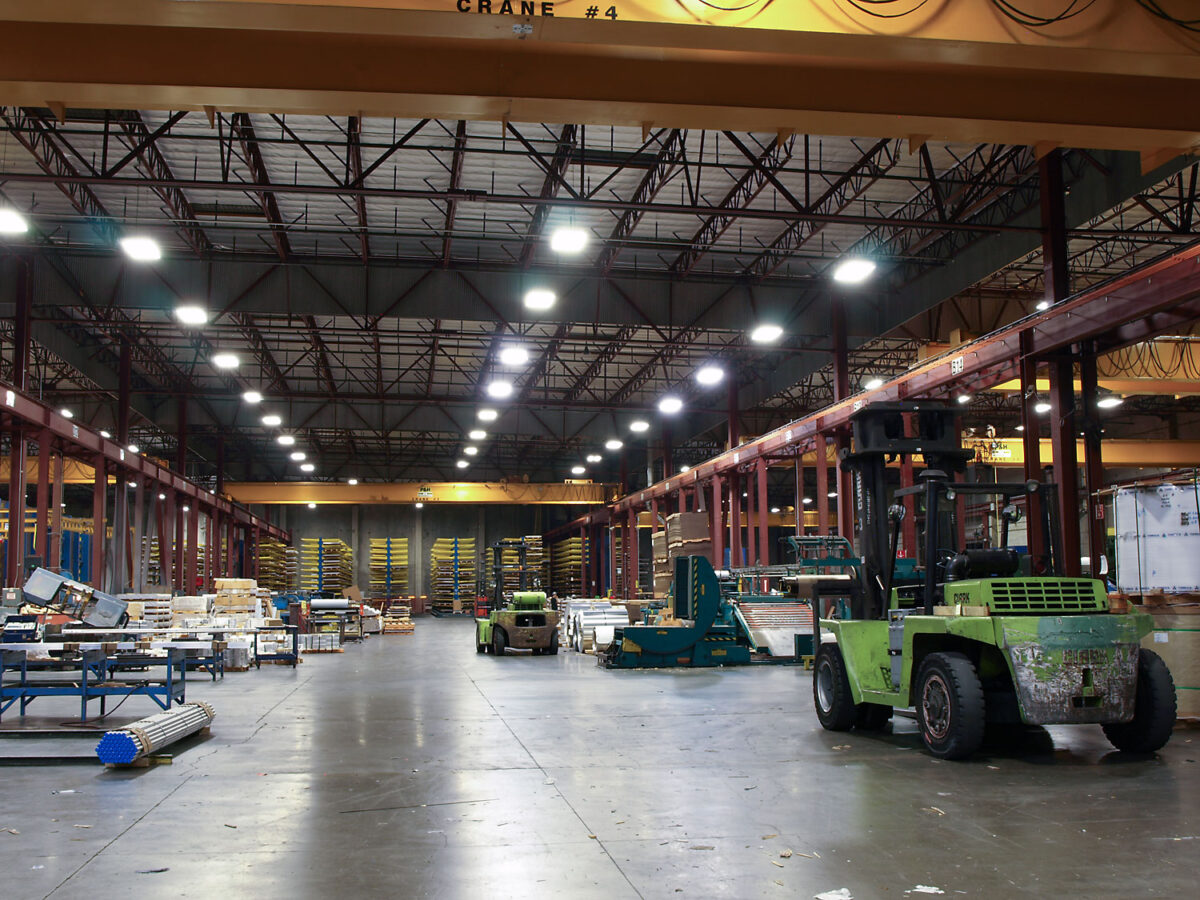
Warehouse applications typically use LED high bay lighting, with specific lumen output selected based on ceiling height and the task requirements of the space (inventory storage vs active picking vs processing).
| Task Type | Typical Lumens Per Fixture | Target Footcandles |
|---|---|---|
| General production area | 20,000-30,000 lm | 30-50 fc |
| Assembly and machining | 30,000-44,000 lm | 50-75 fc |
| Precision manufacturing/inspection | 40,000-58,000 lm | 75-100+ fc |
| Warehouse in mfg facility | 20,000-30,000 lm | 20-30 fc |
| Facility Type | Typical Lumens Per Fixture | Target Footcandles |
|---|---|---|
| Gymnasium (recreational) | 20,000-30,000 lm | 30-50 fc |
| Gymnasium (competition) | 30,000-40,000 lm | 50-75 fc |
| Indoor tennis/pickleball | 19,000-38,000 lm | 50-75 fc |
| Racquetball court | 12,000-19,000 lm | 50-75 fc |
| Ice rink | 30,000-44,000 lm | 50-100+ fc |
Sports facility lighting is application-specific and often subject to governing body standards (USAPA for pickleball, USTA for tennis, NFHS for school sports). See our complete sports lighting guide for detailed standards and fixture recommendations by sport.
| Application | Typical Lumens Per Fixture | Target Footcandles |
|---|---|---|
| Cold storage (refrigerated) | 15,000-25,000 lm | 15-30 fc |
| Food processing | 20,000-30,000 lm | 30-50 fc |
| Parking garage (interior) | 5,000-12,000 lm | 5-10 fc |
| Parking lot (exterior) | 10,000-40,000 lm | 1-5 fc |
| Educational classrooms | 3,000-5,000 lm | 30-50 fc |
Cold storage and food processing require specialized fixtures rated for low temperatures and washdown environments. 1st Source Lighting offers cold storage LED fixtures rated for freezer and refrigerated environments where standard commercial LEDs wouldn’t operate reliably.
For a quick estimate of total lumens needed for a commercial space, multiply your floor area by the target footcandle level:
Total Lumens = Floor Area (sq ft) × Target Footcandles
For a 10,000 sq ft warehouse targeting 30 footcandles, that’s 300,000 total lumens across the facility. Divided by a 25,000-lumen high bay output, you need approximately 12 fixtures. This is a simplified calculation that ignores light loss, room reflectance, and fixture efficiency – good for rough sizing but not for final specification.
For actual commercial specifications, several additional factors matter:
Because of these variables, commercial projects benefit from photometric layout analysis that models actual fixture performance in your specific space. 1st Source Lighting provides free photometric layouts for commercial projects, showing exactly how specified fixtures will perform before you commit to a specification.
For decades, commercial lighting was specified by wattage because legacy technologies (incandescent, fluorescent, HID) had reasonably consistent lumens-per-watt performance within each technology type. A 400W metal halide was always approximately 35,000 lumens; a 4-lamp T8 fixture was always approximately 10,000 lumens.
LED technology broke that assumption. Modern commercial LEDs vary in efficacy from approximately 100 lm/W (baseline) to 200+ lm/W (premium). A 150W LED fixture might produce 15,000 lumens or 30,000 lumens depending on the product design. Specifying by wattage alone gives you no information about actual light output.
For commercial LED specification, the right approach is to start with the total lumen requirement (based on space type, ceiling height, and target footcandles), then select fixtures that deliver those lumens at the best efficacy. Higher-efficacy fixtures produce more light per watt of electricity consumed, reducing both energy cost and heat load on your HVAC system.
Lumens tell you how much light a fixture produces, but not whether it’s the right light for your application. Several additional specifications matter for commercial fixture selection.
Lumen specification is one element of the commercial LED selection process. For the comprehensive step-by-step approach covering lumens alongside footcandles, fixture types, color specifications, and compliance requirements, see our commercial LED lighting buyer’s guide.
Measured in Kelvin (K), color temperature describes whether light appears warm (yellowish) or cool (bluish). Commercial applications generally specify neutral to cool white: 3500K for environments with some warmth, 4000K as the commercial standard, and 5000K for industrial and task-focused spaces. Warm light (2700K-3000K) is typical of residential and hospitality applications, not commercial offices or production. Our lighting terms glossary covers CCT selection for specific applications in more detail.
CRI measures how accurately a light source reveals object colors compared to natural daylight, on a scale of 0-100. Commercial LED fixtures typically provide 80+ CRI, which is adequate for most office, warehouse, and industrial applications. Retail displaying color-critical merchandise (clothing, art, produce) benefits from 90+ CRI for more faithful color reproduction.
Fixtures with the same lumen output but different beam angles deliver very different light patterns. A 22,500-lumen high bay with a 60-degree narrow beam concentrates light in a smaller area, while the same fixture with a 120-degree wide beam spreads light across a larger area with lower peak intensity. Beam angle selection depends on ceiling height and the illumination uniformity your application requires.
Commercial LED fixtures should carry NRTL certification (CSA, UL, or ETL) for electrical safety, DLC listing where utility rebates apply, and BAA/BABA compliance for government and federally-funded projects. Our CSA certification guide covers the NRTL certification landscape in detail.
Commercial and industrial applications often require fixtures rated for specific environments: damp or wet locations, cold temperatures, high ambient temperatures, vibration, dust, or washdown. IP ratings (IP65, IP67, IP69K) indicate dust and water resistance; specific certifications exist for cold storage, food processing, and hazardous locations.
Total lumen requirements depend on your floor area and the target footcandle level for your application. A quick estimate is: Floor Area (sq ft) × Target Footcandles = Total Lumens. For example, a 5,000 sq ft warehouse targeting 30 footcandles needs approximately 150,000 total lumens, or roughly 6 high bay fixtures at 25,000 lumens each. Actual specifications require adjusting for light loss factor, fixture efficiency, and layout spacing.
No. Commercial lighting design targets specific footcandle levels appropriate to each application. Over-lighting wastes energy and can cause glare, eye fatigue, and worker discomfort. The goal is to match lumen output to the actual illumination need for the space type, then select fixtures that deliver those lumens efficiently. Fixtures with too many lumens for the application are as problematic as fixtures with too few.
It depends on the lighting technology. Modern commercial LEDs produce 100-200+ lumens per watt. Linear fluorescent T8 produces 80-95 lumens per watt. Metal halide produces 65-115 lumens per watt. Incandescent produces only 10-17 lumens per watt. The “lumens per watt” specification is called luminous efficacy and is the standard metric for comparing lighting technology efficiency.
Lumens measure total light output from a source, regardless of where that light goes. Footcandles measure illumination reaching a surface (floor, desk, etc.), accounting for fixture placement, mounting height, and beam angle. A high-lumen fixture mounted too high or with the wrong beam angle can deliver low footcandles at the working plane. Commercial specifications require attention to both: lumens for fixture selection, footcandles for space illumination performance.
Commercial LED high bay fixtures typically produce 10,000-60,000+ lumens depending on wattage and fixture design. For ceiling heights of 20-30 feet, fixtures in the 20,000-30,000 lumen range are standard. For 30-40+ foot ceilings, fixtures in the 30,000-50,000 lumen range are appropriate. 1st Source Lighting manufactures LED high bay fixtures from 85W/12,000 lumens to 300W/44,000 lumens to match virtually any warehouse or industrial application.
You don’t convert directly because the ratio varies by fixture. Instead, look at both specifications on the spec sheet. The ratio of lumens to watts is the fixture’s luminous efficacy (lm/W). A spec sheet showing 150W and 22,500 lumens means 150 lm/W efficacy. Compare efficacy numbers between fixtures to identify which products deliver more light per watt of electricity consumed. For a detailed explanation of efficacy, see our efficacy vs efficiency guide.
Warehouse lumen requirements depend primarily on ceiling height and task type. For 25-foot ceilings in general storage areas, fixtures in the 20,000-30,000 lumen range spaced 25-30 feet apart typically provide adequate 20-30 footcandles at floor level. For active picking areas or taller ceilings, 30,000-44,000 lumens per fixture is more appropriate. Facilities with very tall ceilings (40+ feet) require high-output fixtures in the 40,000-60,000 lumen range with narrower beam angles.
Not necessarily. What matters is the lumens per watt (efficacy) ratio. A 30,000-lumen fixture at 150 lm/W uses 200 watts. A 20,000-lumen fixture at 100 lm/W also uses 200 watts. The first fixture produces 50% more light for the same electricity. When comparing commercial LED fixtures, compare efficacy (lm/W) rather than just lumens or just watts. Higher-efficacy fixtures deliver better total value even if the price premium is higher.
Rough lumen calculations get you close, but commercial and industrial projects benefit from photometric analysis that models actual fixture performance in your specific space. 1st Source Lighting provides free photometric layouts for commercial projects, showing exactly how specified fixtures will deliver illumination across your facility. Our engineering team can also coordinate DLC rebate documentation to maximize utility incentive value on your installation.
1st Source Lighting has been designing and manufacturing commercial and industrial LED fixtures in the United States since 1993. All fixtures are CSA listed, BAA compliant, and LM-79 tested with documented lumen outputs you can rely on for specification accuracy.