
Streaming and broadcast of high school athletics has expanded significantly over the past five years. Services like NFHS Network now broadcast tens of thousands of high school events annually, college streaming has become standard for nearly every NCAA Division I event and most Division II and III competition, and even community recreation facilities are streaming youth tournament events for parents and family unable to attend in person. The lighting demands of streamed and broadcast athletics are different from the demands of in-person play, and facilities planning for broadcast capability need to specify against requirements that go beyond standard ANSI/IES RP-6-24 illuminance values. This guide covers the technical specifications that distinguish broadcast-ready gymnasium lighting from standard gymnasium lighting, the engineering choices that affect camera capture quality, and why specifying broadcast-grade fixtures by default usually costs no more than specifying without broadcast capability. For product-level information, our commercial gymnasium lighting category is the primary reference.
Broadcast-ready gymnasium lighting requires four engineering signatures beyond standard ANSI/IES RP-6-24 illuminance compliance: zero flicker through constant-current driver architecture (PWM-based dimming creates flicker that cameras capture as banding artifacts), tight color consistency through 3-step or 5-step MacAdam ellipse binning (camera white balance depends on consistent CCT across all fixtures in frame), elevated vertical illuminance at camera-facing surfaces (typically 60 to 125 fc depending on broadcast tier), and adequate horizontal illuminance for the competition tier being broadcast (75 to 125+ fc for college and broadcast events). Our Premium Gym High Bay meets these specifications by default, which means specifying for broadcast capability up front typically costs no more than specifying without it. The exception is FIBA Level 1 international competition, which requires flicker factor ≤ 1% specifically, achievable only with constant-current driver architecture rather than PWM-based dimming systems.
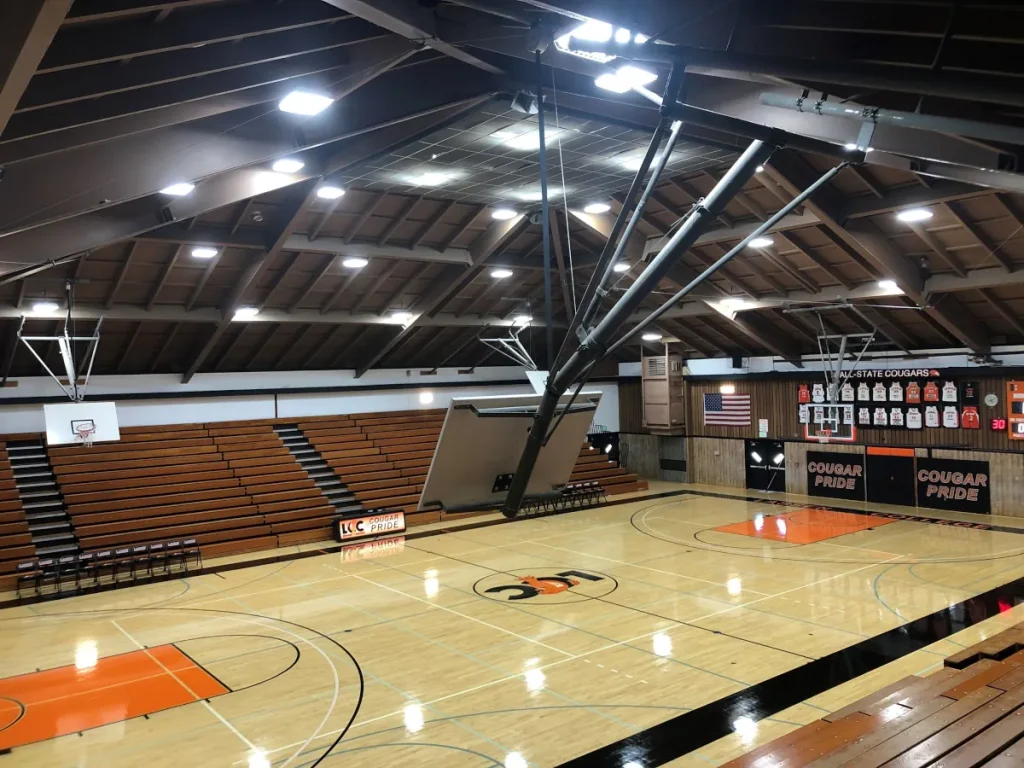
The market for streamed and broadcast athletics has grown faster than facility specifications have caught up. A high school facility built five years ago for in-person varsity competition may now find itself streaming nearly every home game through services like NFHS Network and similar platforms, with families, college recruiters, and remote spectators watching the broadcast. The lighting that worked fine for in-person play may produce visible flicker, color shift, or shadow patterns on the broadcast that no one in the gym physically notices but everyone watching the stream sees clearly.
Three lighting failures show up in broadcast capture but not in direct visual experience:
First, flicker. The human eye filters out fixture flicker above approximately 60 Hz, so in-person observers do not consciously detect flicker even from systems with significant flicker factor. Cameras capturing at 30, 60, 120, or 240 frames per second do not filter flicker the same way. Cameras render flicker as visible banding artifacts that move across the frame as the camera shutter and the lighting cycle interact. The faster the camera shutter, the more visible the flicker becomes, which is why slow-motion replay reveals flicker problems that regular-speed broadcast does not.
Second, color shift across fixtures. The human visual system adapts to slight color differences across a large room without the observer consciously registering the variation. Cameras do not adapt the same way. A camera fixed at one white balance setting captures the entire frame at that white balance, and any fixture that differs in CCT from the calibrated value produces a color cast in the part of the frame illuminated by that fixture. Multiple cameras in different positions can produce visibly different color renderings of the same playing surface, requiring color correction in post-production that becomes impossible to do well in real-time live streaming.
Third, vertical illuminance shortfall on camera-facing surfaces. The horizontal illuminance at the playing floor is often adequate for in-person play but inadequate for camera capture of player faces, jerseys, and team bench areas. Broadcast capture depends on vertical illuminance directed toward camera positions, which most installations achieve through fixture beam distribution rather than additional fixture density.
Facilities that discover broadcast quality problems after the lighting has been installed face three retrofit options, each with significant cost. Add supplemental lighting (which requires additional electrical work, controls integration, and capital expenditure for fixtures the facility otherwise would not need). Replace existing fixtures with broadcast-grade alternatives (which requires another lift access cycle, floor protection, and contractor mobilization). Accept the broadcast quality and live with viewer complaints from streamed events (which damages the facility’s reputation and reduces broadcast viability for higher-tier events). Specifying broadcast-grade fixtures up-front avoids all three of these expensive remediation paths.
Flicker is the most visible broadcast quality problem and the easiest one to specify against during initial fixture selection. The technical lever is the driver architecture of the LED fixture.
LED fixtures are driven by either constant-current drivers or pulse-width modulation (PWM) drivers, and the choice affects flicker performance significantly.
Constant-current drivers maintain steady current to the LED array, producing a steady light output with minimal variation over time. The flicker factor (the ratio of fluctuation in output to mean output) for constant-current driven LED fixtures is typically less than 1%, often as low as 0.1% to 0.3%. This is broadcast-grade by any meaningful standard.
PWM drivers cycle current to the LED array on and off at high frequency to produce dimming and color control effects. The flicker factor for PWM-driven LED fixtures depends on the modulation frequency and depth, but typically runs 5% to 30% even when human observers cannot detect the flicker. PWM drivers are common in commercial LED fixtures because they are less expensive than constant-current drivers and they enable certain dimming and tunable-white features that constant-current architecture does not natively support. They are not appropriate for broadcast applications.
Flicker factor specifications vary by broadcast tier:
The flicker problem becomes more visible at higher camera frame rates. Standard broadcast at 30 or 60 fps captures flicker at the standard cadence; slow-motion replay at 240 fps captures flicker eight times more frequently, making the banding artifacts much more visible during replay sequences. Athletic broadcast production typically uses slow-motion replay for highlight clips and key plays, which means the fixtures need to perform well at high frame rates even if the primary broadcast is at standard rates.
Constant-current driver architecture handles slow-motion replay capture without visible flicker artifacts because the current to the LED array does not cycle at the frequencies that interact with camera shutter rates. PWM-driven fixtures produce visible artifacts at slow-motion frame rates that no amount of color correction in post can fully eliminate.
Modern broadcast-grade LED fixtures use constant-current drivers combined with 0-10V analog dimming control, which adjusts the constant current up or down without introducing PWM artifacts. This is the architecture used in our Premium Gym High Bay. Dimming adjustment from 100% to 10% output produces no flicker, no color shift, and no banding artifacts at any camera frame rate. The dimming range is sufficient for typical broadcast lighting cues including dimmed warm-up periods, full broadcast levels during play, and dimmed lighting for halftime presentations or ceremonies.
The second engineering signature of broadcast-ready gymnasium lighting is tight color consistency across fixtures. The technical lever is the color binning specification used during LED component selection and fixture assembly.
MacAdam ellipses describe the perceptible color difference between two light sources at the same correlated color temperature. The MacAdam ellipse scale is rooted in classic color science research and represents the smallest color difference a trained observer can detect under controlled viewing conditions.
Cameras capture the entire frame at one white balance setting. If fixtures within the frame differ noticeably in CCT, the part of the frame illuminated by the deviant fixture will show a color cast (slightly bluer or yellower than the rest of the frame). Multiple cameras at different positions in the gymnasium each set their own white balance, which means a fixture that drifts from the calibrated CCT may produce different color renderings depending on which camera is capturing.
For broadcast and streamed athletics, 3-step or 5-step MacAdam ellipse binning is recommended depending on the broadcast tier:
The MacAdam ellipse binning specification at initial installation is part of the picture. The other part is how color consistency holds across the fixture lifetime. LED color drift over time can move a fixture out of its initial color bin, especially for fixtures using lower-quality LED components with less stable phosphor systems. High-quality LED selection combined with appropriate thermal management keeps fixtures within their initial bin throughout the rated life. Our Premium Gym High Bay specifies color components and thermal design for color consistency holding throughout the 100,000+ hour rated life, which means broadcast quality at year ten matches broadcast quality at year one.
The third engineering signature is vertical illuminance directed toward camera positions. This affects camera capture quality for player faces, jerseys, team bench areas, and crowd shots.
Cameras capture light reflecting from vertical surfaces (faces, uniforms, bench backs) more than light reflecting from horizontal surfaces (the playing floor). A facility with adequate horizontal illuminance for in-person play may have inadequate vertical illuminance for camera capture, producing broadcast images with washed-out floor color and dim, shadowed player faces.
The technical fix is fixture beam distribution that delivers light at angles producing adequate vertical illuminance throughout the playing volume, not just at the floor. Wide-distribution fixtures with high diffusion factor (such as our LBAT lens) produce more vertical illuminance than narrow-beam UFO fixtures at the same total lumen output, which makes them better suited for broadcast capture.
| Broadcast Tier | Horizontal fc | Camera-Facing Vertical fc |
|---|---|---|
| Internal recording (no broadcast) | 30 to 50 fc | Standard |
| NFHS Network high school streaming | 50 fc minimum | 30 to 50 fc |
| NCAA Division II/III broadcast | 75 to 80 fc | 60 to 100 fc |
| NCAA Division I broadcast | 100 to 125+ fc | 75 to 125 fc |
| FIBA Level 1 international | 140 to 280 fc (1500 to 3000 lux) | Refer to FIBA specifications |
Camera positions in gymnasium broadcasts vary by sport and production scale. NCAA Division I basketball broadcasts typically use four to seven camera positions including baseline cameras, sideline cameras, elevated wide shots, and player-tracking cameras. NFHS Network high school streaming typically uses one to three camera positions. The vertical illuminance specification needs to support the camera positions actually used for the facility’s broadcast applications.
For most facilities, the photometric layout work that confirms horizontal illuminance compliance also models vertical illuminance at typical camera positions. Facilities planning specifically for high-tier broadcast use should request vertical illuminance modeling for the specific camera positions the broadcast production will use.
The strongest specification approach for facilities considering broadcast capability is to specify broadcast-grade fixtures by default rather than upgrading later. The reason: the engineering elements that distinguish broadcast-grade fixtures (constant-current drivers, MacAdam ellipse binning, adequate vertical illuminance) typically cost no more than non-broadcast fixtures when the facility is specifying premium-grade fixtures anyway.
The cost differential between broadcast-grade and non-broadcast fixtures is not a separate “broadcast premium” line item. The cost difference shows up in the underlying component selection: higher-quality LED arrays with tighter color binning, constant-current drivers rather than PWM, and beam distribution engineered for vertical illuminance. Facilities specifying premium-grade fixtures (such as our Premium Gym High Bay) for in-person play already receive these engineering elements as part of the standard product specification. Facilities specifying lower-cost commodity fixtures save on the initial purchase but face the broadcast quality problems described earlier.
The cost differential becomes meaningful when comparing premium gymnasium fixtures to cheap commodity LED high bays. Commodity fixtures using PWM drivers and loose color binning save 30% to 50% on initial fixture cost compared to broadcast-grade alternatives. For facilities certain they will never broadcast events and willing to accept potential color shift and uniformity problems, the savings may be defensible. For facilities with any meaningful possibility of streaming or broadcasting events (which now includes nearly every K-12 and college facility), the savings are typically not worth the long-term broadcast quality limitations.
Broadcast-by-default specification does not mean specifying the highest possible illuminance value for facilities that will not host high-tier broadcast events. A typical high school competition gymnasium hosting NFHS Network streaming does not need 125 fc broadcast-grade horizontal illuminance; 50 to 75 fc is appropriate for the streaming tier. Broadcast-by-default specification means specifying fixtures with the engineering signatures (constant-current drivers, tight color binning, adequate vertical illuminance) at whatever horizontal illuminance level the competition tier requires. The Premium Gym High Bay supports both lower-tier specifications and higher-tier specifications without changing fixture type.
The “broadcast” category covers a wide range of actual production applications, each with different technical demands.
High school streaming through NFHS Network and similar platforms typically uses one to three fixed camera positions, capture at 30 to 60 fps, and limited or no slow-motion replay. The lighting requirements are: 50 fc minimum maintained horizontal at the playing surface (Class III specification), 5-step MacAdam ellipse binning or tighter, flicker factor < 5% (constant-current drivers handle this comfortably), and vertical illuminance at typical sideline camera positions of 30 to 50 fc.
For complete high school competition standards alignment, see our companion guide on gymnasium lighting standards including NFHS facility guidelines.
NCAA conference network broadcasts (Big Ten Network, SEC Network, ACC Network, and similar) typically use four to six camera positions, capture at 60 to 120 fps with slow-motion replay clips, and produce broadcast-quality output. The lighting requirements are: 75 to 100 fc maintained horizontal (Class II specification), 5-step or 3-step MacAdam ellipse binning, flicker factor < 1% to 5% (constant-current drivers handle this), vertical illuminance at multiple camera positions of 60 to 100 fc.
NCAA Division I tournament broadcast (March Madness, Final Four, championship coverage) uses six to twelve camera positions, capture at up to 240 fps for slow-motion replay, and produces national broadcast output. The lighting requirements are: 100 to 125+ fc maintained horizontal (Class I specification), 3-step MacAdam ellipse binning, flicker factor < 1% (constant-current drivers required), vertical illuminance at multiple camera positions of 75 to 125 fc.
FIBA international competition (World Cup, Olympics, continental championships) uses production-grade broadcast capture comparable to NCAA Division I tournament with additional specifications for international broadcast distribution. The lighting requirements are: 1500 to 3000 lux (140 to 280 fc) maintained horizontal at FIBA Level 1, flicker factor ≤ 1% mandatory, CRI 80+ minimum (90+ recommended), 3-step MacAdam ellipse binning, complete vertical illuminance verification.
Internal facility recording for coaching review, athlete training analysis, and educational use does not require broadcast-grade specifications. Standard Class III or Class IV specification is adequate. Constant-current drivers are still preferred for slow-motion review capture, but the flicker factor and color consistency requirements are less stringent than broadcast applications.
Broadcast specifications and player visual experience overlap in some areas and diverge in others. The engineering elements that produce good broadcast capture also produce good in-person player experience for most use cases, but one critical area requires explicit attention: glare control during play.
Broadcast specifications focus on what the camera sees. The technical signatures that improve broadcast capture (flicker reduction, color consistency, vertical illuminance) generally also improve in-person experience, but they do not directly address what athletes experience when looking up at fixtures during play.
The Zone of Illuminance Discomfort, or ZID, is the visual experience an athlete has when their line of sight passes directly through a fixture during play. UGR (the published glare metric) is calculated for static observers and does not measure ZID. A fixture that meets broadcast specifications and meets UGR specifications can still produce significant ZID if the lens has low diffusion factor and individual LED diodes remain visible through the lensing. For complete engineering coverage of ZID, including the diagnostic methods to evaluate fixtures for direct-look performance, see our complete guide to gymnasium glare engineering.
The complete specification for facilities prioritizing both broadcast capability and player visual comfort combines broadcast-grade engineering signatures (constant-current drivers, tight color binning, adequate vertical illuminance) with ZID-addressing optical engineering (high lens diffusion factor across large surface area). Our Premium Gym High Bay combines all these elements in a single fixture specification, which means specifying for broadcast and specifying for player comfort produce the same fixture choice.
For facilities that stream any events through NFHS Network, conference networks, or similar platforms, specifying broadcast-grade engineering signatures (constant-current drivers, tight color binning, adequate vertical illuminance) is recommended even for occasional streaming. The cost differential between broadcast-grade and non-broadcast fixtures is typically minimal at premium fixture specification levels, and the alternative (discovering broadcast quality problems after streaming has begun) is significantly more expensive to remediate.
Flicker factor is the ratio of fluctuation in LED output to mean output, expressed as a percentage. Lower values indicate steadier light output. Cameras capture flicker as visible banding artifacts that move across the frame, especially at slow-motion frame rates. Constant-current driver architecture produces flicker factor below 1%, meeting all broadcast tier specifications. PWM-based dimming systems produce flicker factor of 5% to 30%, which produces visible artifacts in broadcast capture even when in-person observers cannot detect flicker.
MacAdam ellipses describe perceptible color difference between light sources at the same CCT. 3-step binning means color differences between fixtures are barely perceptible to trained observers in side-by-side comparison; 5-step binning means color differences are readily perceptible in side-by-side but acceptable for general commercial applications. For broadcast capture, 3-step is preferred for the highest tiers (NCAA Division I, FIBA Level 1) and 5-step is acceptable for most other broadcast applications.
Existing gymnasium lighting will support streaming if it meets minimum streaming specifications: 50 fc maintained horizontal, constant-current driver architecture (or low flicker factor), color consistency tight enough that camera white balance does not produce visible banding, and adequate vertical illuminance at camera positions. Facilities uncertain about their existing lighting can have a photometric verification done to identify whether the current installation meets streaming specifications or requires upgrade.
Three evaluation methods help: review the fixture specification sheet for driver architecture (constant-current preferred), MacAdam ellipse binning specification (3-step or 5-step), and vertical illuminance modeling capability; request a photometric layout that includes vertical illuminance at typical camera positions; and request a sample fixture for direct evaluation including visual inspection of the lens face and color consistency with other fixtures of the same specification.
No. High school facilities streaming through NFHS Network typically need Class III specifications (50 fc maintained horizontal) with constant-current drivers and adequate color consistency, which is significantly less demanding than NCAA Division I tournament specifications (100 to 125+ fc with stricter requirements). Specifying NCAA-grade illuminance for high school facilities adds capital cost without meaningful benefit. Specifying NCAA-grade engineering signatures (drivers, color binning) at high school illuminance levels is the appropriate approach for high school streaming facilities.
Broadcast specifications layer on top of the multi-sport design rule (specify to the higher of any single sport’s photometric requirements). A facility hosting basketball at NFHS Class III streaming and volleyball at Class IV recreational specifies to Class III with broadcast-grade engineering signatures. The complete fixture specification combines the higher-of-any-sport horizontal illuminance with broadcast-grade drivers, color binning, and vertical illuminance. For more on multi-sport design considerations, see our guide on designing for multi-sport gym facilities.
Broadcast-ready gymnasium lighting is fundamentally an engineering decision about driver architecture, color consistency, and vertical illuminance. The good news for most facilities is that specifying broadcast-grade fixtures up front typically costs no more than specifying without broadcast capability when the facility is choosing premium-grade fixtures anyway. The Premium Gym High Bay meets broadcast specifications for the full range of broadcast tiers from internal facility recording to NCAA Division I tournament use, with the appropriate horizontal illuminance and fixture density determined by the specific tier the facility hosts.
Facilities planning for broadcast capability should request photometric layouts that include vertical illuminance verification at typical camera positions, not just horizontal illuminance at the playing surface. Send us your facility dimensions, ceiling height, intended competition tier, and any planned camera positions, and we will model the broadcast-grade lighting performance for your facility, including standard illuminance compliance and broadcast-specific vertical illuminance modeling.
For facilities planning for higher-tier broadcast use including NCAA Division I, FIBA-sanctioned international competition, or specialized production requirements, contact our engineering team directly. We can review specific broadcast production requirements with you before fixture specification work begins.