
Gymnasium lighting standards are governed by overlapping documents from multiple authoritative bodies: the Illuminating Engineering Society publishes ANSI/IES RP-6-24 as the foundational technical document for indoor sports lighting; NFHS publishes facility guidelines for high school athletic facilities; NCAA publishes Best Lighting Practices for college competition; FIBA publishes Official Basketball Rules including international competition lighting requirements; and USA Volleyball publishes Indoor Rules with sanctioned-competition lighting specifications. Each standard has its own scope, its own metric framework, and its own update cycle. For architects, MEP engineers, athletic directors, and facility specifiers responsible for gymnasium lighting decisions, understanding how these standards relate to each other (and where they fall short) is essential to producing specifications that actually serve the facility’s intended use. This guide explains each standard, how the standards align and where they differ, and the engineering reality of what specification compliance actually delivers in athletic environments. For product-level information, our commercial gymnasium lighting category is the primary reference.
ANSI/IES RP-6-24 is the foundational technical standard for indoor sports lighting in the United States, published in 2025 as the current version of the IES Recommended Practice. RP-6-24 organizes facility specifications into four classes of play: Class I (pro and broadcast), Class II (college and tournament), Class III (high school competition), and Class IV (recreational and practice). NFHS facility guidelines align with IES Class III for high school competition. NCAA Best Lighting Practices align with Class II for college competition with elevated specifications for broadcast events. FIBA Official Basketball Rules apply Class I-equivalent specifications for international competition with specific lux values and uniformity requirements. The standards specify maintained horizontal illuminance, max-to-min uniformity, vertical illuminance, color rendering, and Unified Glare Rating (UGR) limits. UGR compliance is necessary for spec adherence but not sufficient for athlete visual comfort during direct-look conditions, which is why we use the term Zone of Illuminance Discomfort, or ZID, to describe what UGR does not measure.
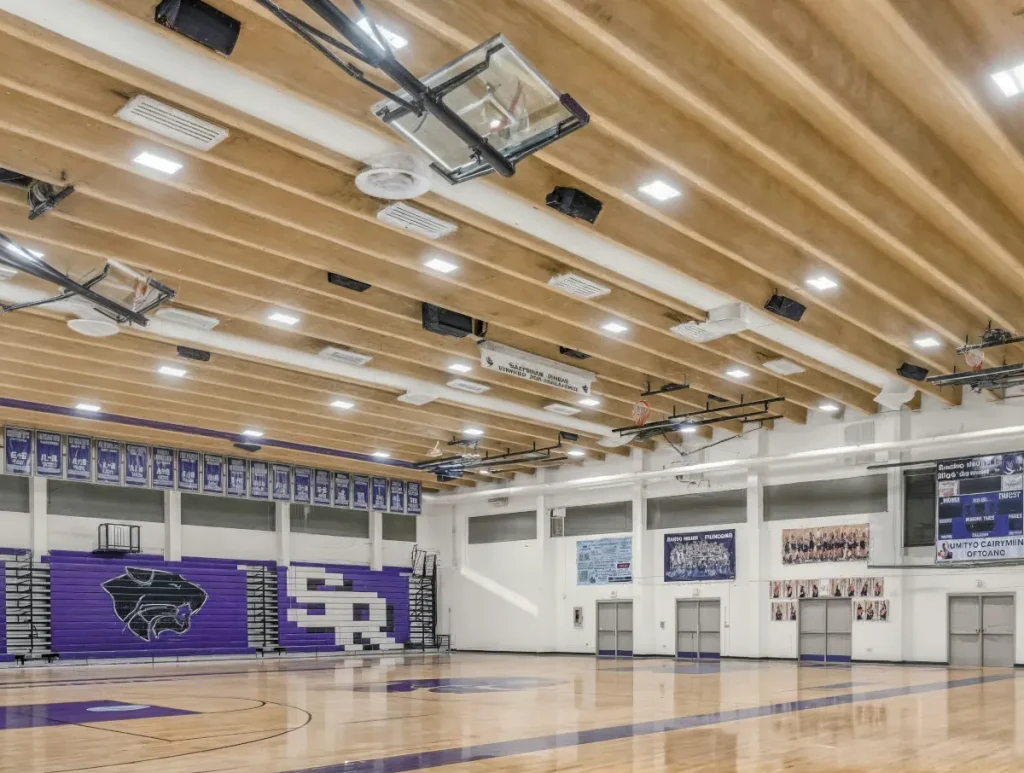
ANSI/IES RP-6-24, published in 2025 by the Illuminating Engineering Society, is the current version of the IES Recommended Practice for Sports and Recreational Area Lighting. It is the foundational technical document for indoor sports lighting in the United States, referenced or aligned with by NFHS, NCAA, and most state-level athletic governing bodies. The 2025 publication updated and replaced the prior RP-6-22 and RP-6-20 documents, with notable additions including enhanced pickleball provisions, futsal additions, and updated correlated color temperature recommendations.
RP-6-24 organizes indoor sports facility specifications into four classes of play, with each class corresponding to a tier of competitive use:
| Class | Application | Avg fc Maintained | Min fc | Max:Min Uniformity | UGR | CRI |
|---|---|---|---|---|---|---|
| Class IV | Recreational and practice | 30 fc | Per uniformity ratio | 3:1 | < 25 | 65+ |
| Class III | High school competition | 50 fc | 25 fc | 2.5:1 | < 22 | 80+ |
| Class II | College and tournament | 75 to 80 fc | 50 fc | 2:1 | < 22 | 80+ |
| Class I | Pro and broadcast | 100 to 125+ fc | 75 to 100 fc | 1.5:1 to 1.7:1 | < 19 | 90+ recommended |
RP-6-24 specifies vertical illuminance separately from horizontal illuminance because the two metrics measure different things and are critical for different aspects of athletic visibility. Vertical illuminance describes the light falling on vertical surfaces or planes, which is what matters for ball-tracking visibility when athletes look up to follow a ball at height. The vertical illuminance requirements scale with the horizontal class but apply to specific heights relevant to each sport.
For basketball, vertical illuminance is critical at rim height (10 feet) for shooting accuracy and at the apex of typical jump shot trajectories. For volleyball, vertical illuminance above the net (8 feet for men’s, 7 feet 4 inches for women’s) is critical for serves and lobs. For pickleball overlay, vertical illuminance at lob apex (typically 12 to 18 feet) is the most demanding indoor court sport requirement. RP-6-24 incorporates vertical illuminance requirements into the class structure rather than treating them as a separate optional consideration.
RP-6-24 specifies CRI minimums by class as shown in the table above. The CRI 80+ minimum for Class III high school competition is appropriate for facilities prioritizing accurate color rendering of court lines, athletic uniforms, and the playing surface itself. CRI 90+ is recommended for Class I broadcast applications because television cameras render color more accurately when the source lighting has high CRI. Color consistency across fixtures, measured in MacAdam ellipse steps, is recommended at 5-step or tighter for general competition use and 3-step or tighter for broadcast applications.
The 2025 update to RP-6-24 (replacing RP-6-22 and earlier RP-6-20) added or updated several specifications relevant to current gymnasium design:
The National Federation of State High School Associations (NFHS) publishes facility guidelines for high school athletic competition. NFHS does not publish a standalone mandatory lighting specification document with the technical depth of IES RP-6-24. Instead, NFHS facility guidelines align with IES Class III for high school varsity competition and reference RP-6-24 (or its predecessors) for technical specifications.
For high school competition gymnasiums, NFHS-aligned specification means meeting RP-6-24 Class III requirements: 50 fc maintained horizontal, 2.5:1 max-to-min uniformity, UGR less than 22, CRI 80+ minimum. State-level high school athletic associations (CIF in California, UIL in Texas, MHSAA in Michigan, and equivalent bodies in other states) generally defer to NFHS facility guidelines for lighting specifications, with state-specific variations primarily affecting facility safety, ADA compliance, and emergency lighting requirements rather than competition lighting specifications.
The increasing prevalence of streaming high school athletics (through services like NFHS Network and similar platforms) has elevated lighting requirements for facilities that host broadcast or streamed events. NFHS does not require Class I broadcast-tier lighting for facilities that occasionally stream events, but facilities prioritizing broadcast quality should specify fixtures that meet broadcast-grade requirements (zero flicker, tight color consistency, vertical illuminance for camera-facing surfaces) by default rather than upgrading later. The Premium Gym High Bay meets these requirements at standard Class III specification because the constant-current driver architecture, MacAdam ellipse color binning, and beam distribution all support broadcast-grade performance without a separate fixture tier.
State-level high school athletic associations vary in how strictly they enforce lighting specifications. Some states have explicit minimum lighting requirements for competition certification; others defer entirely to NFHS guidelines and IES recommendations. Districts should confirm their state association’s specific requirements during the project planning phase rather than assuming alignment with NFHS-IES baseline.
The NCAA publishes Best Lighting Practices documents for various sports including basketball and volleyball. NCAA practices align with IES Class II for general college competition and elevate to Class I for events with broadcast coverage. The 2025-2026 NCAA Best Lighting Practices document for basketball references RP-6-24 as the underlying technical standard.
For NCAA Division I, II, and III basketball competition without broadcast coverage, the recommended specification is 75 to 80 fc maintained horizontal at the playing surface, 2:1 max-to-min uniformity, UGR less than 22, and CRI 80+ minimum. These specifications align with RP-6-24 Class II.
For NCAA basketball competition with broadcast coverage (typically Division I and selected Division II events), the recommended specification elevates to 100 to 125 fc maintained horizontal, 1.5:1 to 1.7:1 max-to-min uniformity, UGR less than 19, and CRI 90+ recommended. These specifications align with RP-6-24 Class I.
NCAA broadcast-tier specifications include vertical illuminance requirements for camera-facing surfaces, typically 60 to 100 fc for Class II broadcast and 75 to 125 fc for Class I broadcast. The vertical illuminance values support television camera capture across the full playing surface and the spectator-facing player benches and team areas. Achieving these vertical illuminance values typically requires careful fixture placement and beam distribution design, not just total lumen output.
NCAA volleyball follows a similar pattern: Class II for general college competition, Class I for broadcast events. The vertical illuminance requirement above the net is more critical for volleyball than for basketball because so much of the action happens at heights above the playing surface. NCAA volleyball broadcast specifications include vertical illuminance at attack height (8 to 12 feet above the playing surface) of 75 to 100 fc.
The International Basketball Federation (FIBA) publishes Official Basketball Rules including lighting specifications for international competition. FIBA specifications use lux rather than footcandles (1 fc equals approximately 10.76 lux) and apply primarily to facilities hosting FIBA-sanctioned international events.
FIBA Official Basketball Rules organize lighting specifications into competition levels:
FIBA Level 1 broadcast specifications include a flicker factor requirement of 1% or less, which is more stringent than typical NCAA broadcast requirements. The flicker factor specification reflects the demands of high-speed and ultra-slow-motion camera capture used in major international broadcast production. Achieving flicker factor ≤ 1% requires constant-current driver architecture rather than PWM-based dimming, since PWM systems typically produce flicker factors above 1% even when human observers cannot detect the flicker.
FIBA specifications apply to US gymnasium facilities only when the facility hosts FIBA-sanctioned international events. For most US gymnasium designs (K-12, college recreation, community, club), the controlling standards are RP-6-24 and the appropriate domestic athletic governing body specifications. FIBA standards become relevant primarily for facilities hosting international tournament play or for venues affiliated with national team programs.
USA Volleyball publishes Indoor Rules including lighting specifications for sanctioned indoor volleyball competition. The current rules (covering the 2025-2027 competition cycle) specify minimum lighting requirements for sanctioned events.
USA Volleyball Indoor Rules specify a minimum 300 lux (approximately 28 fc) measured at 1 meter (approximately 3.3 feet) above the playing surface. This is a vertical illuminance specification, not a horizontal illuminance specification, and the measurement height of 1 meter above the floor reflects the practical reality of where the ball spends much of its time during play.
The 28 fc vertical at 1 meter is a lower bar than the RP-6-24 Class III high school competition specification (50 fc horizontal). Most facilities meeting RP-6-24 Class III specifications also meet USA Volleyball minimum specifications by significant margin, because horizontal illuminance at typical fixture mounting heights produces vertical illuminance throughout the playing volume.
For higher-tier USA Volleyball events including national championships and qualifying tournaments, USA Volleyball recommends elevated lighting specifications consistent with NCAA Class II or Class I competition. Facilities hosting USA Volleyball higher-tier events should specify to the higher of USA Volleyball minimums or applicable IES classes.
Most gymnasium facilities serve multiple competition tiers across their operational life. A high school competition gymnasium that hosts varsity basketball during the school season may also host elementary practice during the day, club volleyball in the evening, and community recreation programming on weekends. The lighting specification needs to support every use without under-specifying for any of them.
The design rule for multi-tier facilities is to specify to the higher of any single use the facility hosts. A facility hosting both Class III high school competition and Class IV recreational programming specifies to Class III. A facility hosting both NCAA Class II college competition and high school Class III competition specifies to Class II. The rule applies because under-specifying for the highest-tier use means that use will fail its requirements when played, even if every other use is comfortably exceeded. For more on this design principle in multi-sport contexts, see our companion guide on designing combined-use multi-sport gymnasium facilities.
Facilities that primarily operate at one tier but occasionally host higher-tier broadcast events face a specific design decision. Two viable approaches:
First, specify the entire installation to the higher tier. The installation supports both daily use and occasional broadcast events without supplemental lighting. Higher upfront capital cost; simpler operation.
Second, specify the entire installation to the daily-use tier and add supplemental temporary lighting for occasional broadcast events. Lower upfront capital cost; more complex event operation.
For facilities occasionally hosting broadcast events, the first approach typically produces better outcomes. Our Premium Gym High Bay meets broadcast specifications by default through constant-current driver architecture, MacAdam ellipse color binning, and adequate vertical illuminance at typical Class II to Class III specifications, which means the higher-tier specification approach often costs no more than specifying without broadcast capability up front.
The standards described in this guide are useful, necessary, and represent serious technical work by the bodies that publish them. They are also incomplete in one specific way that affects gymnasium specification more than any other indoor lighting application: UGR is necessary but not sufficient for athletic environments.
UGR was developed for office and indoor commercial environments where the observer is typically seated, looking horizontally with occasional upward glances. The metric assumes a static observer at a typical seated viewing position over extended viewing periods. For office workers, this is a reasonable model of the visual experience UGR is trying to predict.
For athletes, this is not a reasonable model. Athletes are dynamic. They look up frequently and at sharper angles than the UGR calculation assumes. They glance directly into fixtures while tracking a high lob, a serve, or a jump shot. They depend on rapid pupillary recovery to maintain visual lock on small fast-moving objects after looking back down. A fixture meeting UGR less than 22 for a seated spectator may still cause significant discomfort for a player who depends on direct-look visual recovery for ball tracking.
We use the term Zone of Illuminance Discomfort, or ZID, to describe what UGR does not measure: the visual experience an athlete has when their line of sight passes directly through a fixture during play. ZID is not a published industry metric. It is a description of a real engineering problem that has been hiding behind UGR compliance specifications for years. The phenomenon is driven by the diffusion factor of the fixture lens. Fixtures with discrete bright LED diodes visible through clear or low-diffusion lensing produce severe ZID even when their UGR scores are technically acceptable. Fixtures with high-diffusion lensing across a large surface area produce dramatically lower ZID because the same lumens are spread across a much larger emitting surface.
For the complete engineering analysis of UGR’s limitations and how diffusion factor drives the actual visual experience in athletic environments, read our deep dive on why UGR alone is not sufficient for athletic environments.
For architects, MEP engineers, and facility specifiers, the practical implication is that UGR compliance is necessary for spec adherence but not sufficient for athlete visual comfort. The complete glare specification approach combines UGR compliance with direct-look ZID evaluation, ideally through sample fixture evaluation under realistic viewing conditions before final specification commitment. This is a more rigorous approach than spec sheet shopping alone, and it produces facilities that perform as expected when athletes actually use them rather than facilities that meet specifications on paper but generate complaints once installed.
Beyond the athletic competition standards, gymnasium installations must comply with applicable energy codes and federal procurement requirements for federally-funded projects.
Current energy code adoption varies by jurisdiction. The most common controlling documents are ANSI/ASHRAE/IES 90.1-2025 (the energy standard for buildings except low-rise residential), California Title 24 Part 6 (2025), and IECC 2024 as adopted in major states. Each document specifies maximum lighting power density (LPD) for various space types, including gymnasiums.
For gymnasium spaces, the typical LPD requirement is 0.60 watts per square foot or lower under current codes. This requirement is comfortably met by the Premium Gym High Bay at typical specification ranges, with margin for additional ambient and architectural lighting if the facility design includes it. Some jurisdictions add controls requirements (occupancy sensing, scheduled dimming) that affect installation design beyond the basic LPD compliance.
School district and public facility projects funded through federal infrastructure programs require Buy American Act (BAA) and Build America, Buy America (BABA) Act compliance for the manufactured products specified in the project. BABA, established by the IIJA in 2021, requires that the cost of components manufactured in the United States exceed 55% of the total cost of all components, and that final assembly occur in the United States.
Our gymnasium fixtures are compliant with BAA and BABA requirements for federally-funded projects. Final assembly occurs in Auburn, California with domestic content meeting the 55% threshold. Documentation is available for any federally-funded project requiring formal verification.
For most US gymnasium designs, ANSI/IES RP-6-24 is the foundational technical standard, and the sport-specific governing body standards (NFHS, NCAA, USA Volleyball) align with or modify the IES classes. When a sport-specific standard specifies values that differ from RP-6-24, the sport-specific standard takes precedence for facilities hosting that sport’s sanctioned competition. For facilities serving multiple competition tiers or sports, the design rule is to specify to the higher of any applicable standard.
Yes. RP-6-24 was published in 2025 and is the current version of the IES Recommended Practice for Sports and Recreational Area Lighting. It replaced RP-6-22 and the earlier RP-6-20. Specifications, methodologies, and recommendations in older RP-6 versions should be checked against RP-6-24 for any currently-active design work.
Most state-level high school athletic associations align with NFHS facility guidelines, which align with RP-6-24 Class III for high school competition. Specific state requirements vary; districts should confirm their state association’s requirements during project planning. Class III specifications are the de facto standard for high school competition gymnasiums in the United States.
Class II covers general college competition without broadcast coverage and aligns with RP-6-24 Class II (75 to 80 fc maintained horizontal, 2:1 uniformity, UGR less than 22). Class I covers college competition with broadcast coverage and aligns with RP-6-24 Class I (100 to 125+ fc maintained horizontal, 1.5:1 to 1.7:1 uniformity, UGR less than 19). Most NCAA Division I games and selected Division II events use Class I specifications; Division III and lower-tier events typically use Class II.
Specify to the higher of any single tier the facility hosts. A facility hosting both NCAA Class II college competition and high school Class III competition specifies to Class II. A facility hosting Class III high school competition and Class IV community recreation specifies to Class III. The higher-of-any-tier rule prevents under-specifying for the most demanding use the facility supports.
UGR was developed for office and seated-observer environments and assumes a static observer at typical seated viewing positions. Athletes look up frequently and at sharper angles than UGR’s calculation assumes, and they depend on rapid pupillary recovery for ball tracking. A fixture meeting UGR specifications can still cause significant complaints when athletes glance directly into the fixture face during play. UGR compliance is necessary but not sufficient. The complete glare specification approach combines UGR with direct-look evaluation under realistic viewing conditions.
BAA (Buy American Act) and BABA (Build America, Buy America Act) require that manufactured products used in federally-funded infrastructure projects meet domestic content thresholds. BABA established by the IIJA in 2021 requires 55% domestic content and US final assembly. The compliance requirements apply to projects funded through federal infrastructure programs, including IIJA funding, residual ESSER funds, and other federal pass-through grants. Projects funded through state bond programs, capital reserves, or operating budgets typically do not require BAA/BABA compliance unless the state passes through federal funds.
No, if the standard fixture specification meets broadcast requirements by default. Our Premium Gym High Bay meets broadcast specifications through constant-current driver architecture (zero flicker), MacAdam ellipse color binning (color consistency for camera capture), and adequate vertical illuminance at typical Class II to Class III specifications. Specifying for broadcast capability up-front costs no more than specifying without it and preserves the option to host streamed or broadcast events without supplemental lighting.
Standards-grade specification work is necessary for gymnasium projects that need to meet RP-6-24, NFHS, NCAA, FIBA, USA Volleyball, or any combination of these. The standards provide the technical framework. The specific fixture configuration that meets the standards for your facility’s dimensions, ceiling height, intended use, and competition tier is a photometric design question that requires modeling rather than spec sheet specification alone.
Send us your facility dimensions, ceiling height, intended use, and any specific competition standards your facility must meet. We will prepare a photometric layout showing exactly how the recommended fixture configuration performs against every applicable standard, including horizontal and vertical illuminance verification, uniformity ratios, UGR calculation, CRI confirmation, and complete documentation appropriate for AHJ review or athletic conference compliance audits.
For complex projects involving multiple competition tiers, broadcast considerations, or federal funding compliance, contact our engineering team directly. We have been doing standards-grade gymnasium lighting work since 1993 and we approach each project with the technical, regulatory, and operational considerations specific to facility specification.