
Pharmaceutical cold storage facility lighting sits at the most demanding intersection of cold storage engineering, regulatory compliance documentation, and contamination control that any commercial walk-in lighting application involves. The fixtures must survive walk-in temperatures spanning standard refrigerated (2 to 8°C), deep freeze (down to roughly negative 30°C), and blast freezer (down to roughly negative 40°C) applications. They must operate in environments where temperature deviation of a few degrees can destroy millions of dollars of biologic product. They must comply with FDA Current Good Manufacturing Practice regulations including 21 CFR Part 211. They must support cleanroom environments with maintained pressure differentials that depend on fixture sealing. And they must produce the validation, qualification, and documentation packages that pharmaceutical quality systems require as a matter of routine operation. This guide is written for pharmaceutical facility engineers, quality assurance directors, validation specialists, biotech facility managers, and the procurement teams responsible for pharma facility lighting decisions. It covers the regulatory framework governing pharma cold storage lighting in 2026, the walk-in temperature ranges where our fixtures deploy, the remote-driver capability that extends fixture service life in the most demanding deep freeze and blast freezer applications, the adjacency lighting requirements for rooms housing ultra-low temperature reach-in freezers and liquid nitrogen dewars, the NSF P442 cleanroom protocol that applies to pharmaceutical controlled environments, and the validation and qualification documentation pharma quality systems require. For product-level information, our LED Cold Storage Lighting category is the primary reference, with the Sealed Face Troffer family covering cleanroom applications specifically and the Cold Linear High Bay family covering refrigerated, deep freeze, and blast freezer walk-in applications.
Pharmaceutical cold storage walk-in lighting must satisfy FDA 21 CFR Part 211 Current Good Manufacturing Practice requirements for adequate lighting in production and holding areas, NSF P442 sealed-face protocol requirements for controlled environment fixtures in cleanrooms, and engineering requirements specific to the walk-in temperature range. Walk-in pharmaceutical storage spans standard refrigerated (2 to 8°C), deep freeze (down to roughly negative 30°C), and blast freezer (down to roughly negative 40°C) applications. Ultra-low temperature storage at negative 80°C and cryogenic storage at negative 150°C and below operate in reach-in freezers and liquid nitrogen dewars rather than walk-in rooms, with overhead lighting illuminating the surrounding rooms rather than the appliance interiors. For the most demanding deep freeze and blast freezer walk-in applications, remote-driver configurations with the LED light engine inside the walk-in envelope and driver electronics housed outside the conditioned space extend fixture service life and eliminate the cumulative thermal stress that ends the life of in-fixture drivers over 10+ year operating cycles. The refrigeration multiplier reaches 1.36 to 1.77 across the pharmaceutical walk-in temperature range, making energy economics significantly more favorable than ambient applications. Cleanroom pharmaceutical applications add pressure differential maintenance requirements that depend on fixture sealing performance, with NSF P442 pressure decay testing as the appropriate certification reference. The combination of GMP documentation, cold storage engineering, cleanroom compliance, and validation requirements produces a specification framework that is meaningfully more demanding than commercial cold storage, but the underlying engineering principles are the same with additional documentation and validation layers.
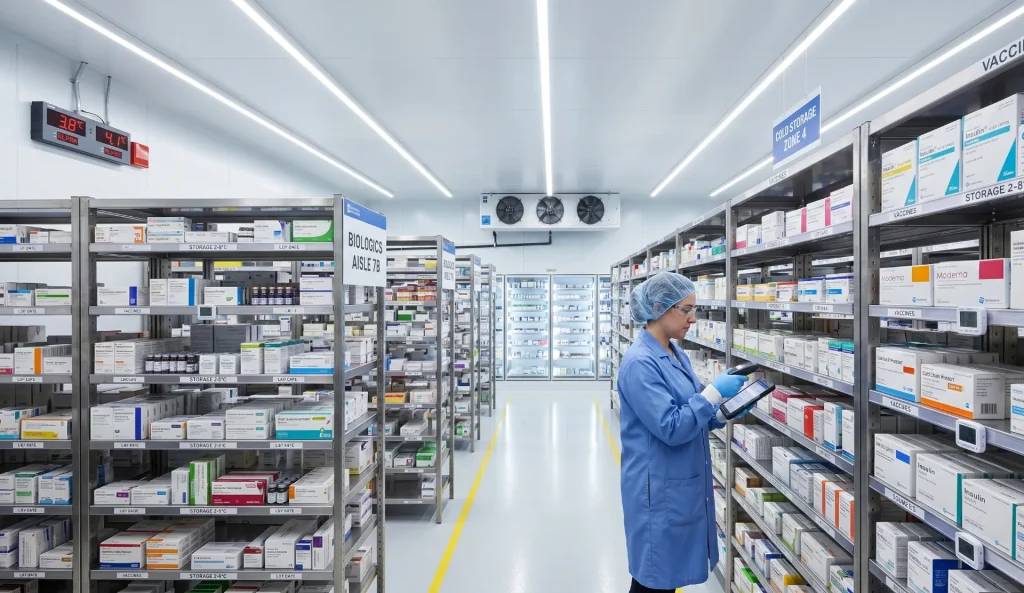
Pharmaceutical facility lighting is governed by FDA 21 CFR Part 211, the Current Good Manufacturing Practice regulation for finished pharmaceuticals, with additional requirements deriving from facility-specific cleanroom classifications, biologics handling protocols, and the validation and qualification framework that pharmaceutical quality systems operate under. The regulatory framework is more demanding than commercial food processing because pharmaceutical product integrity depends on environmental controls that include lighting as one component of the broader controlled environment.
The FDA Current Good Manufacturing Practice regulation for finished pharmaceuticals at 21 CFR Part 211 establishes the manufacturing, processing, packing, and holding requirements that apply to pharmaceutical products in the United States. The lighting-specific provision appears at 21 CFR 211.44, which requires that adequate lighting be provided in all areas. The provision is qualitative rather than prescriptive in the same way that FDA 21 CFR 117 (food preventive controls) is qualitative, with FDA expecting facilities to determine illuminance levels appropriate to the specific tasks performed in each area and to document the basis for those decisions.
The operationally consequential implications of 21 CFR Part 211 for lighting specification are broader than the explicit 211.44 language suggests. The regulation includes requirements at 21 CFR 211.42 (design and construction features) that buildings must be of suitable size, construction, and location to facilitate cleaning, maintenance, and proper operations. The regulation includes requirements at 21 CFR 211.46 (ventilation, air filtration, air heating, and cooling) that environmental control systems must be appropriate for the operations performed. The regulation includes requirements at 21 CFR 211.56 (sanitation) that buildings used in the manufacture, processing, packing, or holding of drug products be maintained in a clean and sanitary condition. The cumulative effect of these requirements is that pharmaceutical facility lighting must support cleaning operations (which means smooth crevice-free fixtures), must not interfere with environmental control systems (which means fixtures that maintain seal integrity under pressure differentials), must not contribute contamination (which means materials and construction appropriate for cleanroom environments), and must produce documentation appropriate for the facility’s quality system.
For pharmaceutical cold storage applications specifically, the 21 CFR Part 211 framework means that fixture specification needs to demonstrate compliance not just with the lighting-specific language at 211.44 but with the broader building and sanitation framework that affects how the lighting interacts with the controlled environment. Validation specialists and quality directors evaluating fixture specifications will reasonably consider all of these requirements rather than 211.44 alone.
Pharmaceutical facilities operate quality systems that include validation and qualification protocols for facility infrastructure including lighting. The standard framework includes Installation Qualification (IQ) verifying that the installed fixtures match the specified design, Operational Qualification (OQ) verifying that the installed fixtures perform within specified parameters across the operating range, and Performance Qualification (PQ) verifying that the lighting system performs reliably during normal operations including thermal cycling, defrost cycles, and any abnormal conditions that may occur.
The documentation produced through IQ, OQ, and PQ becomes part of the facility’s validated state and must be maintained for regulatory review. The implication for fixture specification is that cutsheets, photometric data, IP rating certifications, NSF certifications, and any other specification documentation must be available at the time of installation and must be maintained throughout the fixture’s service life. Manufacturers who ship fixtures without complete documentation packages create validation work that fixtures with complete packages do not, which directly affects project timeline and cost. This is the underlying reason pharmaceutical facility procurement is meaningfully more documentation-intensive than commercial procurement.
For deep freeze and blast freezer walk-in applications, validation protocols typically extend to include thermal mapping verification that confirms the lighting system does not create temperature gradients within the storage envelope. This is particularly important for biologics storage where product temperature uniformity is critical to product integrity. Fixture specifications for the coldest walk-in applications need to address heat generation patterns and document the absence of localized heating that could affect product storage conditions.
Pharmaceutical cleanrooms operate under classification frameworks including the ISO 14644 series (ISO 5, 6, 7, 8, 9 cleanrooms) and the FDA cGMP cleanroom classifications (Class A, B, C, D under EU GMP Annex 1 alignment). Each classification specifies particle count limits per cubic meter for different particle size ranges, and the cleanroom design including HVAC, filtration, and pressure differential management is engineered to maintain those particle limits during operation.
The lighting specification implication is that cleanroom fixtures must not introduce particles into the controlled environment, must not compromise pressure differential maintenance through air bypass at fixture penetrations, and must withstand the cleaning protocols (typically more aggressive than food processing) used to maintain cleanroom particle counts. Standard troffer designs that allow air bypass between fixture and ceiling are inappropriate for cleanroom applications because the bypass compromises the pressure differential that the HVAC system is engineered to maintain. NSF P442 sealed-face protocol addresses this requirement directly, which is why P442 is the appropriate certification reference for cleanroom pharmaceutical lighting.
Pharmaceutical walk-in cold storage operates across three primary temperature ranges, each with distinct fixture engineering considerations. Understanding which range applies to a specific walk-in determines fixture selection, driver specification, and the level of engineering attention the installation requires.
Standard refrigerated walk-ins at 2 to 8°C are the most common pharmaceutical walk-in application, supporting storage of most vaccines, many biologics, plasma derivatives, blood products in some configurations, finished pharmaceutical dosage forms requiring controlled temperature storage, and a wide range of compounded and finished products. Walk-in rooms at this temperature range use the same fixture engineering as commercial refrigerated cold storage, with the addition of pharmaceutical documentation and certification requirements.
Fixture selection for standard refrigerated walk-ins typically uses our Cold Linear High Bay for higher ceiling applications and our Sealed Face Troffer or LED Vapor Tight for finished-ceiling or lower mounting applications. NSF/ANSI 2 certification is appropriate for any zone where compounded preparations or open product handling occurs, with NSF P442 added for cleanroom-classified walk-ins. The refrigeration multiplier at this temperature range is typically 1.22 to 1.33, similar to commercial refrigerated applications, making the underlying energy economics consistent with the commercial cold storage analysis covered in our companion guide on the refrigeration multiplier in cold storage LED lighting.
Deep freeze walk-ins operating down to roughly negative 30°C support storage of plasma, frozen vaccines, certain biologics, and bulk pharmaceutical materials requiring frozen storage above ULT temperatures. These walk-ins require cold-rated driver specifications including negative 40°F cold start capability, solid polymer or ceramic capacitors to avoid electrolytic capacitor freezing, and IP66 minimum sealing to manage condensation during defrost cycles.
The refrigeration multiplier at deep freeze operation is typically 1.36 to 1.50, strengthening the financial argument for engineered LED specification proportionally. Plasma storage, vaccine reserves, and many biologic bulk distribution applications operate at this temperature range and benefit significantly from the multiplier-amplified savings of properly specified LED lighting. For the coldest applications within this temperature range, and for any walk-in where extended driver service life is a priority, remote-driver configurations become a meaningful specification consideration (covered in the next section).
Blast freezer walk-ins operating down to roughly negative 40°C support rapid pulldown of plasma and other biologics that require minimization of intracellular ice crystal formation, certain biologic manufacturing intermediates that require rapid cooling for stability, and specialized applications where rapid thermal transition is critical to product integrity. This is the coldest pharmaceutical walk-in environment and the engineering challenge increases significantly at this temperature range.
The refrigeration multiplier at blast freezer operation reaches 1.50 to 1.77, producing the strongest energy economics argument of any pharmaceutical walk-in application. The specification complexity is also highest, with thermal stress on driver electronics, gasket materials, and housing seals all reaching levels that exceed standard deep freeze applications. Remote-driver configurations are typically the appropriate specification for blast freezer walk-ins, both to support reliable cold-start performance and to extend driver service life beyond what in-fixture driver electronics can typically achieve in this thermal environment.
Remote-driver configurations are a distinguishing capability of our Cold Linear High Bay product family and an underrated specification consideration for the most demanding pharmaceutical walk-in applications. The configuration involves mounting the LED light engine inside the walk-in envelope where the diodes benefit from cold operation, while housing the driver electronics in a separate enclosure outside the conditioned space where ambient temperatures support normal driver operation and service life.
The engineering case for remote drivers becomes meaningful as walk-in operating temperatures drop into the deep freeze and blast freezer range. Standard in-fixture driver electronics, even when specified with cold-rated cold start capability and solid polymer capacitors, experience cumulative thermal stress across thousands of cold cycles over a 10+ year service life. The cold-start capability ensures the driver begins operating reliably at low temperatures, but the long-term thermal cycling of capacitors, transformers, and control electronics still drives a slow degradation that eventually ends the driver’s service life ahead of the LED light engine itself.
By relocating the driver outside the conditioned envelope, the driver electronics operate in ambient or moderately cool conditions throughout the fixture’s service life. The thermal cycling that would have accumulated on in-fixture electronics is eliminated. The capacitors do not face repeated freeze-thaw stress. The control electronics do not need to start from sub-zero conditions every defrost cycle. The result is driver service life that matches or exceeds the LED light engine service life, eliminating the most common end-of-life failure mode in deep freeze and blast freezer applications.
For pharmaceutical walk-ins specifically, this extended driver life matters more than in commercial applications because every fixture replacement in a pharmaceutical environment triggers validation and documentation work that commercial replacements do not. Extending driver life from 50,000 to 100,000+ hours through remote-driver configuration eliminates one or more rounds of validation documentation across the facility’s operating life, which has both direct labor cost implications and indirect operational impact during the validation work.
Remote-driver installations require cabling between the driver enclosure and the light engine that handles the voltage drop associated with extended runs, sealed envelope penetrations that maintain the thermal integrity of the walk-in, driver enclosure mounting in an ambient or moderately cool space accessible for service, and electrical work that accommodates the separated configuration. The installation typically costs 50 to 100 percent more per fixture than standard cold storage installations, depending on the specific facility geometry and the distance between driver location and light engine location.
The economic case for remote-driver specification depends on the application. For standard refrigerated pharmaceutical walk-ins at 2 to 8°C, standard in-fixture drivers with cold-rated specifications provide adequate service life and remote-driver configurations typically do not justify the added complexity. For deep freeze walk-ins at the colder end of their range (below roughly negative 20°C), remote-driver configurations become worth evaluating against the alternative of one or two in-fixture driver replacement cycles over the facility’s operating life. For blast freezer walk-ins at the coldest pharmaceutical walk-in temperatures, remote-driver configurations are typically the right specification.
The complete remote-driver installation is engineered for the specific facility rather than catalog-specified, and engagement with our engineering team during project planning is the appropriate procurement approach. Sending us your walk-in dimensions, operating temperature, mounting heights, and driver enclosure location options as part of the photometric layout request allows us to develop the specific remote-driver configuration that matches the facility geometry.
Ultra-low temperature storage at negative 80°C and cryogenic storage at negative 150°C and below are critical pharmaceutical applications, but they do not occur in walk-in rooms. ULT storage operates in reach-in freezer appliances mounted in cabinets or upright configurations. Cryogenic storage operates in liquid nitrogen dewars, cryogenic tanks, and specialized vapor-phase containment systems. These appliances are sealed thermal envelopes with their own internal controls, their own internal access mechanisms, and no overhead lighting integration. The lighting question for ULT and cryogenic pharmaceutical operations is not about lighting inside the cold envelope but about lighting the rooms that house the cold appliances.
ULT freezer rooms in pharmaceutical facilities typically house banks of upright ULT freezers (Thermo Scientific TSX, Eppendorf CryoCube, Stirling Ultracold, and similar product lines) ranging from 14 to 30 cubic feet of internal capacity per unit. A typical biorepository or large vaccine storage room may contain 10 to 50 or more ULT units arranged in rows or banks, with aisles between rows for product access and service. The rooms themselves operate at standard ambient temperature (with HVAC engineering sized to handle the substantial heat rejection from the ULT compressor banks) or at slightly cool conditions (typically 60 to 70°F) to reduce the thermal load on the ULT units.
Cryogenic storage rooms typically house liquid nitrogen dewars, vapor-phase cryogenic tanks, and the LN2 supply infrastructure that supports cryogenic operations. Dewars are vacuum-insulated containers with sealed top access; vapor-phase systems are larger units holding biological samples in the vapor space above the liquid nitrogen rather than in direct contact with the liquid. Like ULT rooms, cryogenic storage rooms operate at ambient or slightly cool temperatures with HVAC engineering sized to handle the LN2 evaporation and the heat load from supply infrastructure.
The lighting requirements for these rooms are similar to general pharmaceutical storage with attention to a few specific considerations. Illuminance levels typically run 50 to 100 footcandles maintained to support inventory management, batch verification, and quality control of the products going into and out of the cold appliances. Color rendering should be CRI 80 minimum, with CRI 90+ appropriate for inspection-intensive operations. Color temperature in the 4000K to 5000K range supports accurate label reading and visual identification of products handled in these rooms.
The specific environmental factors that distinguish these rooms from general pharmaceutical storage are the heat rejection from the appliances and the potential for liquid nitrogen exposure in cryogenic rooms. ULT freezer banks reject substantial heat from their compressor systems, which means the rooms can run warmer than nominal setpoint during peak compressor load periods. The lighting specification should account for ambient temperatures that may reach the upper end of typical commercial fixture operating ranges. Cryogenic rooms with LN2 dewars and supply infrastructure include the possibility of oxygen displacement during LN2 release events, which means the lighting specification should support emergency egress visibility under conditions where personnel may need to leave the room quickly.
For both room types, NSF/ANSI 2 certified fixtures are typically specified for any zone where open product handling occurs (transferring product between ULT freezers and transport containers, accessing dewar contents, batch labeling and verification). Sealed-face construction supports the cleaning protocols typical of pharmaceutical environments. Our Sealed Face Troffer family and LED Vapor Tight family both serve well in these applications, with selection between them driven by ceiling type and mounting preference rather than environmental requirements.
The most common specification error in pharmaceutical cold storage lighting procurement is treating ULT and cryogenic storage as walk-in applications requiring fixtures rated for negative 80°C or colder operation. The actual application is room lighting at ambient or slightly cool temperatures, which means standard pharmaceutical cold storage fixtures with NSF/ANSI 2 certification and appropriate documentation are the correct specification. Operators specifying exotic cold-rated fixtures for these rooms over-specify and pay for capability that does not match the application; operators specifying standard commercial fixtures without pharmaceutical documentation under-specify on the documentation dimension and create procurement complications during validation.
The right framing during specification work is to identify each room by its operating temperature (the walk-in itself, not the appliances inside it) and to specify fixtures appropriate to that operating temperature plus the pharmaceutical documentation requirements. Walk-in pharmaceutical storage at 2 to 8°C, deep freeze walk-in at down to roughly negative 30°C, and blast freezer walk-in at down to roughly negative 40°C are the cold environments where our cold storage fixtures with cold-rated drivers (and optionally remote-driver configurations) deploy. Ambient or moderately cool rooms housing ULT freezers, LN2 dewars, and biorepository operations are general pharmaceutical environments where standard pharmaceutical cold storage fixtures with appropriate certification deploy.
NSF P442 is a protocol specifically developed for controlled environment light fixtures used in pharmaceutical cleanrooms and other controlled environments where maintained pressure differentials are critical to facility operation. P442 builds on the broader NSF/ANSI 2 food equipment framework with additional requirements specific to controlled environment applications, most notably the pressure decay test that evaluates fixture sealing performance against the pressure differentials cleanrooms operate under.
The pressure decay test measures the rate at which pressure equilibrates across a sealed fixture installed in a ceiling plenum. The test simulates the pressure differential conditions of a cleanroom (typically 2 inches of water column pressure differential between cleanroom and plenum) and evaluates whether the fixture maintains the seal that the HVAC system depends on for pressure differential maintenance. A fixture that fails the pressure decay test allows air to bypass between cleanroom and plenum, which compromises the pressure differential that the cleanroom is engineered to maintain.
The practical implication for facility specification is that NSF P442 certified fixtures provide documented evidence that the fixture will not compromise cleanroom pressure differential maintenance, while non-certified fixtures may or may not provide adequate sealing depending on installation details. For pharmaceutical cleanrooms operating Class A, B, C, or D classifications, the cost difference between P442 certified fixtures and standard troffers is significantly smaller than the cost of cleanroom certification failures attributable to pressure differential problems.
NSF/ANSI 2 alone is sufficient for pharmaceutical environments that do not maintain pressure differentials, including standard refrigerated walk-ins, ambient pharmaceutical warehouses, and any space where the primary contamination concern is surface contamination rather than airborne particles or pressure differential maintenance. NSF P442 is the appropriate certification reference for cleanrooms (any classification), aseptic processing areas, sterile compounding facilities, and any other controlled environment where pressure differentials are critical to facility operation.
For pharmaceutical facilities operating mixed environments (some cleanroom space, some standard pharmaceutical storage, some commercial cold storage), zone-by-zone specification is the appropriate approach. NSF P442 for cleanroom zones, NSF/ANSI 2 for general pharmaceutical zones, and standard commercial cold storage specifications for warehouse and storage zones produce both efficient capital deployment and defensible compliance documentation.
Our Sealed Face Troffer family is engineered to NSF P442 protocol, with the pressure decay test results available for any cleanroom procurement requiring formal certification documentation. The complete documentation package including P442 testing, cutsheets, photometric data, and material declarations ships alongside fixture orders for cleanroom applications.
The combination of FDA 21 CFR Part 211, walk-in cold storage engineering requirements, NSF P442 cleanroom protocol, and validation documentation requirements produces a specification framework with several elements that are non-negotiable for pharmaceutical cold storage applications.
The first specification decision is matching fixture capability to walk-in operating temperature. Standard refrigerated walk-ins at 2 to 8°C typically use our Sealed Face Troffer for finished ceiling applications and LED Vapor Tight for exposed structure applications. Deep freeze walk-ins (down to roughly negative 30°C) use our Cold Linear High Bay with explicit cold-rated driver specification. Blast freezer walk-ins (down to roughly negative 40°C) typically use Cold Linear High Bay with remote-driver configuration for extended service life. Rooms housing ULT freezers and LN2 dewars at ambient or moderately cool temperatures use standard pharmaceutical cold storage fixtures matched to the room’s actual operating temperature rather than to the temperature of the appliances inside the room.
NSF/ANSI 2 is the baseline certification for any fixture installed in pharmaceutical food-contact or splash zones (compounding pharmacies, formulation areas, fill-finish operations involving product exposure). NSF P442 is the additional certification required for cleanroom installations where pressure differential maintenance is critical. The certifications layer rather than substitute: a cleanroom fixture should carry both NSF/ANSI 2 and NSF P442 certifications, while a standard pharmaceutical storage fixture only needs NSF/ANSI 2.
CRI 80 minimum is the baseline for general pharmaceutical environments, with CRI 90+ recommended for inspection, quality control, and visual identification tasks. Color temperature of 4000K to 5000K is the typical pharmaceutical specification, providing crisp neutral white light that supports accurate color discrimination for product identification, batch verification, and quality inspection. Some pharmaceutical applications involving photosensitive products may require specific spectral characteristics or shielded fixtures, which adds to the specification complexity but is application-specific rather than general.
Pharmaceutical applications often require higher illuminance levels than commercial cold storage, particularly for inspection, quality control, and visual identification tasks. Typical specifications include 50 to 100 footcandles maintained for general pharmaceutical storage and 75 to 150 footcandles for inspection and quality control zones. The photometric design must also account for vertical illuminance on labeling and identification surfaces, which is critical for batch verification and product handling accuracy.
Pharmaceutical sanitation typically uses more aggressive chemical sanitizers than food processing, including isopropyl alcohol, hydrogen peroxide, vaporized hydrogen peroxide (VHP), and various sporicidal agents depending on the application. Fixture materials must withstand these sanitation chemistries without degradation. 316 stainless steel housings, polycarbonate lensing, and silicone gaskets (for halocarbon refrigeration systems) or EPDM gaskets (for ammonia refrigeration systems and aggressive chemical exposure) are typical specifications.
For blast freezer walk-in applications operating at the coldest pharmaceutical walk-in temperatures, remote-driver configurations are typically the appropriate specification. The configuration involves the light engine appropriate for the walk-in environment, the driver enclosure located outside the walk-in envelope in an ambient or moderately cool space, cabling rated for the extended run and the thermal gradient between driver and light engine, and sealed penetrations through the walk-in envelope that maintain thermal integrity. The complete remote-driver installation is engineered for the specific facility rather than catalog-specified, and engagement with our engineering team during project planning is the appropriate procurement approach.
Pharmaceutical cold storage applications span a wide range of facility types, each with specific lighting requirements that derive from the products handled and the regulatory framework that applies.
Vaccine storage and distribution facilities typically operate refrigerated walk-ins at 2 to 8°C for vaccine inventory, with ULT reach-in freezers handling mRNA vaccines and other products requiring ULT storage. The walk-in refrigerated environments use standard pharmaceutical cold storage fixtures with NSF/ANSI 2 certification appropriate for vaccine handling. The rooms housing the ULT freezers use standard pharmaceutical fixtures matched to room temperature rather than appliance temperature. NSF P442 certification is appropriate for any cleanroom compounding or fill-finish operations within the facility.
Biologics manufacturing and storage facilities operate across the full pharmaceutical walk-in temperature range from standard refrigerated through blast freezer, depending on the specific biologic and manufacturing stage. Lighting specifications need to accommodate the full range, with zone-by-zone fixture selection appropriate to each operating temperature. The validation documentation requirements are typically more extensive than vaccine storage because the manufacturing operations involve multiple process steps with temperature-sensitive intermediates. ULT and cryogenic storage operations within biologics facilities use reach-in freezers and LN2 dewars in adjacency rooms rather than walk-in cold envelopes at those temperatures.
Tissue and cell banking facilities typically operate cryogenic storage through liquid nitrogen dewars and vapor-phase cryogenic systems housed in adjacency rooms at ambient or moderately cool temperatures. The lighting requirements focus on the adjacency rooms and access areas, with attention to the validation and traceability documentation that tissue banking quality systems require. Many tissue banking facilities also operate refrigerated walk-ins at 2 to 8°C for sample preparation and temporary holding, which use standard pharmaceutical cold storage fixtures.
Compounding pharmacy and sterile compounding facilities operate cleanroom environments under USP <797> and USP <800> requirements, with associated refrigerated walk-in storage for compounded preparations. The cleanroom areas require NSF P442 certified sealed face troffers, while the refrigerated walk-in storage uses standard pharmaceutical cold storage specifications. The combination produces a typical specification with multiple distinct fixture types across the facility.
Pharmaceutical distribution centers handle product storage and order fulfillment at temperatures appropriate to the products in the facility. Many distribution centers handle multiple walk-in temperature ranges (ambient, refrigerated, deep freeze) within a single facility, with zone-by-zone lighting specifications appropriate to each temperature range. The validation documentation requirements are typically less extensive than manufacturing facilities but more extensive than commercial distribution, with attention to the handling and storage conditions that pharmaceutical quality systems require to be documented.
Pharmaceutical cold storage projects produce documentation packages that are substantially more extensive than commercial projects. Understanding the documentation requirements at the start of the project prevents the timeline extensions and procurement complications that typically result from incomplete documentation at the time of installation.
The standard documentation package for a pharmaceutical cold storage fixture installation includes fixture cutsheets with complete specifications, IP rating certifications, NSF/ANSI 2 certifications for food-contact and splash zone applications, NSF P442 testing documentation for cleanroom applications, photometric IES files for the installed configuration, materials declarations covering housing, gasket, and lens materials, sanitation chemical compatibility statements covering the specific sanitation chemistries used in the facility, cold-rated driver specifications and operating temperature documentation, BAA/BABA compliance documentation for any federally-funded projects, and (for remote-driver installations) remote-driver installation and validation documentation specific to the project.
Our cutsheet, IES file, and certification documentation is available through our cutsheet library and IES file library resources, with additional documentation including BAA/BABA compliance and validation-ready packages available on request for pharmaceutical projects. The complete documentation work for a typical pharmaceutical cold storage project adds 2 to 6 months to project timelines depending on the validation scope, which is a meaningful consideration during project planning.
The fixtures themselves do not carry a separate “cGMP compliance” certification because cGMP is a manufacturing practice framework rather than a product certification. However, the fixtures must support the facility’s cGMP compliance, which means they must meet the relevant fixture-level specifications (NSF/ANSI 2 for food contact and splash zones, NSF P442 for cleanroom applications, IP66 or IP69 for the environmental sanitation regime, cold-rated drivers for cold storage applications), and the documentation package must support facility validation and qualification requirements. The right framing for pharmaceutical procurement is that the fixtures need to be validation-ready and documentation-complete rather than carrying any specific “cGMP” designation.
NSF/ANSI 2 is the broader food equipment standard covering materials, design, and construction for food handling equipment including overhead lighting fixtures in food contact and splash zones. NSF P442 is a specialized protocol developed for controlled environment lighting in pharmaceutical cleanrooms, which adds pressure decay testing and other cleanroom-specific requirements to the broader NSF/ANSI 2 framework. The certifications layer rather than substitute: a cleanroom fixture typically carries both NSF/ANSI 2 and NSF P442, while a non-cleanroom pharmaceutical fixture only needs NSF/ANSI 2. P442 is the appropriate certification reference for any application where maintained pressure differentials are critical to facility operation.
ULT and cryogenic pharmaceutical storage operates in reach-in freezers and liquid nitrogen dewars rather than walk-in cold rooms. There are essentially no walk-in pharmaceutical storage environments operating at negative 80°C or below, because the engineering requirements for maintaining personnel access to a walk-in at those temperatures are not practical for routine pharmaceutical operations. The lighting question for ULT and cryogenic operations is about lighting the rooms that house the ULT freezers and LN2 dewars, which typically operate at ambient or moderately cool temperatures and use standard pharmaceutical cold storage fixtures matched to the room temperature rather than the appliance temperature. Our cold storage fixtures cover the actual pharmaceutical walk-in temperature range from 2°C standard refrigerated through roughly negative 40°C blast freezer applications.
Remote-driver configurations become worth evaluating for deep freeze walk-ins operating below roughly negative 20°C and are typically the right specification for blast freezer walk-ins operating at the coldest pharmaceutical temperatures. The configuration extends driver service life from 50,000 to 100,000+ hours by eliminating the cumulative thermal stress that ends in-fixture driver life in sub-zero environments, which eliminates one or more rounds of validation documentation across the facility’s operating life. The installation costs 50 to 100 percent more per fixture than standard configurations but typically pays back through extended service life and eliminated validation work. For standard refrigerated walk-ins at 2 to 8°C, in-fixture cold-rated drivers provide adequate service life and remote-driver configurations do not typically justify the added complexity.
For standard refrigerated walk-ins at 2 to 8°C and deep freeze walk-ins at colder temperatures, commercial cold storage fixtures may be appropriate provided they meet the NSF/ANSI 2 certification requirement for any food-contact or splash zone applications and provided the documentation package supports the facility’s validation requirements. For cleanroom applications requiring pressure differential maintenance, NSF P442 certification is the appropriate specification, which is typically a pharmaceutical-specific requirement rather than a commercial cold storage default. For blast freezer walk-ins at the coldest pharmaceutical walk-in temperatures, our remote-driver Cold Linear High Bay configuration is typically the appropriate specification rather than a commercial cold storage default.
The standard pharmaceutical validation framework involves Installation Qualification (IQ) verifying fixture installation matches design, Operational Qualification (OQ) verifying fixture performance across operating range, and Performance Qualification (PQ) verifying reliable operation during normal facility operations including thermal cycling. The documentation supporting validation includes cutsheets, certifications, photometric data, material declarations, sanitation chemical compatibility statements, and cold-rated driver specifications. For deep freeze and blast freezer walk-in installations, additional thermal mapping documentation may be required to confirm the lighting does not create temperature gradients within the storage envelope. For remote-driver installations, the validation documentation extends to include the remote-driver configuration specifics. The complete validation documentation package typically requires 2 to 6 months to assemble depending on project scope.
The refrigeration multiplier across the pharmaceutical walk-in temperature range matches the commercial cold storage ranges. Standard refrigerated walk-ins at 2 to 8°C produce multipliers of roughly 1.22 to 1.33. Deep freeze walk-ins produce multipliers of 1.36 to 1.50. Blast freezer walk-ins reach 1.50 to 1.77. The multiplier-amplified savings make engineered LED specification financially compelling across the full pharmaceutical walk-in range, with the strongest financial case at the coldest temperatures where remote-driver configurations also typically become appropriate. The complete refrigeration multiplier framework with worked examples is covered in our companion guide on the refrigeration multiplier in cold storage LED lighting.
Yes. Our cold storage and sealed face troffer product families are compliant with the Buy American Act (BAA) and Build America, Buy America (BABA) Act for federally-funded projects. Final assembly occurs in Auburn, California with domestic content meeting the 55 percent threshold required for BABA-compliant manufactured products. Compliance documentation is available on request and typically ships alongside fixture orders for any federally-funded project including pharmaceutical cold storage projects pursuing federal funding pathways. The complete BAA and BABA framework is documented on our BAA/BABA compliance page.
Emergency egress lighting in pharmaceutical cold storage facilities must meet the same general pharmaceutical requirements as primary lighting where the emergency fixtures are installed in regulated zones. This means NSF certification appropriate to the zone, shatter-resistant lensing, appropriate IP rating, and cold-rated battery and component specifications for facilities operating at cold storage temperatures. Standard commercial emergency fixtures with non-cold-rated batteries will not maintain their listed runtime in cold environments, which creates both code compliance and life-safety concerns. The specification should be explicit about cold-rated emergency components for any pharmaceutical walk-in operating at refrigerated or frozen temperatures, and the emergency lighting validation typically requires testing under actual operating temperature conditions rather than ambient testing alone.
Pharmaceutical cold storage lighting projects typically take 6 to 18 months from initial project identification through commissioning and validation completion. The timeline includes project scoping and specification (1 to 3 months), bid documentation and procurement (2 to 4 months), fixture ordering and lead time (2 to 4 months for standard cold storage fixtures, 3 to 6 months for blast freezer walk-in remote-driver configurations), installation (1 to 2 months phased around facility operations), and validation documentation and approval (2 to 6 months depending on scope). Federally-funded projects requiring BAA/BABA compliance documentation typically add 2 to 4 months. The validation documentation is often the longest single phase and benefits from early planning rather than treatment as a post-installation task.
Pharmaceutical cold storage lighting is the most documentation-intensive cold storage lighting application in commercial practice. The combination of FDA cGMP compliance, walk-in temperature range engineering, cleanroom pressure differential maintenance, remote-driver provisions for the coldest walk-in applications, and validation documentation requirements produces a specification framework that requires more engineering attention than commercial cold storage, but the underlying engineering principles are the same with additional documentation and validation layers. Specifying the right fixtures at the start of the project, planning for the documentation work, and engaging validation specialists early are the steps that separate well-executed pharmaceutical projects from projects that produce timeline overruns, validation findings, and procurement complications.
We have been engineering pharmaceutical cold storage and cleanroom lighting fixtures since 1993. Our Sealed Face Troffer family is engineered to NSF P442 protocol for cleanroom applications, our Cold Linear High Bay family covers standard refrigerated, deep freeze, and blast freezer walk-in applications with remote-driver configurations available for the most demanding deep freeze and blast freezer installations, and our LED Vapor Tight family covers exposed-structure applications across the pharmaceutical walk-in temperature range. Send us your facility dimensions, walk-in operating temperatures, cleanroom classifications, sanitation chemistry, refrigeration system documentation, and the specific regulatory framework your facility operates under (FDA cGMP, USP <797>, USP <800>, ISO 14644, or any combination). We will prepare a free photometric layout showing the recommended zone-by-zone fixture specification with appropriate NSF certifications, IP ratings, cold-rated driver specifications including remote-driver configurations where applicable, and complete documentation packages appropriate for pharmaceutical validation and qualification. For projects involving blast freezer walk-in applications, novel biologic handling operations, custom remote-driver configurations, or other application-specific requirements, contact our engineering team directly. Pharmaceutical cold storage lighting is the most demanding application in our category, but the engineering principles and documentation framework are well-established, and the projects deliver reliable performance and defensible audit posture when specified and installed correctly.